Seasonal changes call for seasonal dishes. A few years ago on a surprisingly hot April day I was sitting in the reading room at the New York Public Library with Whitney Cookery Collection V. 5 and first encountered a pair of seventeenth-century recipes to prevent seasonally specific melancholy.
One recipe, “Against mellancholly for the sumer” (134-135), instructs a reader to chop up various herbs (borage, balm, rosemary), mix them with a little bit of sugar, add them to “ordinary beer,” strain them out after infusing, and drink from this mixture all summer long. By sipping this beverage, a person might ward off (or prevent against) an excess of black bile building up in their body over the summer and leaving them in a melancholy state. I don’t tend to feel melancholy in the summer so I have not yet attempted to prepare this recipe, but a few days ago I tried my hand at the second recipe in the sequence: “Against melancholy for Winter” (135)
Original Recipe
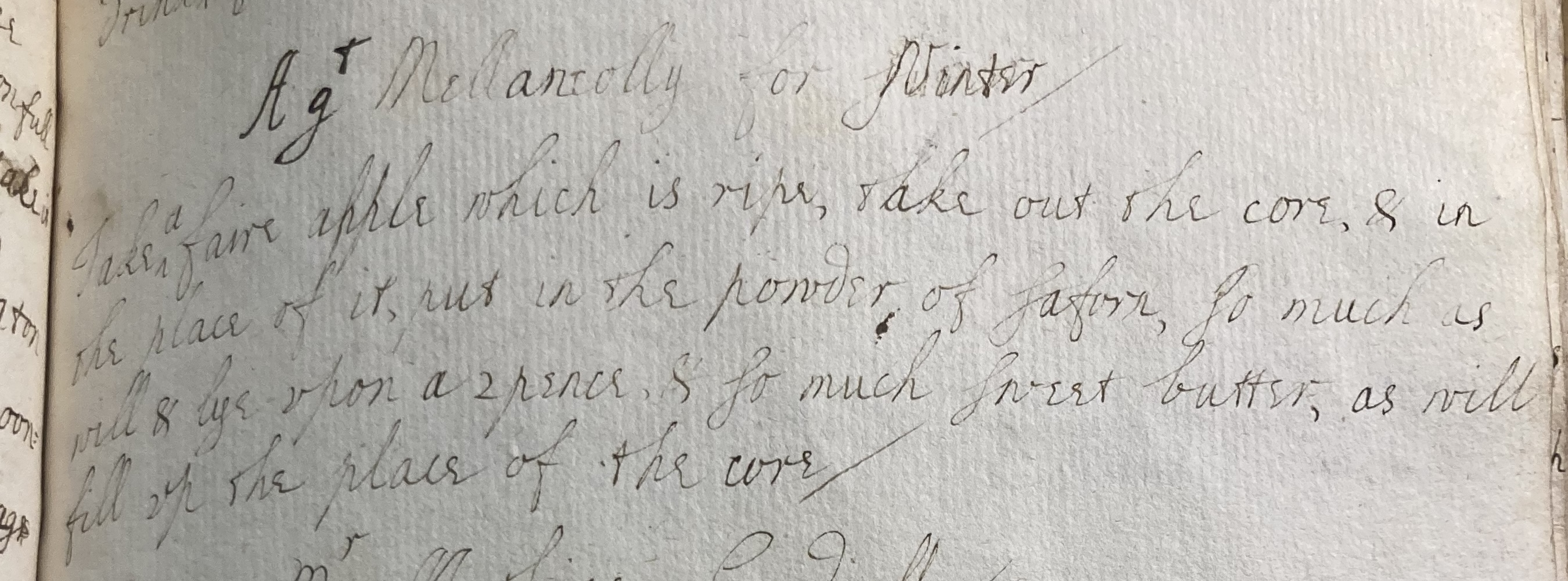
Against melancholy for Winter
Take a faire apple which is ripe, take out the core, & in
the place of it, put in the powder of saforn, so much as
will & lye vpon a 2 pence, & so much sweet butter, as will
fill vp the place of the core
While true winter is still a long way off, this recipe appealed to me on a chilly autumn morning when I was reviewing my manuscript notes. I had an abundant supply of ripe apples to hand and, as this recipe did not include any sugar, I opted to use a Macintosh instead of a tart American baking apple like a Granny Smith.
I was not surprised to see saffron in this recipe because it was thought to be distinctly humorally warming and to inspire happiness in Renaissance medical and culinary theory. In his Herbal, John Gerard writes that saffron “maketh the senses more quick and lively, shaketh off heavy and drowsy sleep, and maketh a man merry.” Figuring out how much “merry” saffron would fit on a seventeenth-century “2 pence” coin took a bit of calculation, but again, I was not surprised to see a coin mentioned because this is not an uncommon way to measure spices in the period. When I shared this measurement with my spouse Joseph, he quickly wrote back informing me that the diameter of a silver, Charles II two pence coin was about 15 millimeters (a smidge smaller than a US dime). I drew a 15mm circle on a piece of baking parchment and used that to measure my saffron.


Even though it appears to be a simple preparation, this recipe leaves quite a lot up to the imagination and the cook. To prevent winter melancholy, am I supposed to just eat a fresh ripe apple stuffed full of butter and saffron? Or am I supposed to cook or bake this apple? Or am I supposed to carry it around, smell it, gaze upon it, and contemplate its beauty? If I’m supposed to eat it, how often, and how much, and when in the day should I consume saffron butter apple to ward off winter melancholy? The previous recipe for summer melancholy is much more specific about preparation and use. A daily sip of herb-infused beer is necessary to prevent summer melancholy. I baked my apple before eating it, but if you decide to eat a crisp apple with butter and saffron, please do write to me and let me know if it improves your mood.


Updated Recipe
1 apple
3 Tablespoons of butter at room temperature (a little more or less depending on the size of your apple)
10 strands / 1 generous pinch of saffron
Preheat your oven to 350F.
Wash your apple well and remove the core.
Measure out the saffron. Crush it in a mortar and pestle. Sprinkle it onto your butter.
Fill the apple with the butter and saffron. Adjust amount of butter as necessary.
Place the apple in a ceramic, glass, or metal baking dish with high sides. Pour in enough water so that the bottom half of the apple is submerged. (I used two cups of water.) For extra safety and ease navigating the oven, I put my baking dish on a baking sheet.
Bake for about an hour until the apple is tender.
Serve immediately.


The Results
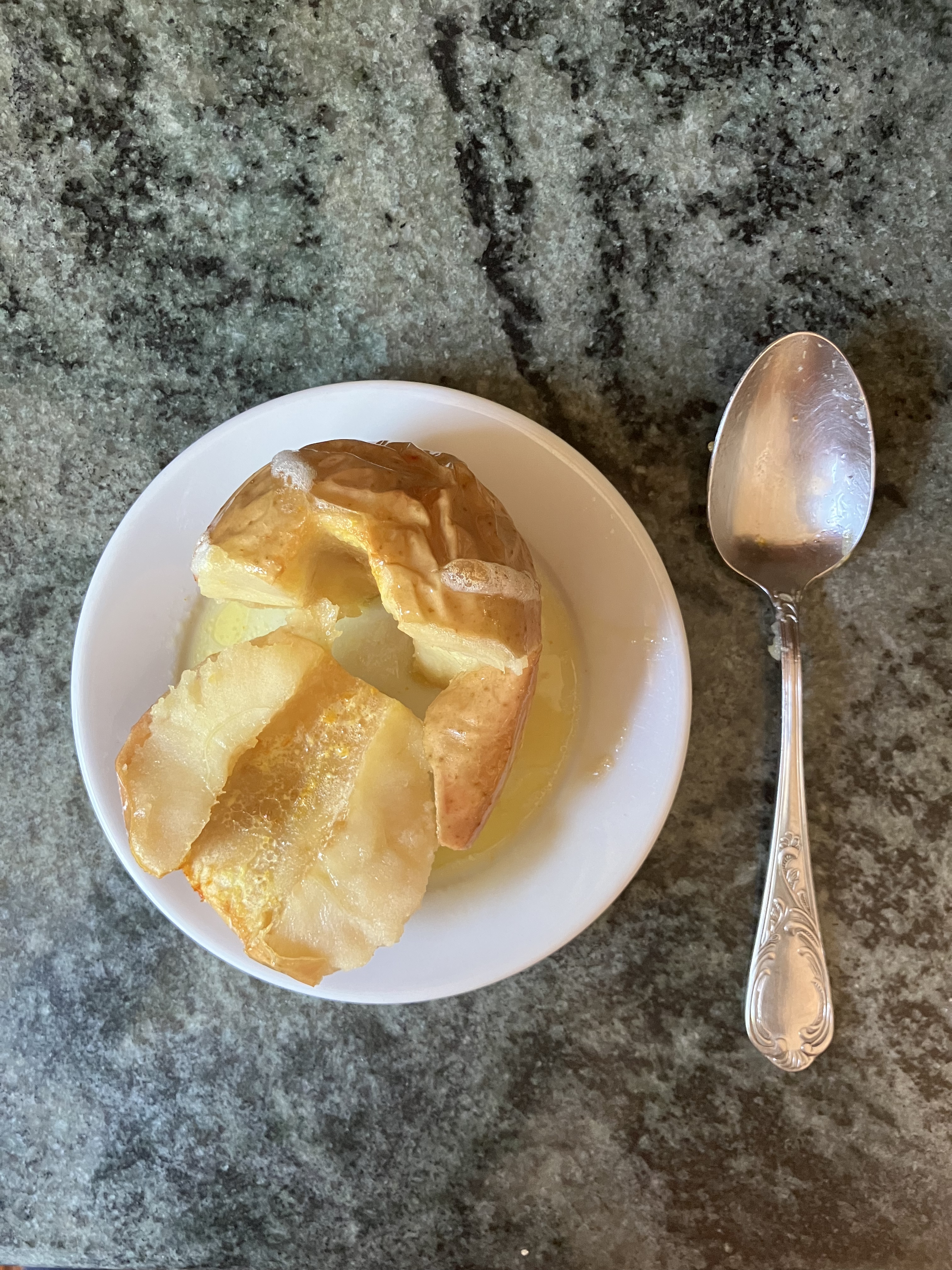
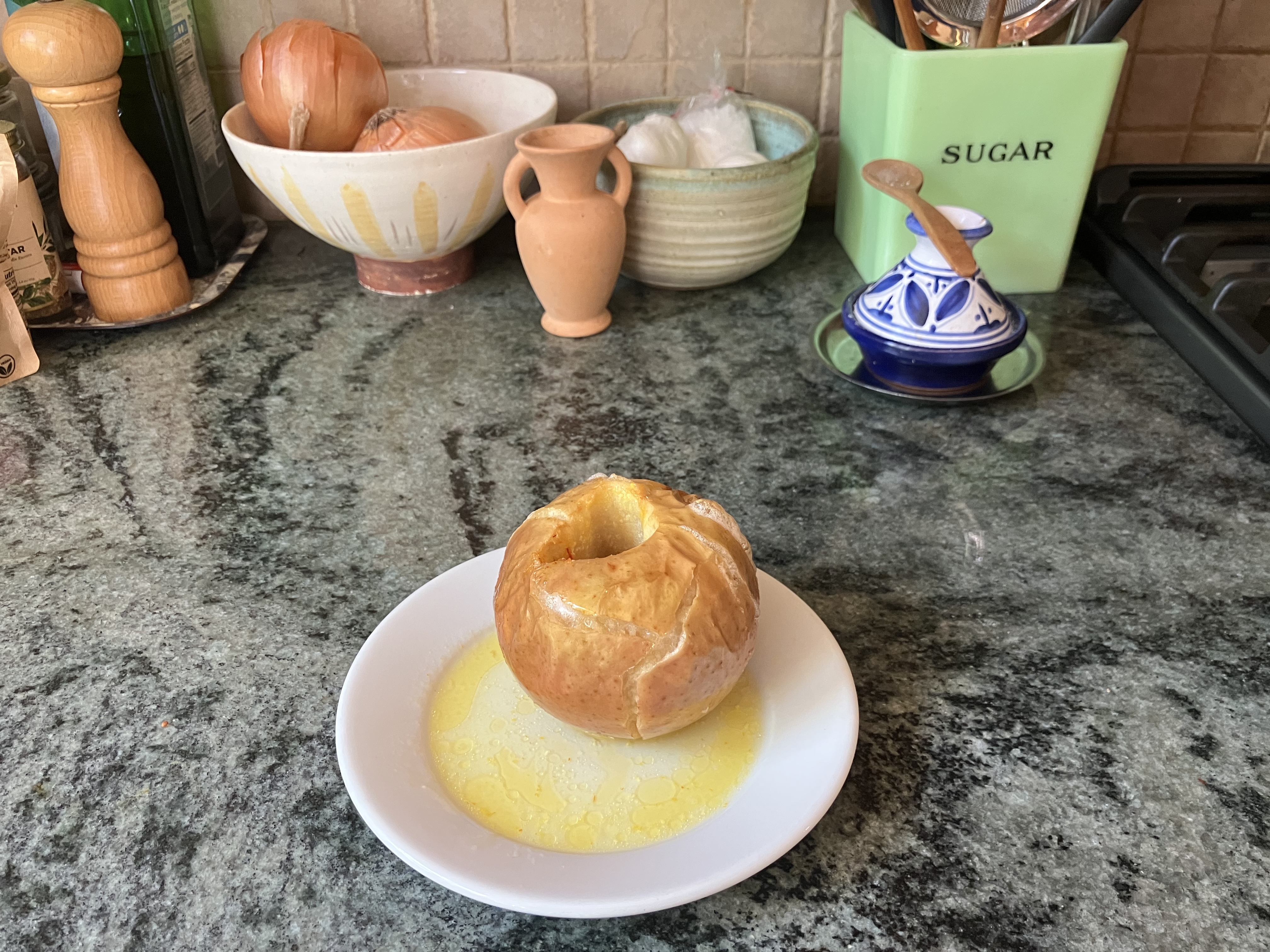
Apple, butter, and saffron are a beautiful combination. The juicy baked apple turned golden from the saffron. Luscious with butter and tangy with spice, the apple was delicious hot from the oven. It was tasty at room temperature with yogurt. Pairing this baked apple with a dollop of rich whipped cream, or a pour of smooth custard, or a scoop of vanilla ice cream would make a delectable, seasonal dessert.
I did find that some of the saffron butter flooded into the baking liquid during cooking and it felt like a waste to simply discard it. When the baking liquid had cooled down a little bit, I poured this “saffron butter water” into a container, put it in the refrigerator, and let the flavored butter solidify. This reconstituted “saffron butter” was a delicious addition to a crumble topping for a plum fruit crisp that I baked the next day.
Bolstered by saffron, apples, and butter, I’m now prepared to make merry during the cooler seasons ahead.