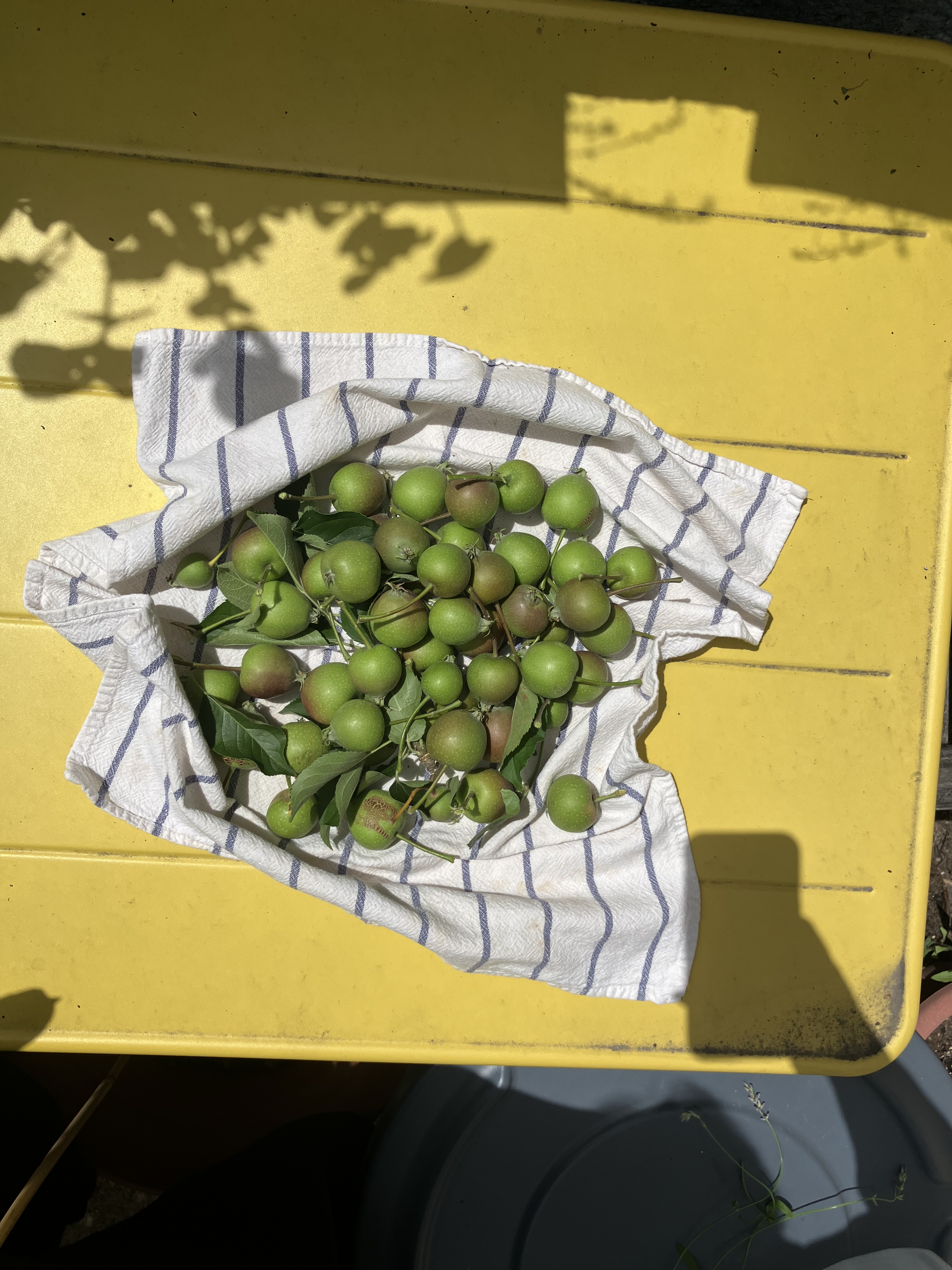
It became abundantly clear that it was time to thin the clusters on the apple trees in the back garden when the branches began to bend in unusual ways. Codlings, unripe young apples, were weighing down the long thin branches. I needed to pick quite a few.
I cooked with codlings for the first time in 2023 when I prepared a recipe for a “codling tart.” I was in the middle of writing my new book Shakespeare in the Kitchen and I was inspired to write a little about Shakespeare’s play Twelfth Night in the opening of the post:
I first learned that a “codling” was an unripe apple from the footnotes in a copy of William Shakespeare’s Twelfth Night. When Cesario arrives at Olivia’s gate and refuses to leave, Malvolio turns to ambiguous metaphors to describe the persistent youth to his mistress:
Not yet old enough for a man, nor young
enough for a boy—as a squash is before ’tis a
peascod, or a codling when ’tis almost an apple. (1.5.155-157)A codling is almost an apple, like a boy is almost a man. The Oxford English Dictionary records both the literal and metaphorical definitions of “codling” — “Originally: an immature or unripe apple; a type of hard apple suitable only for cooking” in medieval and Renaissance usage, and, later, in Shakespeare’s lifetime, “figurative. With implication of immaturity or inexperience: a young man, a youth. Obsolete.”
As I sat down today to write about the codling preserve that I tested last week, I almost began my post the same way! Reading Shakespeare got me excited to learn about codlings through research and recipe testing: Cooking with codlings these past years has deepened my understanding of Shakespeare’s culinary metaphor — Shipwrecked Cesario is new to serving Orsino as an eunuch and unripe in wooing a lady like Olivia. Whenever it makes sense in the coming months, I’ll continue to connect my recipe recreations with my research on Shakespeare’s culinary metaphors (a sort of complete works of Shakespeare, in the kitchen).


Original Recipe
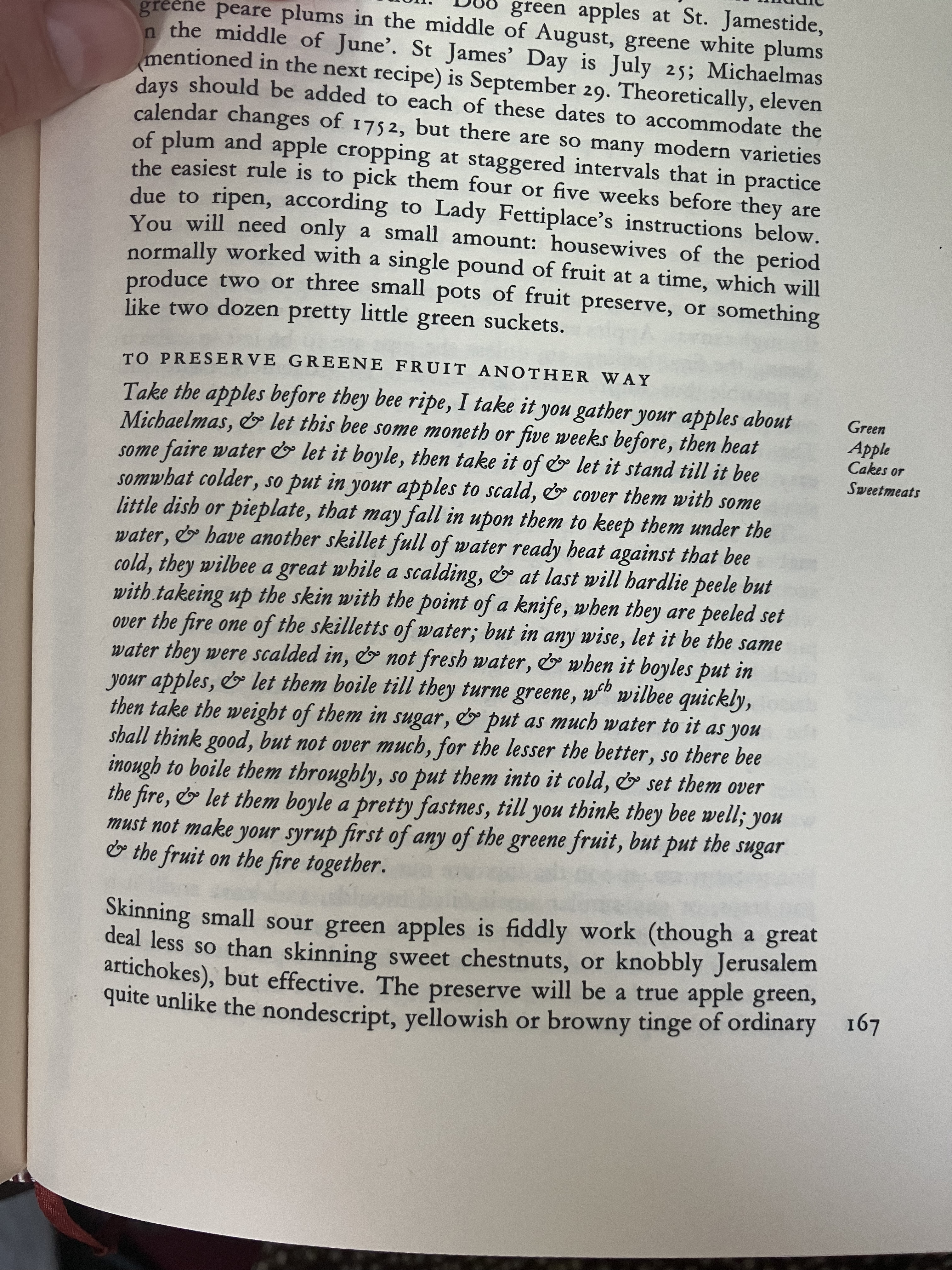
Elinor Fettiplace, edited by Hilary Spurling (p. 167)
I’ve recently been enjoying reading Hilary Spurling’s edition of Elinor Fettiplace’s 1604 manuscript recipe book which organizes the Elizabethan recipes into a calendar. In the summer months, there are many recipes to preserve fruit: unripe fruit that must be picked for other fruit to thrive (such as codlings) and perfectly ripe fruit that must be quickly dealt with before it rots. Fettiplace’s recipe (and Spurling’s extensive notes) provide a detailed method of scalding the codlings, peeling them, cooking down the pulp, and adding sugar to make a delicious preserve.
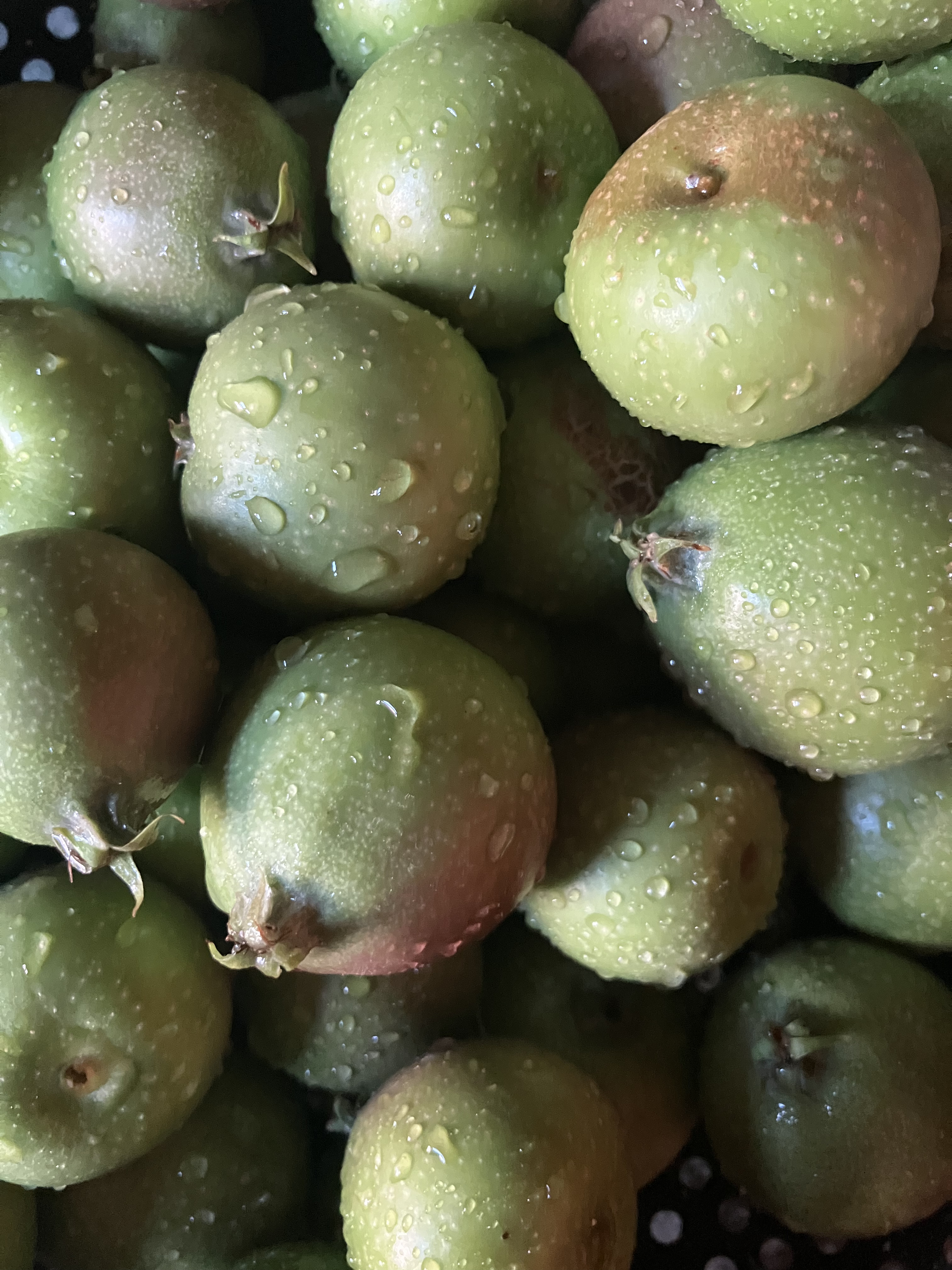
The sharp, green preserve is delicious, but my own experience making this recipe was a bit messy. The skin should come off the scalded fruit, but it did not in my case despite using four waters. I tried to take Spurling’s guidance and strain out the apple pits instead of cutting up the apples, but I only managed to strain about a third of my preserves before the pectin set everything too much for my strainer to handle.


Updated Recipe
Ingredients: codlings, sugar, water (to be measured in proportion)
Equipment: candy thermometer, multiple pots and pans, preserve storage jar(s), a scale
Prepare for making preserves: Put a small plate in your freezer. Prepare your storage jar(s). If they’re not fresh from the dishwasher, rinse them with boiling water.
Scald the codlings in near-boiling water four times: Set two large pots full of water on the stove and bring to a boil. When they reach the boiling point, turn them off. Add the washed codlings to the first pot and let scald for 15 minutes. Use a colander to keep the floating codlings below the water. As the timer runs down, bring the second pot of water to a boil again. Transfer the codlings to the second pot of water and let scald for 15 minutes. Repeat this process twice by reheating the first pot of water and using it for the third scald and then reheating the second pot of water and using it for the fourth scald. Reserve all the water.
Peel the codlings as best you can. Use a small sharp knife and your fingernails. Peel them under water that is as warm as your hands can stand.
[In my recipe attempt I went straight from peeling to cooking the codlings and making the preserve. I would suggest removing the cores and cutting the codlings into quarters or eights at this stage.]
Cook the codlings more by simmering them in the reserved water in a large pot for 15 minutes. Reserve the cooking water.
Figure out proportions for making the preserve. Fettiplace suggests equal weights of cooked codlings and sugar. Spurling suggests to each pound of codlings and sugar, using 1 cup of the reserved cooking water. I had 790g of cooked apple and I cooked it with 790g sugar (4 cups) and 1 3/4 cups of the reserved cooking water. [I followed Spurling’s proportions, but if I make this again I will reduce the sugar to 3/4 cup to each pound of cooked fruit. I’d like to taste a little more of the sharp apple flavor.]
Make codling preserves. Put the cooked codlings, sugar, and reserved cooking water in a heavy saucepan with ample extra room. [I actually switched to a larger pot after I took the photograph above!] If you’re using a candy thermometer, affix it to the side of the pot. Cook at a high heat and bring the mixture to the boil. Continue to cook and stir and mash the apples chunks into a thick pulp. Cook until the preserve reaches 220°F and/or when you run a spoon along the bottom of the pan the fruit does not immediately flood the space again. (My total cooking time was 25 minutes, but this will vary.) As your preserve nears temperature or the spoon parts it more effectively, put 1 teaspoon on the freezer plate and let sit for 30 seconds. If the preserve holds its shape when you tilt the plate, it has set. If the preserve is browning quickly or looks set before the temperature reaches 220°F, try the plate test earlier.
[Option to strain your preserves before storing in jars! I did this, but if you remove the skins and seeds pretty well beforehand this might be unnecessary.]
Put in your prepared jars. Store this small-batch preserve in the refrigerator and consume within two weeks. You can extend the life of your jam by properly canning it or by freezing it.
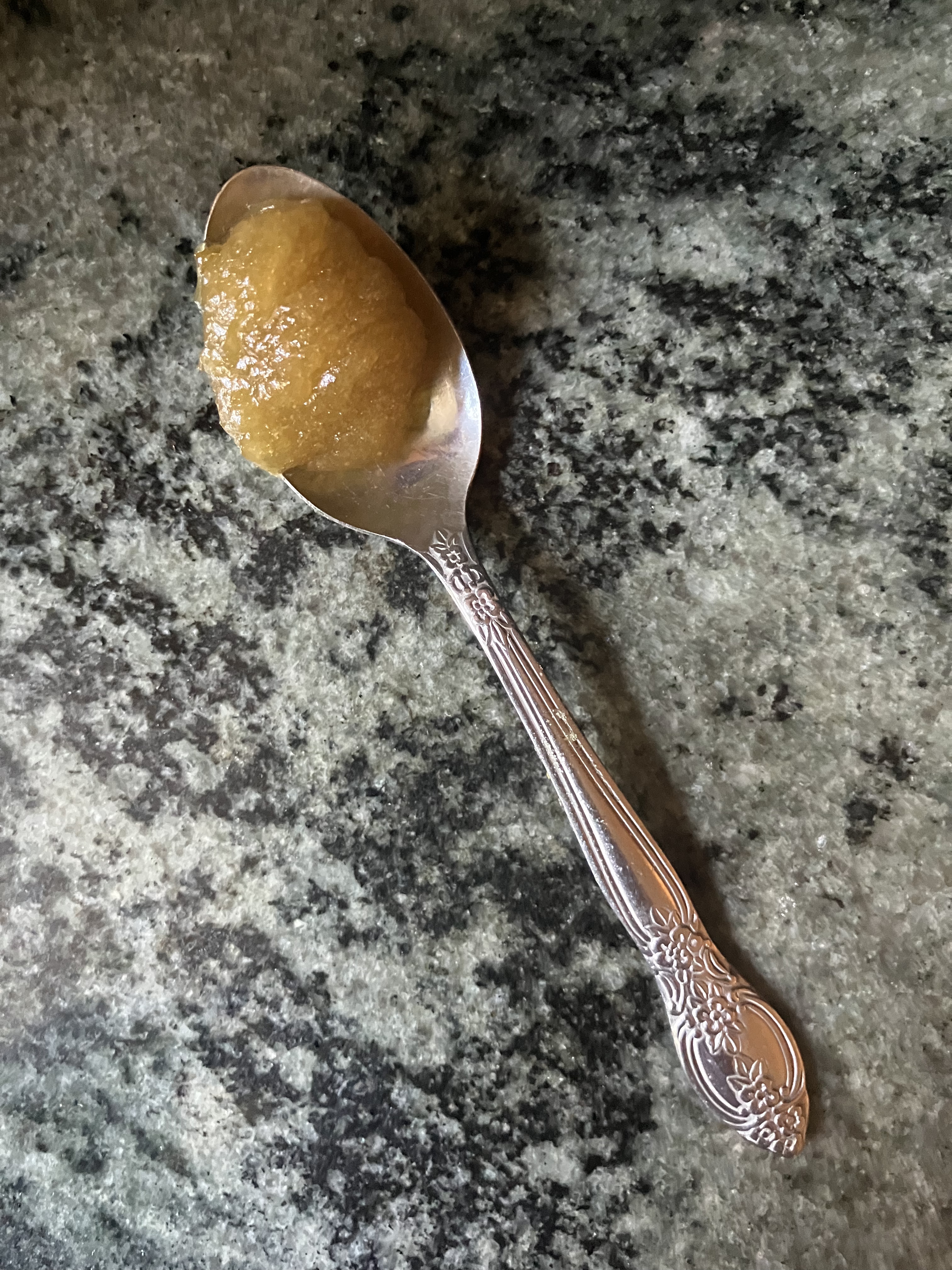
The Results
Tangy and sweet, the preserve is delicious. I’m excited to slather it on toast and eat it with cheeses. As I wrote above, I might make it a little less sweet if I make it again next year. That being said, it still carries a delightful unripe sharpness — the true essence of codlings.


Always such unique information!
Thank you!
I have been doing some transcribing at the Library of Congress, have you seen what is available there? Here is a link, but you could do a search on the Libray of Congress site for Early American cooking. https://crowd.loc.gov/campaigns/cookbooks/
Thank you for sharing this resource! I haven’t spent much time with Library of Congress collections yet, but this is a great reminder to follow this transcription project.
I enjoyed reading this. When I lived in America in the early 1980s we had a crabapple tree in our yard and I used to make such delicious crabapple jelly. Now I live in Morocco and have made preserved olives here as well as apricot preserves. I’m now older and no longer able to cook, but I found it fascinating that you are using this book of Elizabethan recipes and trying them out. I never heard of coddlings, but enjoyed reading about your experience making preserves!
Thank you so much for reading!