Hannah Woolley’s Bisket Pudding

A few weeks ago I prepared a dish of “Portugal Eggs,” a complicated banqueting dish with  many elements, from MS Codex 785. Like the recipe for “Lemmon Cakes” I posted a while ago, this recipe was copied into the manuscript from Hannah Woolley‘s The Queen-like Closet or Rich Cabinet: Stored with all manner of Rare Receipts For Preserving, Candying and Cookery. Very Pleasant and Beneficial to all Ingenious Persons of the Female Sex (1670). Woolley was an all-around lifestyle guru who not only wrote cookbooks, but also provided guidance on etiquette, homemaking, and interior design. (More on all this coming soon.)

In any case, this complex recipe required many components and one was biskets, neutral, lady-finger-like cookies. These bland, sweet, and slightly floral biscuits compliment the flavors around them.  Alyssa wrote about fixing a similar recipe, Hannah Glasse’s Naples biscuits, when she prepared “Artificial Potatoes.” I made a big batch of “the best bisket Cakes” from MS Codex 785 and I decided I would use them for a second recipe, Hannah Woolley’s “Bisket Pudding,” rather than let them go to waste.

Essentially, this is a bread pudding that starts with a rose-water scented cookie instead of stale bread. You can either make both recipes or use any bland cookie, old cake, or stale bread as the base of Woolley’s pudding.

The Recipe(s)

bisket Cakes

To make the best bisket Cakes

Take four new laid Eggs, leave out two of the
whites, beat them very well, then put in two
Spoonfulls of Rosewater, and beat them very
well together, then put in a pound of double
refin’d sugar beaten and search’d and beat
them together one hour, then put to them
one pound of fine flour, and beat them
together a good while, then put them upon
plates rubb’d over with butter, and set
them into the Oven as fast as you can
but have a care you do not bake them
too much.


Bisket Pudding

CCLXXII. To make Bisket Pudding.

Take Naples Biskets and cut them into Milk, and boil it, then put in Egg, Spice, Sugar, Marrow, and a little Salt, and so boil it and bake it.

Our Recipes

Cakes

This recipe was relatively straightforward to update. It makes about 24 cookies.

4 eggs (2 whole, 2 whites only)
2 t rosewater
1 lb sugar (2 2/3 c)
1 lb flour (3 2/3 c)
butter or baking spray to coat the baking sheets

Preheat your oven to 350F. Grease two baking sheets with butter or your preferred baking spray,

Beat the eggs in a large bowl. I used a hand mixer for this, but a standing mixer would also work well. Add the rosewater to the eggs and continue beating. Add the sugar and beat on a high setting until the mixture starts to look fluffy (about 1 minute). Add the flour in three batches, allowing each to mix in fully.

Shape the dough into rough ovals. I did this by picking up about 2T of the dough and rolling it roughly in my hand. Make sure that you leave about a half an inch between the cookies as they expand a lot as they cook.

Bake 15 minutes. The bottom of the biscuits should be nicely browned and the top still a little spongy.

Cool on a rack before storing.

Pudding

Boil then bake this “bread” pudding. Instead of adding bone marrow to the mix, I substituted some butter in its place.

2 c. milk
6-10 biskets, broken into small pieces
2 eggs
2 T sugar
2T butter
1/2 t cinnamon
1/4 t salt

Preheat oven to 350F. Butter a baking dish. I used an 8-inch oval ceramic dish, but a glass dish or a baking tin will work as well.

Pour the milk into a medium sauce pan. Add the broken biskets to the milk until you can no longer submerge the biskets in the liquid. Cook over a low heat for 5 minutes.

Meanwhile, whisk together eggs, sugar, butter, cinnamon, and salt. Add to the pan and stir to combine. Remove from heat.

Pour pudding mixture into your buttered baking dish. Bake for 45 min.

The Results

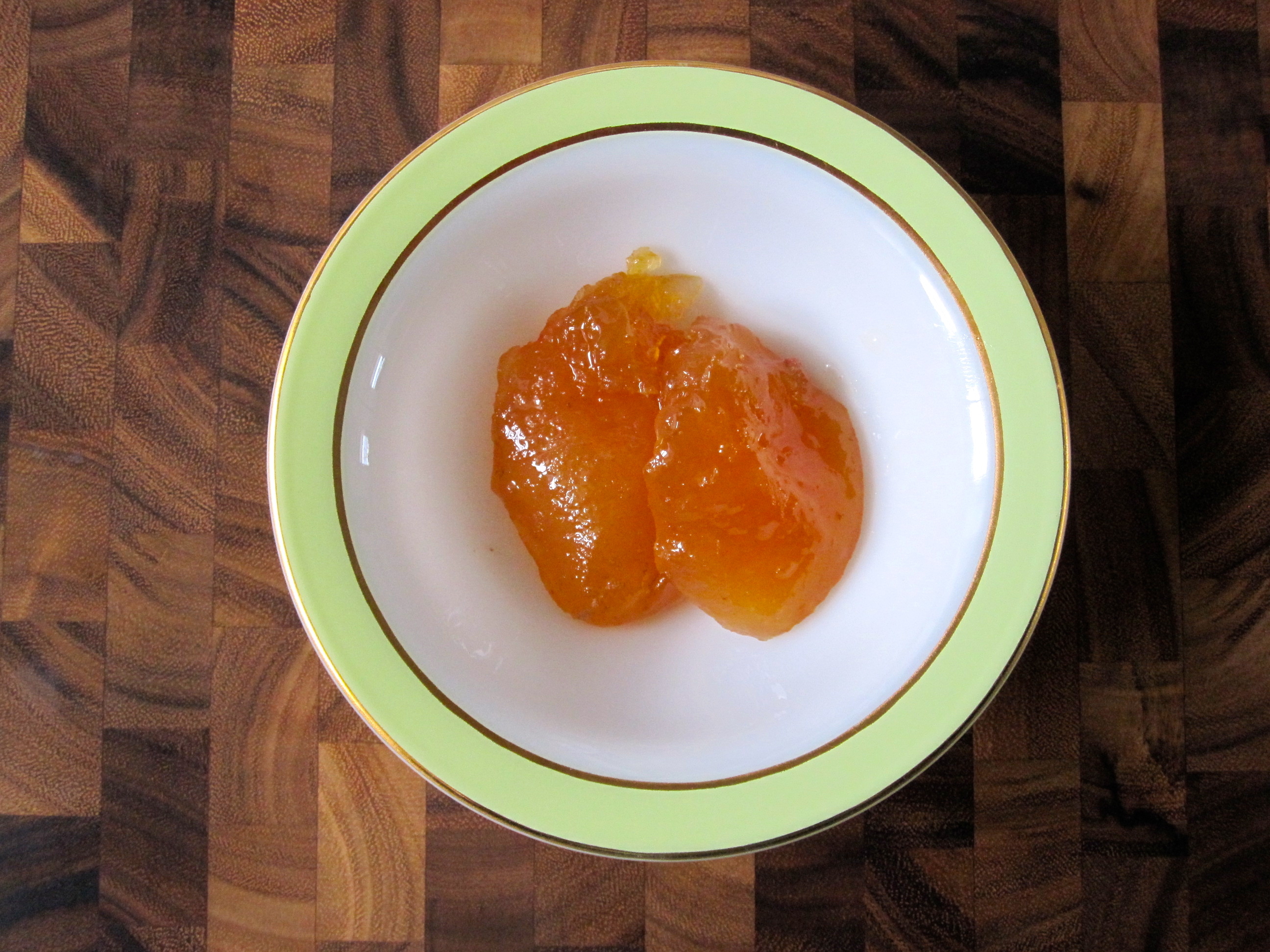
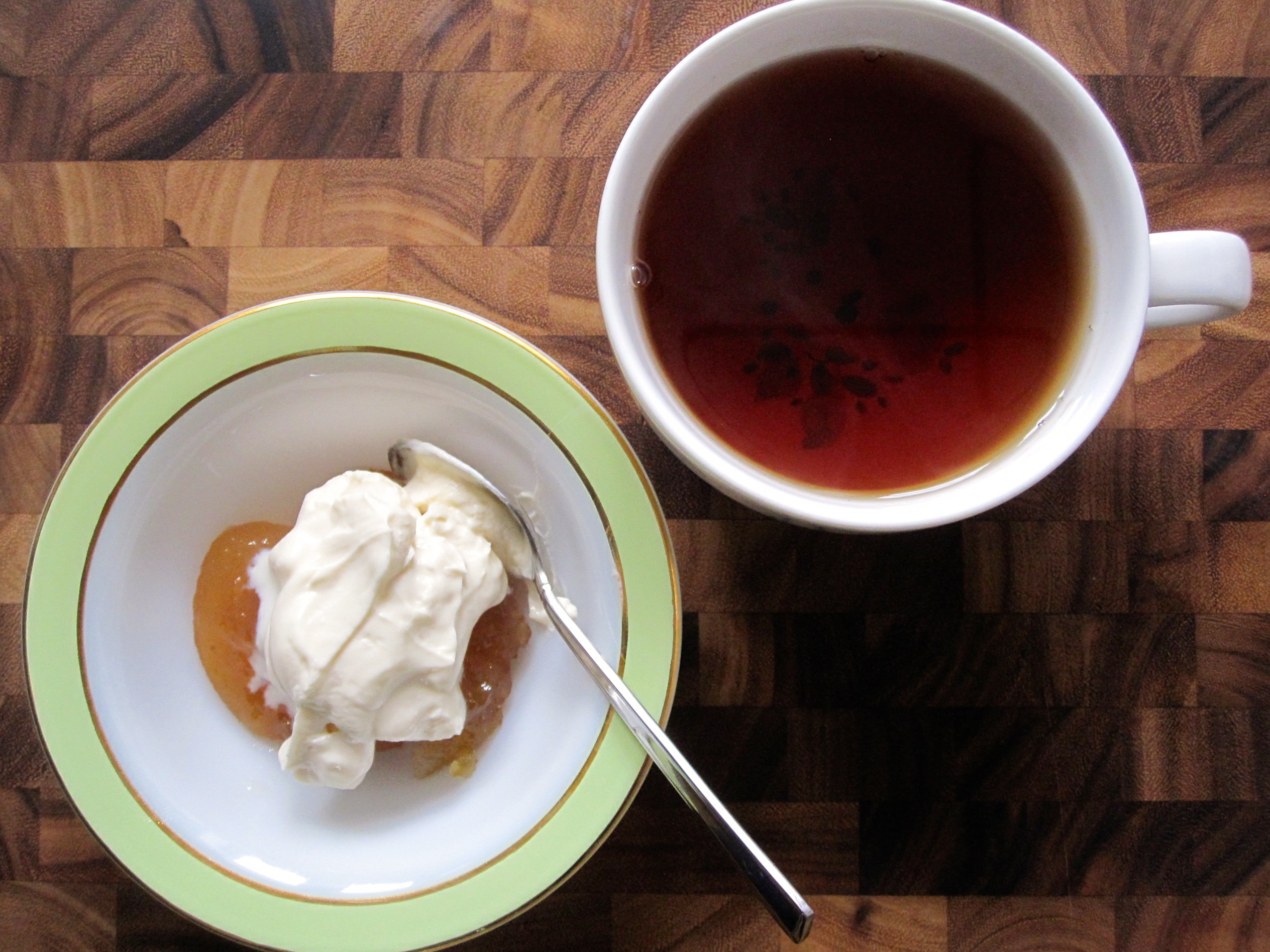
This pudding is delicious. It’s sweet, dense, and sticky like a good bread pudding should be. The rosewater that overpowered the biskets themselves is far mellower with the addition of dairy and cinnamon. The crispy edges are my favorite.

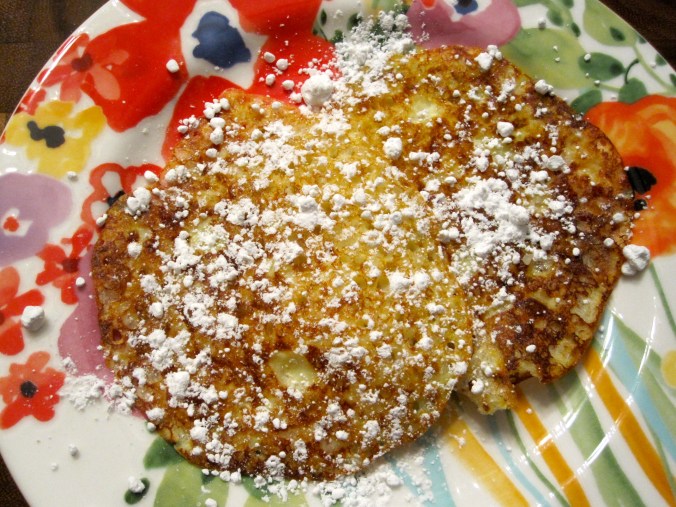
The photos don’t look like much, but I promise that this packs an impressive flavor.

To make a Simnel

Before I moved to England to study a decade ago, I had never heard of a Simnel Cake. When I asked people what it was, I usually got the same response: a light fruit cake for Easter. Needless to say, I was initially baffled by the concept of a “light” fruit cake.  But when I finally tried a Simnel Cake I knew I’d been missing out. It was sweet with marzipan and candied peel, rich with spice, and yes, it was “light.”  Now I always urge my spouse to make one as Easter approaches. We also usually re-watch this clip about Simnel-baking and egg-tossing from Hugh Fearnley-Whittingstall’s River Cottage series, too.

Although the origins of the Simnel Cake are highly debated, the Oxford English Dictionary includes mentions of Simnel from medieval and early modern sources. It’s long been “A kind of bread or bun made of fine flour” and “A rich currant cake, usually eaten on Mid-Lent Sunday in certain districts.” When I saw a recipe “To make a Simnel” in perennial favorite manuscript MS Codex 785, I knew which version of the Easter Simnel I’d be making this year.

The Recipe

simnel

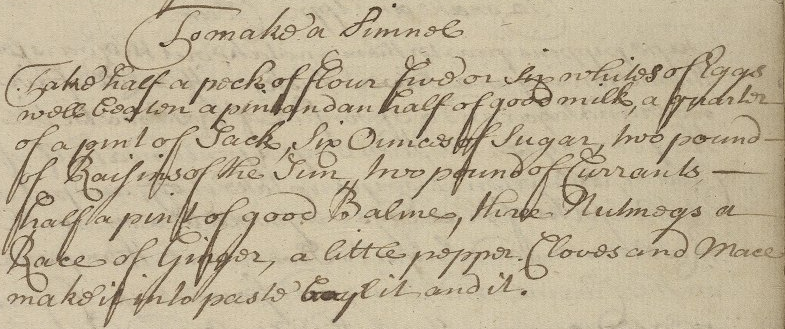
To make a Simnel
Take half a peck of flour five or six whites of Eggs
well beaten a pint and an half of good milk, a quarter
of a pint of Sack, six Ounces of sugar, two pound
of Raisins of the Sun, two pound of Currants
half a pint of good Balme, three Nutmegs a
Race of Ginger, a little pepper, Cloves and Mace
make it into paste boyl it and it.

From the start, I wasn’t sure how much this would taste like a “light fruit cake” without the marzipan and candied peel showcased in modern recipes. But the recipe seemed straightforward except for that “half a pint of good Balme.” Ivan Day’s historical baking guide suggests that liquid “balme” in baking recipes often refers to liquid “barm,” or the yeasty scum on the top of home-brewed beer. This barm would have been full of wild beer yeasts. It leavened the bread and imparted funky fermented flavors. Researching this ingredient led me to treat this recipe for Simnel as a rich yeast bread.

Our Recipe

Our version of the Simnel receipt is quartered from the original recipe and makes two hearty loaves. I hand-kneaded this bread, but a standing mixer with a dough hook should also do the trick. Since this is a yeast bread, make sure you budget for an hour and a half of rising time! Alternatively, you can prepare the dough in advance. Keep it in you fridge overnight, allow it to return to room temperature for about an hour or so, and then bake it.

It was fun to pour a favorite local beer into this dough. I used Yards “Brawler,” an English mild style session beer,  but other lagers and pale ales will work as well.  Feel free to experiment with other beers and let us know if they impart unique flavors to the bread. I also used brandy in place of the sack, but sherry is an equally good substitute.

4 1/2 C flour (1.75 lb)
1/4 C sugar (1.5 oz)
1 t yeast
1/2 t nutmeg, freshly grated or ground
1 t ground ginger
1/4 t black pepper, freshly ground or pre-ground
1/4 t ground cloves
1/4 t mace
1 1/2 C raisins (1/2 lb)
1 1/3 C currants (1/2 lb)
3/4 C milk
2 egg whites, beaten
1 C beer
1 oz sack

Mix the dry ingredients — flour, sugar, yeast, spices — in a large, sturdy bowl. Add the raisins and currants.

Add the milk to the dry mix and stir it in. Add the eggs and continue stirring. Add the beer and the sack. The mix should resemble a rough dough that you can shape into a ball. If it’s too wet to handle, add a little more flour by the tablespoonful. Alternatively, if it’s too dry, add water, milk, or beer by the tablespoonful to soften it.
Knead the dough on a floured surface for five minutes until the dough is smooth. It should look glossy and consistent. Don’t worry if the raisins and currants keep falling out of the dough! Just fold them back in. Shape the dough into a ball.

Place the dough into a bowl greased with butter, baking spray, or oil. Set in a warm place to rise for about an hour and a half. This dough doesn’t rise dramatically because of the huge amount of dried fruit mixed into it. The dough is ready to bake when it springs back when poked.

Preheat your oven to 375F. Grease two baking sheets with butter, baking spray, or oil. I shaped my dough into two, round, free-style loaves, but you can also bake it in a well-greased rectangular or circular baking tin.

Bake for 35-40 minutes until the loaves are nicely browned on top and bottom. When you turn them over and tap the bottom, the bread should make a hollow sound.

The Results

This is a delicious, spicy, fruity bread.  It reminds me more of spiced, English hot cross buns than the modern simnel cakes I’ve eaten. The pepper keeps catching me off guard as I eat slices with tea whilst grading a huge pile of midterms and papers. The beer, milk, and eggs add a sweet richness to the bread that I’d normally expect from a loaf of challah. It makes great toast and I anticipate it freezing well, too.

To make a seed cake

So, I chose to make this particular recipe because 1) I had all the ingredients on hand, and 2) it looked easy. I admit it – no loftier goals than that. But isn’t ease and convenience how we often choose recipes? And perhaps the same applied for this cake’s original cooks. After all, we don’t always have the inclination (or eggs) to make a “rich cake” that requires 24 eggs. But a simple cake that requires only four ingredients? No wonder Catherine Cotton included this recipe in her book.

This “seed cake” comes from one of our favorite volumes, Catherine Cotton’s UPenn Ms. Codex 214. We’ve seen seed cakes come up in other seventeenth- and eighteenth-century recipe books, so it seems safe to say that seed cake was probably fairly common at the time. Interestingly, this recipe would have yielded quite a large cake: halved, it more than filled an 8″ round, so this would have been cake for a crowd.

IMG_4867

The Recipe

seed cakes

To make a seed cake

Take the whites of 8 eggs beat them very well then
put the yolks to them & beat them very well together then
put to it a pound of sugar beat & sifted very fine & beat
it for half an hour then make it a little warm over the
fire & after that put in 3 quarters of a pound of flower
very well dryed a quarter of an ounce of carraway seeds
stirr it well together & put it into the pan it will take 3
quarters of a hour to bake it /

Our Recipe
(halved from the original)

4 eggs, separated
1 heaping c. (1/2 lb.) sugar
1 1/4 c. (6 oz. or 3/8 lb.) flour
1.5 tsp. (1/8 oz.) caraway seeds

Preheat oven to 350F. Grease and flour a 9″ round pan or other baking dish.*

In a standing mixer or with a handheld mixer, beat eggs whites until stiff but not dry. Then add egg yolks and beat until mixture is uniformly yellow and still fluffy. Add sugar and beat at medium speed for about 10 mins., or until light and shiny.* Scrape down bowl and stir in flour and caraway seeds with a spatula.

Bake for 45-50 mins., until top is dry and firm to the touch. Cool in pan 10 mins., then run a knife around the edges to loosen it and turn cake out onto a wire rack to cool completely.

*Note: I used an 8″ round pan and, as you can see, barely escaped a cake batter overflow disaster. 9″ would be safer.

**Note: I actually forgot the next step, to “make it a little warm over the fire”! This didn’t seem to detract from the final outcome, but you might set the mixing bowl briefly over a double boiler if you’d like to be thorough!

The Results

I’m always curious to try a recipe that we see come up, with minor variations, across multiple recipe books. But I didn’t have extraordinarily high hopes for this cake – eggs + sugar + flour + caraway seeds? I expected something blandly palatable, mildly sweet, perhaps dense and a little dry.

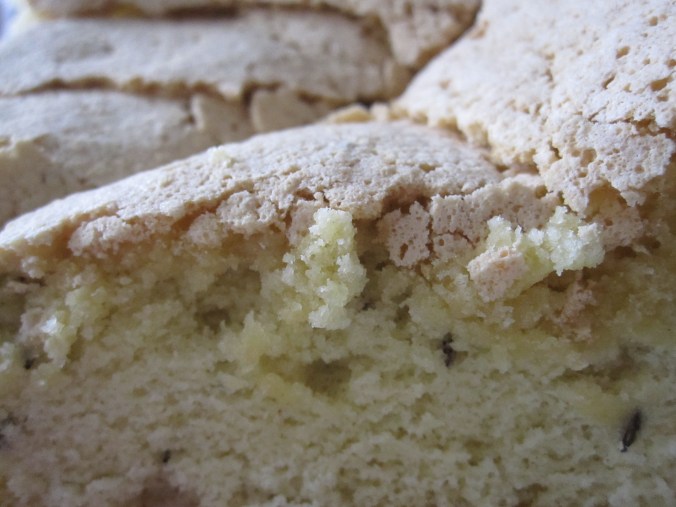
Instead, I ended up with something between a pound cake and an angel food cake: sweet without being cloying, moist, nicely chewy, with a sweet crackly crust. Hello, seed cake! Welcome to the rotation – I’ll be making this one again. And while the simplicity of the recipe is part of its charm, it also means that there’s plenty of room for experimentation with extracts, zest, different seeds in different amounts, perhaps even finely chopped dried fruit or miniature chocolate chips. Wrapped well, it stayed moist for several days. And it’s a lovely cake to have with tea or coffee.

IMG_4865

To presarue quincis to by in gilley

These preserved quinces, like the preserved apples and apricots, will be a delightful accompaniment to the pancake recipes we posted last week.

When I was in kindergarten, our class held an alphabet feast. Each of us was assigned a letter of the alphabet and tasked with providing a food whose name began with that letter. The “A” student could bring apples, the “P” student could bring pie, as the “Q” student I faced a great challenge. But, as always, my brilliant and resourceful mother had an idea: Quince Jam. I’m not sure I had ever tasted quinces before that day when we finally found a jar of imported Quince Jam after visiting what seemed like every specialty store in the western towns of Essex County, NJ. The “Q” student in the the other class may have had an easier time making quiche than hunting for quinces, but I think that my mom and I came out on top. My classmates and I ate quince jam on saltines sitting cross-legged on the classroom floor, or at least that’s how I remember it. I don’t think I tasted quince again until the man who is now my husband poached them in wine for dessert one cold winter evening in London.

Recalcitrant and inedible in their raw state, quinces have long inspired fear and love among cooks. Amanda E. Herbert shows how a gifts of “Marmalade of Quinces,” or other sugared fruits, circulated in a female social network in her book Female Alliances: Gender, Identity, and Friendship in Early Modern England. Local, hearty English quinces were softened and tempered with boiling and the extravagant use of imported sugar. Preserved quinces shared between women demonstrated generous consumption of expensive sweeteners and inborn feminine skills at taming the unruly quince. Molly Wizenberg’s recent post on Orangette reflects a twenty-first-century view of this very same issue and offers a great, simple recipe for taming and tenderizing this “esoteric fruit.” Since that early encounter and more recent reintroduction, I’m hooked on quinces. I’ve been making Hugh Fearnley-Whittingstall’s Sticky Quince and Ginger Cake for years now, Nigella Lawson’s Quince Meat is my household’s standard mince pie filling (or at least it was before  these came along), and I’ve long admired quince-whisperer Nigel Slater’s recipes.

This recipe from UPenn MS Codex 252 instructs cooks in a complex method for preserving quinces in a gelatinous liquid thickened with sugar and pectin from apples and the quinces themselves. Our recipe, below, is a bit simpler.

The Recipe

preserved quinces

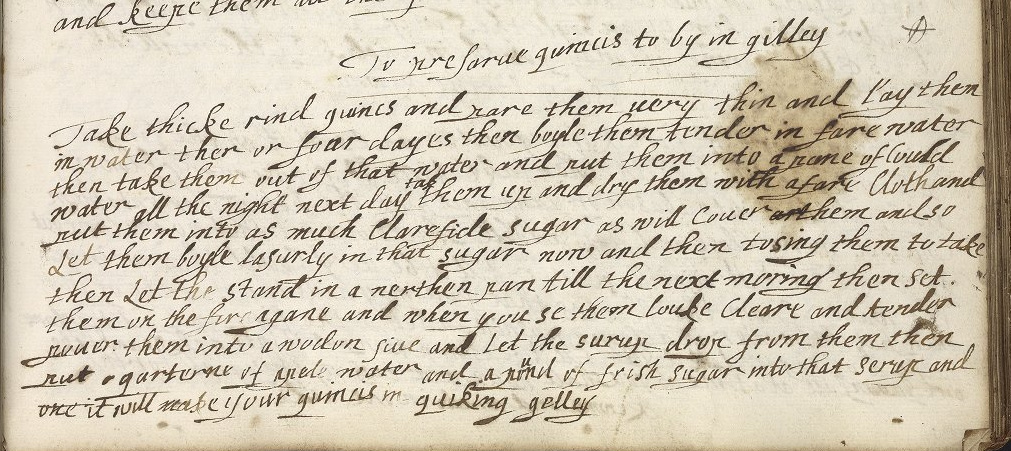
To presarue quincis to by in gilley    X

Take thicke rind quincs and pare them uery thin and lay them
in water ther or four dayes then boyle them tender in fare water
then take them out of that water and put them into a pane of could
water all the night next day tak them up and dry them with a fare cloth and
put them into as much clarefide sugar as will couer or them and so
Let them boyle lasurly in that sugar now and then tosng them to take
then Let the stand in a nerthen pan till the next moring then set
them on the fire agane and when you se them louke cleare and tender
pouer them into a woden sive and let the surup drop from them then
put a quarterne of apele water and a pound of frish sugar into that serup and
one it will make your quincis in quiking gelley

Despite the lengthy description of cooking methods in this recipe, it is easy to streamline and requires very few ingredients. A quick search on Early English Books Online reveals many uses of “apple water,” or water in which apples have been boiled, in culinary and medicinal recipes. For this recipe, it seems to add pectin to the preserving liquid.

Our Recipe

1 quince
1 apple
3/4 c sugar (to use in 1/4 c and 1/2 c quantities)
6 c water (to use in 2 c quantities)

1 jar (if you plan to can these or prefer to store them in a jar)

*These proportions yield 1 ball jar of stewed quinces in sweet liquid. This can easily be doubled or tripled to preserve more fruit.*

Peel and core a quince. Slice it thin.  Soak in two cups of cold water overnight (or for a few hours depending on what suits your schedule).

Drain the quince from the soaking water and put in a pot with 1/4 c sugar and 2 c water. Bring to a boil and then turn it down to a simmer to cook the quince “leisurely” until soft. (I let my quince simmer for about two hours while I was doing other things.) Using a colander, strain out the quinces and discard the cooking liquid. Set quinces aside.

Either during the last half hour of cooking the quinces, or after, prepare a jar and make the apple water/preserving liquid.

Fill your jar with boiling water and then discard. Put the quinces in the jar.

Roughly chop an apple, skin core and all. Put the apple in 2 c water in a pot. Bring to a boil and then simmer for a half hour.  Remove the apples and add 1/2 c sugar to the cooking liquid. Boil until the sugar dissolves. Pour this liquid into the jar with the quinces. Let cool before covering.

The Results

Now, these preserved quinces did not  last long in my kitchen. (I eating them with pancake, ice cream, yogurt, cake, etc.) I cleaned my jar with boiling water, but I did not properly can these. If you want to can a batch of these, Marisa McClellan has great advice over here on Food and Jars and in her cookbooks.

Unfortunately, the syrup did not become jelly. I think this is partly because the original recipe instructs cooks to discard the pectin rich quince cooking water. On the other hand, perhaps my apple water could have been prepared more effectively. Luckily, the non-jellied liquid made an awesome syrup for the pancakes. Let us know if your quinces jelly!

Pancakes Two Ways

Today is Mardi Gras, Shrove Tuesday, and a wonderful day to eat pancakes! We’ve prepared two pancake recipes from MS Codex 631 – and like those rice puddings we made a few months ago, they’re curiously different. This time, we chose two pancake recipes from the very same page of Judeth Bedingfield’s recipe book (1730s and 40s). Alyssa was intrigued by the recipe for rice pancakes and Marissa took charge of the conventional “pancake.” We keep coming back to this manuscript because of Bedingfield’s comprehensive collection and her tendency to include multiple recipes for the same dish. (Check out the rice pudding, potato pudding, Potingall cakes, “Peas Pods” of Puff Paste, and perennial favorite Carrot Pudding from Bedingfield’s book.)

The Recipes

pancakes

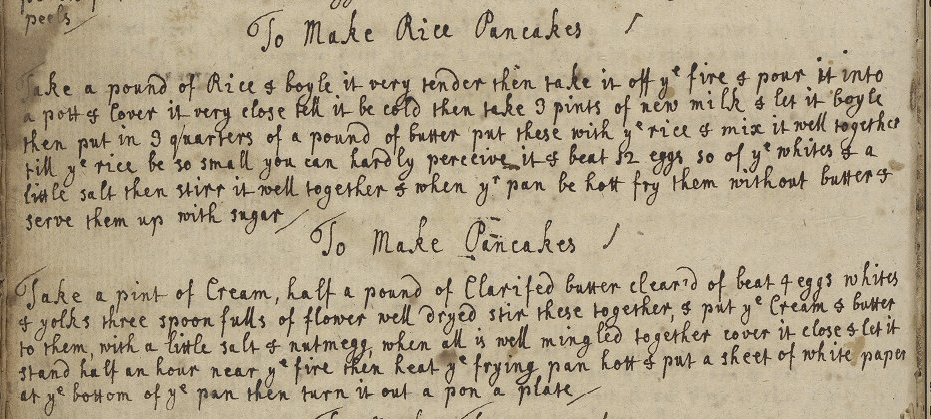
To Make Rice Pancakes
Take a pound of Rice & Boyle it very tender then take it off the fire & pour it into
a pott & Cover it very close till it be cold then take 3 pints of new milk & let it boyle
then put in 3 quarters of a pound of butter put these with the rice & mix it well together
till the rice be so small you can hardly perceive it & beat 12 eggs 10 (so?) of the whites & a
little salt then stirr it well together & when your pan be hott fry them without butter &
serve them up with sugar

To Make Pancakes
Take a pint of Cream, half a pound of Clarifed butter clear’d of beat 4 eggs whites
& yolks three spoon fulls of flower well dryed stir these together & put the Cream & butter
to them, with a little salt and nutmegg, when all is well mingled together cover
it close and let it
stand half an hour near the fire then heat the frying pan hott & put a sheet of white paper
at the bottom of the pan then turn it out a pon a plate

Our Recipes

Rice Pancakes

Like Marissa’s “Pancakes” below, these are thinner and eggier than modern American pancakes. The rice adds an interesting taste and texture: they turn out like rice pudding in crêpe form.

IMG_4853

I quartered the original recipe and it made about 18 pancakes using a 1/4 c. measure. (I lost a few along the way when flipping them went awry, as seen below.)

1/4 lb. (heaping 1/2 c.) rice*
3/4 pint (1.5 c.) milk
3 tbsp. butter, diced
3 eggs (1 whole egg + 2 whites)
pinch salt
sugar (powdered or granulated) for serving

*Note: I used Arborio rice because it’s what I had; anything you have handy should work as well.

Cook rice according to instructions; drain and then cool completely in a covered container.

Bring milk to a boil in a small saucepan. Turn off heat and add butter, stirring so that butter melts. Add milk mixture to rice and mix it well. (The original directs you to mix it until the “rice be so small you can hardly perceive it.” I stirred and stirred but could still perceive the rice, so then I wondered if this suggested some mashing? I blitzed the mixture a few times with an immersion blender to break up the rice a bit, though you could skip this step.)

With a hand mixer, stand mixer, or (if feeling in need of an arm workout) by hand, whisk two egg whites until frothy. Stir whole egg into rice mixture, then whites and a pinch of salt.

Heat non-stick pan as you would for regular pancakes (medium heat). Pour small pancakes: I used a 1/4 c. not quite filled. Be sure to scoop to the bottom of the bowl, as the rice sinks. Cook until large bubbles form throughout, about 3 mins., then flip the pancake and let brown on the other side.

Serve topped with sugar of your choice.

These turned out to be tastier than I thought they would, actually. They are, however, somewhat fiddly to make, as the batter is thin (no flour) and prone to breaking when you flip the pancake. Keeping the pancakes on the smaller side and letting them brown thoroughly solved this issue. (Mostly.) The rice adds some nice chewiness and a surprising degree of flavor. If you really wanted them to taste like rice pudding, adding a splash of vanilla or almond to the batter could be great. Zest would work too. Plus, they’re a great use for leftover rice, as the recipe can be scaled to however much you have. Many pancaking possibilities!

Pancakes

These pancakes are a precursor to flat, crêpe-like British pancakes and a far cry from fluffy, American pancakes. This doesn’t make them any less delicious than the American breakfast classic, but it’s worth mentioning at the start. These rich pancakes are slightly leavened with beaten eggs and ask to be served with sweet or savory sides.

IMG_4566

I’ve halved the original recipe. It makes 4 pancakes and serves 2. Double, triple or quadruple as you desire!

1/2 c cream
8T butter (1 stick) melted, solids removed, plus 1 T for cooking
2 eggs, separated
3T flour
1/4 t nutmeg
1/4 t salt

Combine cream and clarified butter and set aside. Beat egg whites until frothy. I used a hand mixer for this, but a whisk or a standing mixer would also work. Add yolks, then flour, then salt and nutmeg. Finally, stir in cream and butter mix. Let stand for a half an hour.

Heat 1 t butter in an 8-inch pan.  Pour 1/4 of the batter into the pan and allow it to spread out. Cook pancakes for 1 min on each side. (Flipping is easier after the first pancake.) Serve immediately.

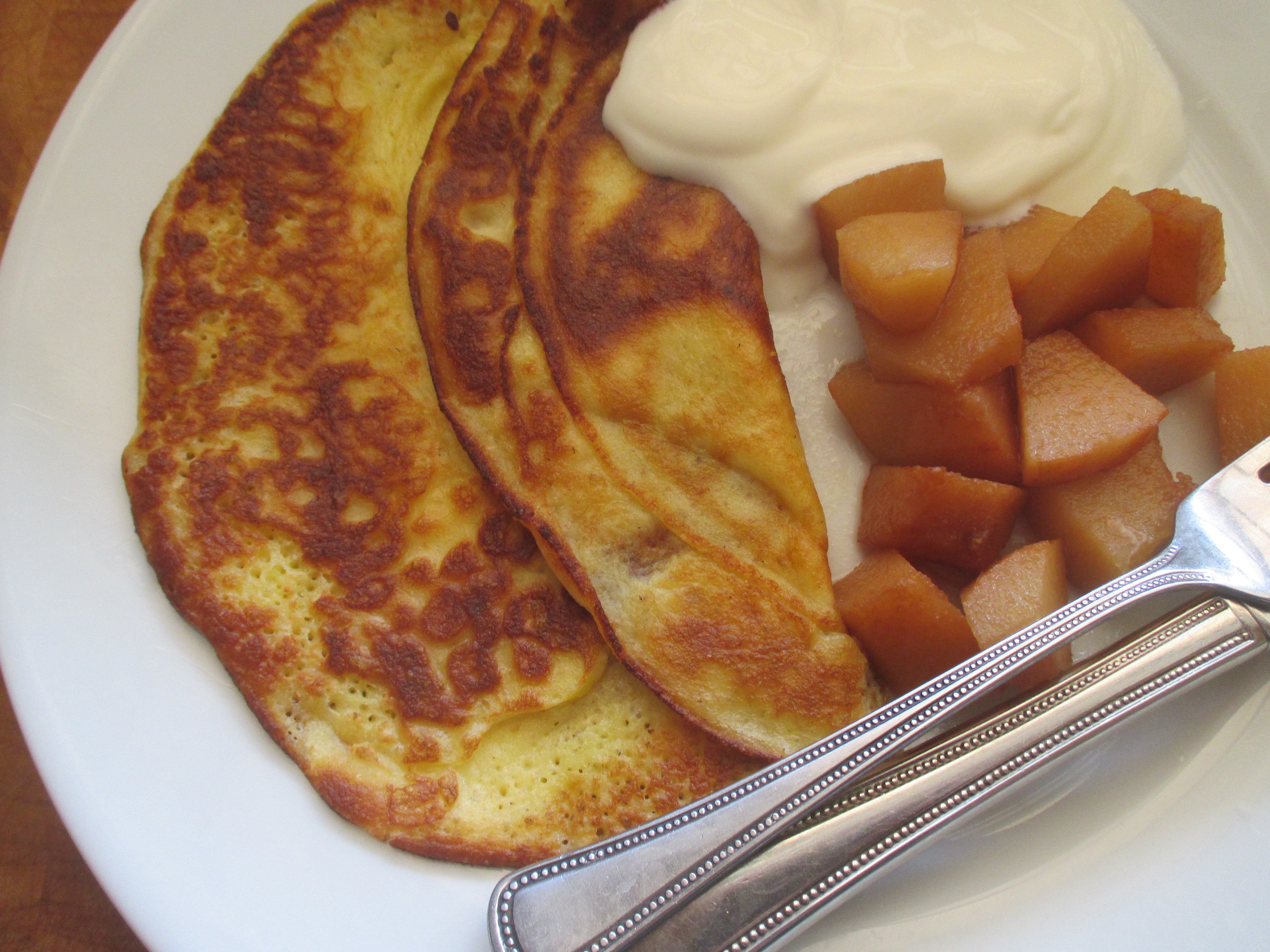
These crêpe-like pancakes were deliciously scented with nutmeg and rich with dairy. Served with yogurt and quinces (recipe coming soon), they made a warm and hearty breakfast on a cold morning. Since this recipe does not call for any sugar, it would be easy to take them in a savory direction by serving them with eggs, cheese, fresh sage or dill, or even breakfast meat like sausage or bacon.  I’ll be making these again for breakfast, brunch, and dinner.

Pancake-Off: The Results

A draw! We liked both of these quite a bit. Enjoy either of these pancakes with fresh fruit, yogurt, syrup, honey, nutella, or even preserved apples and apricots. And stay tuned for the recipe for the preserved quinces pictured with Marissa’s pancakes!

Chacolet from Rebeckah Winche’s Receipt Book at the Folger Shakespeare Library

We wrote a version of this post for the Folger Shakespeare Library’s research blog, The Collation. You can read it here. A special thank you to the Folger and everyone who came out to our Free Folger Friday lecture in December and got a sneak peak at these recipes.

Dear readers, we finally found a chocolate recipe to share with you! Since we launched this project we’ve been looking for chocolate. Alyssa and I love chocolate, our friends and family who taste our recipes love chocolate, and we were pretty sure you would love a historical chocolate recipe, too. We knew hot chocolate or drinking chocolate existed in early modern England, but it took us a while to find a recipe. Chocolate was a luxury good and not necessarily something that would have been found in the households of the people who were writing the manuscripts we’re working with. Drinking chocolate finally became more affordable and widespread in the late seventeenth and eighteenth centuries.

The Folger Shakespeare Library in Washington DC has a wide range of culinary manuscripts, and we’ve barely scratched the surface of their holdings. In October we participated in a Transcribathon sponsored by Early Modern Recipes Online Collective and the Early Modern Manuscripts Online Project. Reading through Rebeckah Winche‘s receipt book, Folger MS V.b.366, we found this recipe for “Chacolet.” As the coordinators of the Transcribation noted, the manuscript has a dated inscription, “Rebeckah Winche 1666,″ that conveniently locates the book in a seventeenth-century English household.

The recipe for “Chacolet” describes the process making hot chocolate from whole cocoa beans. Europeans may have encountered cocoa beans, but many would also have encountered chocolate in processed cakes that resemble the final product of this recipe as Sarah Moss and Alexander Badenoch suggest in Chocolate: A Global History. Moss and Badenoch also remind us that our modern chocolate bars are still more than one hundred years away at the time that this recipe was copied down. Only in the nineteenth century did chocolatiers develop the modern machines and processes, like conching, that utterly transformed this rare bean into smooth, modern chocolate (57, 61). Our friends at The Recipes Project have also written some great posts about chocolate consumption. Amy Tigner has two posts about it here and here, and Amanda E. Herbert describes how she teaches with chocolate here.

The Recipe

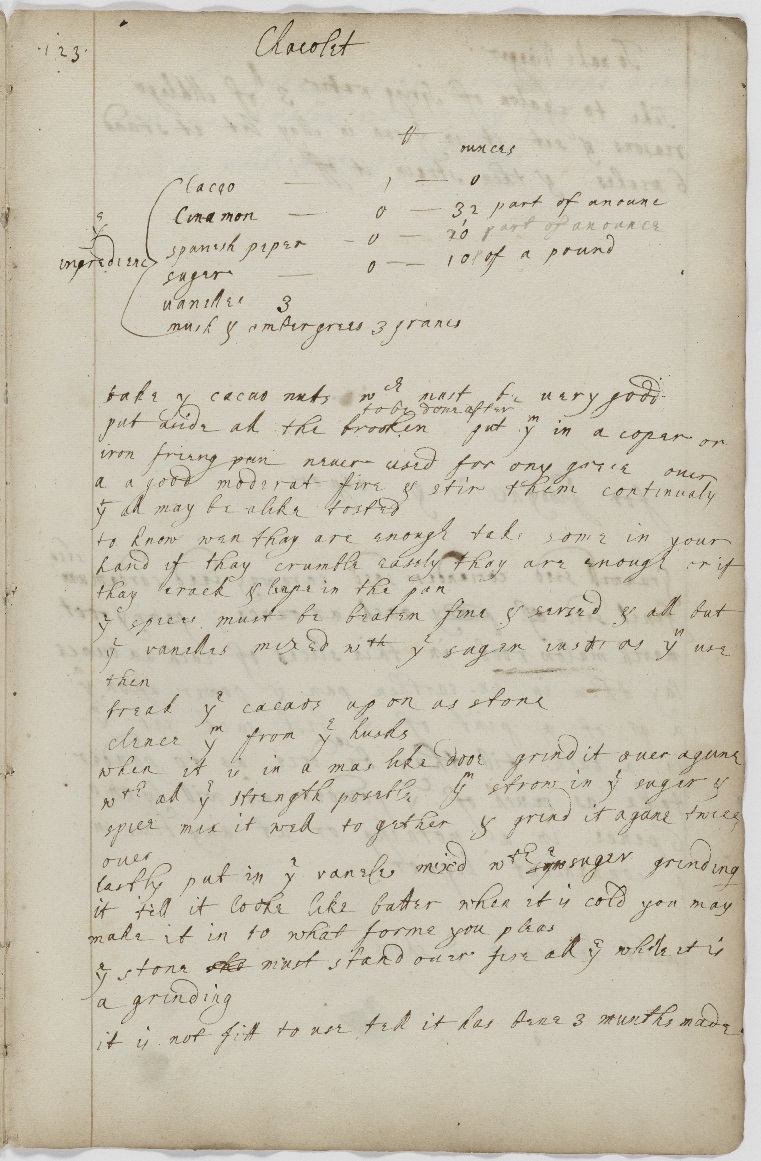
folger image chacolet, croppedChacolet

the ingredienc

# ounces
cacao – 1 – 0
cinamon – 0 – 3,2 part of an ounc
spanish peper – o- 20 part of an ounce
sugar – 0 – 10th pf a pound
uanilles 3
musk & ambergrees 3 granes

take th cacao nuts which must be very godd
put aside all the brooken ^(to be done after) put them in a coper or
iron frieng pan neuer used for any pech ouer
a a good moderat fire & stir them continualy
Yt all may be alike tosted
to know wen thay are enough take some in your
hand if thay crumble easily thay are enough or if
thay crack & leape in the pan
the spices must be beaten fine & sevied & all but
the vanelles mixed with the suger iuste as the use
then
break the cacaos upon as stone
clener them from the husks
when it is in a mas like dooe grind it ouer againe
wth all the strength possible then strew in the suger &
spice mix it well to gether & grind it agane twice
ouer
lastly put in the vaneles mix’d wth sye the suger grinding
it till it looke like batter when it is cold you mak
make it in to what forme you pleas
the stone must stand ouer fire all the while it is
a grinding
it is not fitt to use till it has bene 3 munths made

One interesting feature of this recipe is that it looks much more like a modern recipe than other recipes in Winche’s book or in the archive of historical recipes we’ve been exploring in general. Most of those are written as narrative paragraphs that combine measurements and instructions. This one looks more like what we’ve come to expect recipes to look like in the twentieth and twenty-first centuries: it begins with a list of ingredients with amounts – cocoa beans, cinnamon, Spanish pepper, sugar, vanilla, musk, and ambergris – and then includes a methods paragraph explaining what to do with these ingredients.

Since the recipe’s formatting and instruction was somewhat familiar, our process of updating focused more on the ingredients. Now, it’s hard to find whole cocoa beans in their husks in a specialty grocery store, let alone a basic supermarket. At a health foods stand in Reading Terminal Market in Philadelphia Alyssa and I found cocoa nibs: dried and chopped pieces of cocoa beans. This form of chocolate is popular with bakers seeking to add crunch to chocolate chip cookies and raw foods enthusiasts looking for alternatives to processed chocolate. By grinding the cocoa nibs first by hand in a molcajete and then in a coffee grinder we often use for spices, I produced a hot cocoa mix with an even consistency. However, I decided to prepare Rebecca Winche’s “chacolet” two different ways: with cocoa nibs to get closer to the original cocoa beans and with cocoa powder, a pantry staple today. I also decided to leave out the rare, funky, and/or glandular musk and ambergris.

Our Recipes

starting with cocoa nibs

1/3 c cocoa nibs
1 1/2 t cinnamon
1/2 t crushed red pepper flakes
1/2 c sugar
1 t vanilla extract

To make the hot chocolate mix:

Heat the cocoa nibs in a shallow pan for about two minutes. When they begin to look glossy, add the cinnamon and crushed red pepper and stir to combine. Remove from heat.

Now it’s time to grind your cocoa nibs and spice mix. We started this process in a molcajete and then transferred the mixture to a coffee grinder that we also use for grinding spices. In the coffee grinder the mixture turned into a solid paste. A dedicated spice grinder or a small food processor would also do the trick.

Return the cocoa and spice mix to the pan. Add the sugar and vanilla extract. Stir over a low heat for 2-4  minutes until the sugar is completely integrated and the mixture is uniform in color and texture. Some clumps will form, especially at the bottom of the pan.

Transfer the cooled mixture into a jar and label with the date. Store in a cool, dry, dark place.

To make hot chocolate:

Heat one cup milk over a medium heat until steamy. Add 3 T hot cocoa mix. Whisk over heat for another minute or two until it begins to simmer and mix is completely dissolved. (We owe this part of our instruction to Smitten Kitchen’s recipe for “decadent hot chocolate mix.”)

starting with cocoa powder

1/3 c cocoa powder
1 1/2 t cinnamon
1/2 t crushed red pepper flakes
1/2 c sugar
1 t vanilla extract

To make the hot chocolate mix:

Add all the ingredients to a shallow pan.  Stir over a low heat for 2-4  minutes until the sugar is completely integrated and the mixture is uniform in color and texture. Some clumps will form, especially at the bottom of the pan.

Transfer the cooled mixture into a jar and label with the date. Store in a cool, dry, dark place.

To make hot chocolate:

Heat one cup milk over a medium heat until steamy. Add 3 T hot cocoa mix. Whisk over heat for another minute or two until it begins to simmer and mix is completely dissolved. (We owe this part of our instruction to Smitten Kitchen’s recipe for “decadent hot chocolate mix.”)

The Results

When I tasted the cocoa nibs version I was totally blown away. It was much spicier than I  expected and had a nutty, chocolate taste. The oils and larger granules from the cocoa nibs gave the mixture a unique texture. The cocoa powder version had a more concentrated chocolate flavor. Despite the fact that both versions have the same amount of chili flakes, this one was less spicy. The texture was smooth and creamy. I could drink either of these on any cold day!

The original recipe also made a curious suggestion: to wait three months before using the chocolate. Since I still had some of the cocoa nib mix in my cupboard a month after I first tested the recipe, I decided to test this point. The flavors had deepened and mellowed. The chocolate flavor in this cup of cocoa was deep and, in the whole, less spicy than the bath I made fresh. Feel free to store your hot cocoa mixes in a jar or plastic container in a cupboard for use throughout the winter and spring. Let us know if it changes over time!

By making this recipe two ways I was first and foremost negotiating the realities of a modern kitchen – it’s a lot easier to take cocoa powder, that marvel of modern chocolate processing, down from the pantry shelf than to cocoa beans or even cocoa nibs. But despite the different starting points, the side-by-side taste testing of the two versions showed remarkable similarities– the mix of chocolate and warming spices is the real flavor-profile of the recipe and that remained consistent. When Alyssa and I cook in historical archives we’re often confronted by the possibilities and limits of how much of the past we can taste. Accessing these recipes gives us the opportunity to try dishes that early modern cooks tried centuries ago – not just to read about them, but to make them and savor them. We cannot duplicate their exact taste profile, but we can approximate it and do so in ways that make sense for our own modern kitchens.

Pippins preserved at cristmas

In the happy flurry of holiday baking and cooking, sometimes a simple recipe is welcome. I came across these preserved apples while on the hunt for gingerbread recipes in Catherine Cotton’s recipe book, UPenn Ms. Codex 214. The recipe is in the same handwriting as those for ginger-bread and gengerbread that we experimented with – and really liked – here, so it probably dates to the late 1690s or early 1700s. All these “Pippins preserved at cristmas” require is a few apples, some sugar, a lemon, and water. Whether you make this simple dish or enjoy your own seasonal favorites, we hope you are having a lovely holiday season.

The Recipe

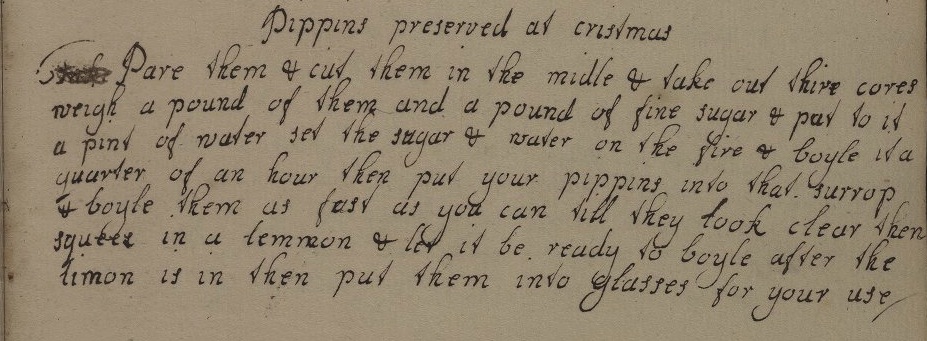
pippins preserved

Pippins preserved at cristmas

Take Pare them & cut them in the midle & take out thire cores
weigh a pound of them and a pound of fine sugar & put to it
a pint of water set the sugar & water on the fire & boyle it a
quarter of an hour then put your pippins into that surrop
& boyle them as fast as you can till they look clear then
squeez in a lemmon & let it be ready to boyle after the
limon is in then put them into glasses for your use /

IMG_4840

Our Recipe

1 lb. apples (~2), peeled, halved, and cored
1 lb. (2 c.) sugar
1 pint (2 c.) water
juice of 1 lemon

Combine sugar and water in a med. saucepan and bring to a boil, cooking for 15 mins.

Add apples and cook them at a steady boil, turning the apples occasionally. (They might want to boil over, so keep an eye on them.) Cook for about 45 mins., until apples are translucent and your kitchen smells delightful. Add the lemon juice and cook for another minute or two. Serve warm or refrigerate.

The Results

These apples are not complicated to make – or to eat! I used up a few apples that were kicking around my crisper after the last round of applesauce, I think a macintosh and a fuji. Both fell apart a bit while cooking, which didn’t bother me, but if you’d like the apples to stay in their halves, a harder variety like a granny smith might work nicely.  The end result tastes of very, very sweet apples, almost honey-like in their intensity. You probably wouldn’t polish off a large bowlful of these. (Which perhaps explains the relatively small yield of this recipe? Perhaps the preserved apples might have been used to flavor other dishes, or have been eaten sparingly on their own for a little taste of something sweet.) I topped them with my favorite maple yogurt to cut through some of the sweetness. With a cup of tea, they made a great breakfast for me and my sweet-tooth.

And while we’re a few days past December 25, as Marissa reminded me, on Christmas day in 1662 Samuel Pepys’ wife was ill, so they celebrated with take-out mince pies and she started making her own “Christmas pies” the next day. Pull a Mrs. Pepys and make these “Pippins preserved at cristmas” well into January.

IMG_4844

To make minceed pyes

I fell in love with mince pies in London on a cold December day. British winters are shockingly raw, wet, and dark to an American visitor accustomed to sharp, east coast wind and bright winter light. These sweet, spiced pies warmed me to my core. Traditional British holiday festivity is full of warmth and spice to combat the cold, the dark, and the damp. The mince pie that converted me was made by my spouse, Joseph,  who also helped me prepare this recipe for “minceed pyes” from Ms. Codex 214, Catherine Cotton’s recipe book that also led us to three interesting gingerbread recipes.

Although most mince pies today start with a base of raisins, currants, and occasionally apples and quinces, mince pies traditionally began with meat. The meat was flavored by these additional fruits, not the other way around. This recipe begins with a “neats tongue,” a calf or beef tongue. Gervase Markham’s starts with a leg of mutton. A mince pie recipe that I considered preparing from MS Codex 252 uses ox cheek. This nineteenth-century cookbook published in Boston even has a mince pie recipe that starts with tongue. I swallowed my reservations, took the trolley to Reading Terminal Market in Philly, and ordered a beef tongue from a butcher.


The Recipe

mince pies

To make minceed pyes

Take a neats tounge parboyle it and mince it very small
put to it a pound of beefe suit and 2 pound of reasons
of the son stoned and minceed very small a quaarter of
a pound of sugar the peal 2 lemmons cut small a little
cloves & mace and nutmeg a quarter of clarret a little
salt mix all this together with 6 or 8 pipings smally shred
and two pouund of currants or as many as you see feet
for your past take a pound and quarter of flower a pound
and a half of butter and put it into water and seet it on
the fire & let it boyle make the past & put in half a pound
of lofe sugar finely beaten & mix it in the flower put in the
yolks of 4 eggs & the whites of 2 so worke it up and
as you fill them put in canded orange & green sittorn
finely cut such as you eate hot when they come out of the
oven put in sume butter & white wine

The recipe begins with instructions for preparing a rich mincemeat: parboiled tongue, grated beef suet (or beef fat), raisins, sugar, lemon peel, pipings (or apples), and currants seasoned with clarret (red French wine from Bordeaux), cloves, mace, nutmeg, and salt. In many ways, this ingredient list is similar to modern recipes for mince pies — fruit, suet/fat, booze, spices, sugar, and citrus. But then there’s that tongue. Tongue is, of course, a staple of many cuisines, but I’d never prepared one before. Luckily Joseph has never balked at an offal challenge and helped me by brining and parboiling the tongue following Fergus Henderson’s recipe from Nose to Tail Eating. This process adds at least three days of brining and three and a half hours of slow boiling to the overall cooking time. Another food blogger has reconstructed the recipe with great photos of the method here.

Once the mincemeat is ready, this recipe calls for an interesting method of pastry making and a final round of seasoning with candied orange and “sittorn” peels (lemon peel), butter, and white wine. Between the lengthy tongue preparations, ingredient sourcing, and making the candied peel, I decided to prepare my favorite pie crust from Orangette instead of trying out this pastry method as well. Although this was really born out of fatigue and convenience, there’s another more pressing reason, too: Early modern pie crusts weren’t always meant to be eaten. In many cases they simply served as a semi-edible container that would preserve meat and other ingredients during extended periods of storage. Ken Albala discusses this in a recent essay where he re-reads Hamlet’s famous statement that  the baked meats from his father’s funeral were served at his mother’s wedding. Sure, Gertrude may have remarried quickly, but baked meat pies were designed for long storage all the same. The instruction to add butter and wine at the very end also tipped us off that this pastry might fundamentally be utilitarian because sealing meat pies with hot fat and alcohol was part of the preserving method. I’ve included an updated version of the pastry recipe below and I plan to revisit it in the future (pastry off?), but we wanted you to have mince pies in time for Christmas!

Our Recipe

Ingredients

Mincemeat:

Our recipe is quartered from the original, but we’ve included the original amounts [in brackets] as they were given in the recipe.

1/2 lb beef or calves tongue, parboiled and chopped. (The tongue we purchased weighed  three pounds. We added 1/4 lb of tongue to half the mincemeat mix.) [1 neats tongue]
1/4 lb (4 oz.) suet (beef fat) [1 lb] substitute in butter or vegetable shortening for a vegetarian version)
1/2 lb (1 1/2 c) raisins [2 lbs]
1/2 lb (1 1/2 c) currants [2 lbs]
2 apples, peeled and chopped very small [6-8 apples]
1/4 c sugar [1/4 lb]
zest of half a lemon [zest of 2 lemons]
1 c claret (or other red wine) [1 quart claret]
1/2 t mace
1/2 t ground cloves
1/4 t nutmeg, ground or grated
1/4 t salt
1/2 c candied orange and lemon peel (We used this recipe from Smitten Kitchen to make ours from two clementines and one lemon.)
1/3 c white wine
2 T butter, cut into small pieces

Pastry:

This is the full recipe. As we discussed above, we made our favorite pie crust from Orangette because of tongue fatigue.

1 1/4 lb flour
1 1/2 lb butter
water
1/2 lb sugar
2 whole eggs
2 egg yolks

Method

Prepare the mincemeat:

Mix together tongue, suet, raisins, currants, apples, spices, lemon zest, sugar, and claret and set aside. Right before you make the pies, add the candied peel, white wine, and butter.

Prepare the pastry:

*We didn’t test this part of the recipe. Feel free to use your favorite pie crust like we did.*
Put your flour in a bowl. Heat the butter and water in a small saucepan until it comes to a boil. Pour into the flour and stir until a dough forms. Add the sugar and eggs. Mix until your have a workable pastry.

Make pies:

Preheat the oven to 425 F.

Roll out the pastry. Using a pastry cutter or drinking glass, cut circles. We used a 2 5/8 in (68 mm) pastry cutter to make nice little pies. Make sure you have an even number of circles so that you have bottoms and lids for all your pies.

Butter two-three baking sheets. Put 2 t mincemeat on each bottom. (Remember to add the candied peels, white wine, and butter to the mincemeat just before!)

Place a lid on each pie. Push down the edges of the pastry to seal. Poke a few air-holes in the lid with with a fork. We brushed the top with an egg wash for a golden crust, but this step is optional.

Bake mince pies for 10-15 minutes until golden brown. Sprinkle with powdered sugar to serve if you want these to look especially festive.

This recipe made 25 mince pies with enough leftover mince meat to make another full batch.

The Results

These mince pies are delicious: spicy, fatty, and subtly sweet. We divided our mincemeat into two batches, one with and one without the tongue. The pies with the tongue were deeply meaty, but the currants, raisins, and apples held their own to compliment the umami flavors. The pies without tongue were very fruity. They tasted really similar to mince pies I’ve made before from Nigella Lawson’s recipe, which includes quinces in the mix. (There’s a version of that recipe on this blog.)

Next time, I’ll add more mace, cloves, and nutmeg. I might add the candied peel and white wine to the mincemeat from the beginning.  On the other hand, I might leave out those last 2 T butter which felt extraneous. We also have a ton of leftover mincemeat in the fridge. I’m excited to see how the next batch tastes after the flavors marry for a bit longer. There’s a Christmas tree that needs trimming and there’s nothing like eating holiday baked goods and making the house merry.

Alyssa and I would like to thank Joseph Malcomson for rising to the tongue challenge and helping us devise and prepare this recipe.

To make good Gengerbread

Last week, Marissa and I were very pleased to give a talk on “Shakespeare’s Kitchen” at the Folger Shakespeare Library, part of its Free Folger Friday series. Good timing: the foundations of Shakespeare’s kitchen area at New Place in Stratford-upon-Avon were discovered by an archaeological team (!) just the week before. We cooked up a few new recipes for the event. Now, it’s been suggested that I might be a rabid fan of the Christmas season. I think I’m just enthusiastic. (Typed while looking at the decorated pine branches on my bookshelves [my version of a tree] and listening to Bing Crosby. Ok, fine. Very enthusiastic.) So, we decided to be seasonally festive with these recipes. Along with the (awesome) hot chocolate mix that Marissa will be sharing soon, we investigated early modern gingerbread.

For the gingerbread mission, I turned to a new – to us – recipe book: UPenn Ms. Codex 214.  Both the front and back covers are embossed with the original owner’s name, and the inscription includes a date, so we know that the book originally belonged to Catherine/Catharine Cotton and was compiled starting around 1698. We’ll definitely be revisiting this collection, which contains a range of appealing recipes – including the poached apples I have my eye on next. Cotton’s book turned out to be well-suited to this particular mission, as it contains three gingerbread recipes: one with honey and candied peel, one with brown sugar and milk, and one with treacle and caraway seeds.

Gingerbread as a dessert began appearing in Europe around the fifteenth century, originally as a mixture of breadcrumbs held together with honey and ginger, then shaped using molds. At Queen Elizabeth I’s court, gingerbread was baked into the shape of people and decorated to look like visiting foreign dignitaries – the first gingerbread men! In the late seventeenth century, ginger would have been imported into England (most likely from Jamaica, the Spice Islands, or India) as the whole root, sometimes pickled. That Cotton’s book includes not one but three recipes for gingerbread indicates ginger’s availability and the treat’s popularity by 1698.

IMG_4822


The Recipes

CC 45r

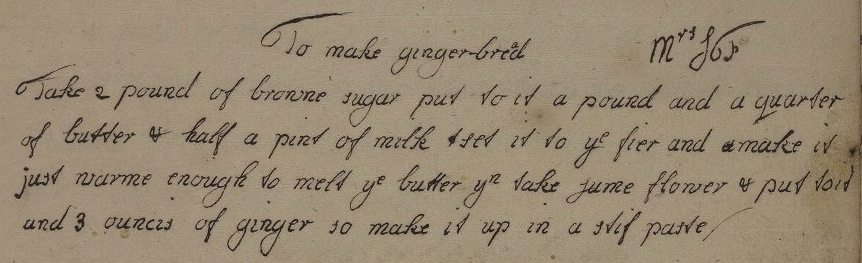
To make ginger-bread                               Mrs JT

Take 2 pound of browne sugar put to it a pound and a quarter
of butter & half a pint of milk tset it to the fier and amake it
just warme enough to melt the butter then take sume flower & put to it
and 3 ouncis of ginger so make it up in a stif paste /

CC 43r

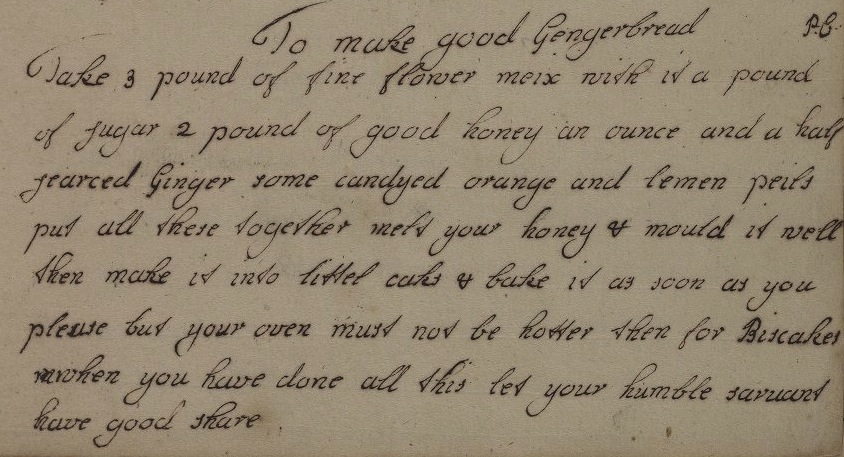
To make good Gengerbread                                      P.C.

Take 3 pound of fine flower meix with it a pound
of sugar 2 pound of good honey an ounce and a half
searced Ginger some candyed orange and lemen peils
put all these together melt your honey & mould it well
then make it into littel caks & bake it as soon as you
please but your oven must not be hotter then for Biscakes
mwhen you have done all this let your humble saruant
have good share


Our Recipe: “To make ginger-bread”
[quartered from original*]

1 1/4 c. brown sugar
10 tsp. butter
1/4 c. milk
2 c. flour
3/4 oz. fresh ginger, peeled and minced (about 1″ ginger root)

Combine sugar, butter, and milk in medium saucepan and cook over low heat, stirring frequently, just until butter is melted. Remove from heat. Add ginger, then stir in flour in two batches.

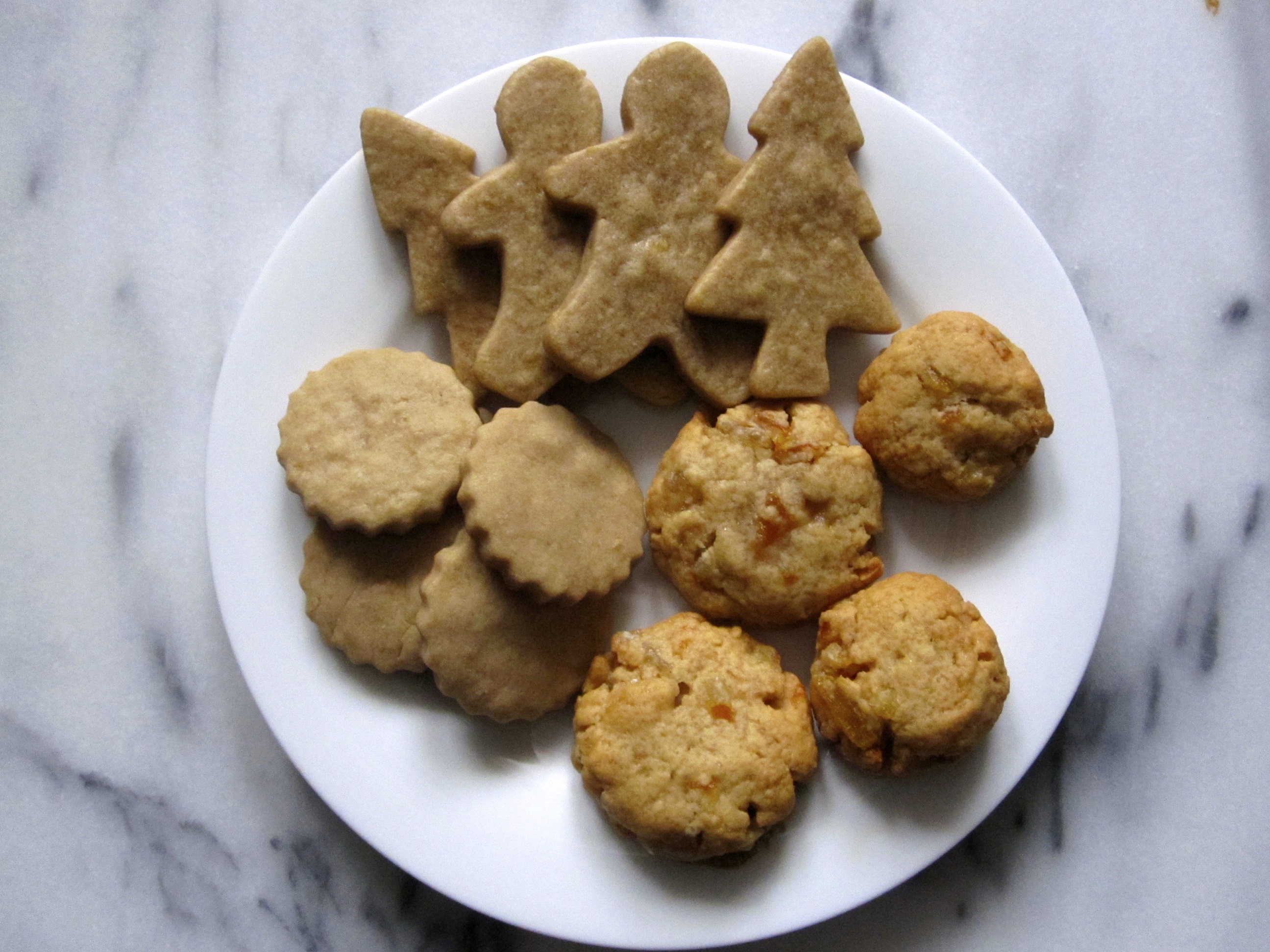
To use immediately**: Scoop dough in tablespoon-sized balls. Flatten slightly with fingertips or bottom of a water glass.

To roll out***: Pat dough into a disc, wrap in plastic, and refrigerate at least 2 hours or overnight. Roll to 1/4″ thickness on a floured board and cut out in shapes.

Both methods: Bake at 350F for 12 mins., until bottoms are golden brown. (Tops will look slightly puffed but won’t take on much color.) Remove from baking sheet and cool on a wire rack. Makes ~2-3 dozen cookies.

*I halved the recipe and ended up drowning in gingerbread cookies – over 50 of them! Quartering the recipe makes for a more reasonable yield, but it can easily be scaled back up if you’re in need of gingerbread for days.

**The recipe implies that the dough can be used right away. However, I’d added enough flour that it was starting to taste bland and the dough was still fairly soft and sticky. I knew I wouldn’t be able to roll it out, so I scooped it into balls and experimented with flattening some of them. The flatter the discs, the better they baked – the scoops left round didn’t have the nice bite that the thinner cookies did.

***”Paste” can stand in for our modern “pastry” in these cookbooks, so it didn’t seem unlikely that the original could have been rolled and cut out. To manage this, I refrigerated the dough, which made it much easier to handle. In fact, it rolled and baked up beautifully – this is definitely my preferred method for this recipe.

Our Recipe: “To make good Gengerbread”
[quartered from original]

2 1/2 c. flour
1/2 c. sugar
1 c. honey
~1 c. candied peel (2 oranges + 1 lemon), roughly chopped****

Combine flour, sugar, and honey in a large mixing bowl, using a spatula or (as I did) your hands. Add the peel and make sure it is evenly distributed through the mixture. The dough will be very crumbly.

Using a scoop or soup spoon, take about 1.5 tbsp. of dough at a time and squeeze/pat it into a flattened ball. Bake cookies at 350F for 15-18 mins., until lightly browned and fragrant.

****Candied peel is an ingredient we run into frequently in these early modern recipes. As we’ve discussed with some readers, candied peel is readily available in British supermarkets but not in most American ones, so we sometimes end up substituting zest to approximate the taste (if not texture) of the citrus peel. For the gingerbread, however, I wanted to see how the peel would work with the ginger and also thought the sticky peel might help these crumbly cookies hold together, so I made my own using this recipe.


The Results

One winner, one respectable second-place finish! The “ginger-bread” gingerbread was surprisingly flavorful, given its short list of ingredients: there’s a LOT of sugar and butter and ginger in there, but they all meld well together, perhaps mellowed by the addition of milk, and these were neither overwhelmingly sweet nor too gingery. (I might even increase the ginger next time, maybe throw in 1/2 tsp. of powdered ginger to add some bite.) As noted above, I experimented with making these into balls, discs, and cut-out cookies. They all worked, but the cut-out cookies baked uniformly and had a good bite while retaining some softness. I’ll use this method from now on.

The “Gengerbread” gingerbread turned out to be tasty toothbreakers. Because the original recipe suggests melting the honey, I’m guessing that honeycomb might have been used here, and that the wax would have helped as both a binding and softening agent. I didn’t have any honeycomb, but I did have an old(ish) jar of honey waiting to be used – good enough. I had to add slightly more honey than called for to get the dough to hold together. They were still fairly dry and VERY hard. (I made them in two sizes and found the smaller cookies even more difficult to bite into than the larger ones!) Some gnawing was require on the first day, though they softened over the next few days. (And, as was helpfully suggested at the Folger talk, you could put a slice of bread or apple in the container with them to speed this softening process.) I like the candied peel + ginger combination very much – in fact, you taste the honey and the citrus more than the ginger here, which is interesting. I probably won’t be making these exact cookies again because I’m not sure my teeth can handle it, but I might play with adding honey and/or candied peel to some other gingerbread recipes.

Will I abandon the family gingerbread recipe that I make every year? Not a chance. But making these two recipes – I’ll report back on the third once I acquire some treacle – introduced me to some new gingerbread ideas and highlighted the variety available in just one recipe book. And the room to play with different techniques. In this project, not being given a specific method can nerve-wracking – particularly for someone who likes to follow very precise baking instructions. (See: me.) But it’s also liberating. There’s room for creativity, fun, and experimentation in the ambiguity. I’m looking forward to seeing what else is in Cotton’s book. Stay tuned.