Carrot Pudding

Carrot cake is generally a crowd-pleaser. But carrot pudding? When we found this recipe in UPenn Ms. Codex 631, we were intrigued. We also wanted to try a pudding simply because we’ve found so many of them in early modern recipe books. Puddings may have been the eighteenth-century equivalent of the recent cupcake craze.

This two-volume recipe book is dated 1730 (vol. 1) and 1744 (vol. 2) and belonged to Judeth Bedingfield, though it contains the handwriting of multiple persons. The carrot pudding recipe comes from the first volume, which includes not only other recipes for cooking – pickled pigeon, for instance, “quaking pudding,” quince cream, and many more – but also for making various kinds of wine and cordials and for household remedies for ailments like colic. It provides a wonderful example of the range of recipes that early modern recipe books can include. (In fact, stay tuned for when we make our way through some of its other recipes in Ms. Codex 631!)
carrot pudding

The Recipe

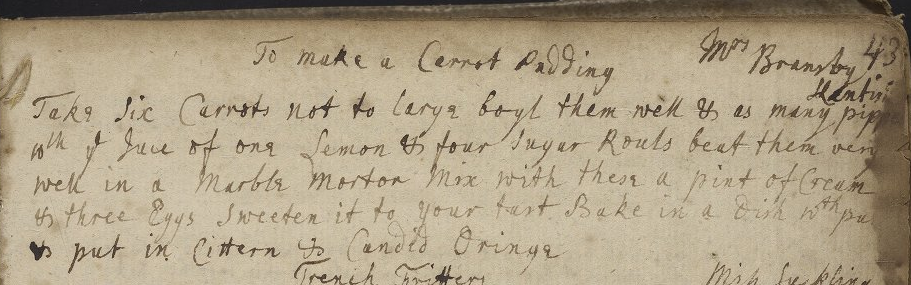
To make a Carrot Pudding    Mrs Bransby Kent[xxx]

Take six Carrots not to large boyl them well & as many pip[pins]
with the juce of one lemon & four sugar rouls beat them very
well in a Marble Mortor Mix with these a pint of cream
& three Eggs Sweeten it to your tast Bake in a dish with pu[xxx]
& put in Cittern & Candid Oringe

The corner of the recipe is damaged, but comparing this to other contemporary carrot pudding recipes confirms the “pippins” in the ingredients. “Cittern” is not defined in the OED as anything other than a stringed instrument, so unless the writer was garnishing this pudding with a very surprising ingredient, “cittern” probably means citrus, probably candied or preserved. We could have tracked down candied peel for the “Candid Oringe” but concluded that zest would impart a similar taste. If you happen to have candied peel readily available to you, 1) we’re jealous, and 2) it would probably be great here.

In our modern kitchens, we’re used to pulling out granulated sugar rather than the sugar loaves or rolls that early modern cooks would have used. But Marissa happened to have some minimally-processed “panocha” cane sugar rolls in the pantry that we wanted to try here. We ended up grating a fraction of one roll – hard work for just a sprinkling of sugar! Rather than continuing the arm workout, we used primarily granulated cane sugar.


Our Recipe

{We were somewhat unsure of how much we would enjoy carrot pudding, so we halved the recipe. And even though we did enjoy it, this amount still works well, as it fills two-thirds of a standard pie dish. We also added cinnamon and ginger because we suspected that they’d work here, and they do; any spices you would add to a pumpkin pie would also work.}

3 carrots, peeled and chopped roughly

2 apples, peeled and chopped roughly (*we used Macintosh apples but might try a tarter variety like Granny Smith next time)

1/4 – 1/3 c. sugar (start with 1/4 and add more if necessary)

1/4 tsp. cinnamon

1/2 tsp. ground ginger

scant 1/2 pint heavy cream

2 eggs

zest and juice of 1/2 lemon

zest of 1 orange

Preheat oven to 350F; butter a pie dish or other ovenproof dish.

Boil carrots for ~8 mins. or until tender; add apples for last 2 mins.

In food processor or blender, puree carrots, apples, sugar, zests, cinnamon, and ginger. Then add cream, eggs, and lemon juice; blend until smooth.

Pour carrot mixture into dish and bake 30-40 mins., until set. (It will be slightly more wobbly than baked pumpkin pie filling.)

Serve at room temperature or chilled.

The Result

Very orange. And surprisingly pleasant: the apples, citrus, and spices balanced the vegetal base of the carrot. The consistency was somewhere between a pumpkin pie filling and a flan: firm enough to hold its shape when sliced, but jiggly enough that a few dollops ended up on the floor between pie dish and plate. (Oops.) We might bake it in a pie crust next time, or add another apple to the mixture, or perhaps roast the carrots and apples before pureeing them for additional depth of flavor. Adding some pureed carrots to a pumpkin pie base might also work well.

We assume that there will inevitably be a few recipes in this project that we make out of curiosity, gulp down a taste or two, agree that it’s “interesting” (with air quotes), and then continue on with our culinary lives, never to make it again. But carrot pudding does not make that list.

Could Possett

CookingArchives-4092

Photo by Carley Storm Photography http://www.carleystormphotography.com

In the heat of the Philadelphia summer, we’ve been on the lookout for refreshing beverage recipes to prepare alongside hearty, early modern fare. “Could Possett,” a boozy herbaceous lemonade, hit the spot.

This recipe comes from UPenn Ms. Codex 252, an all-purpose household manuscript that was in use between 1600 and 1710. Food recipes are intermixed with medicinal recipes throughout the manuscript.

The Recipe

could posset

To make Could Possett

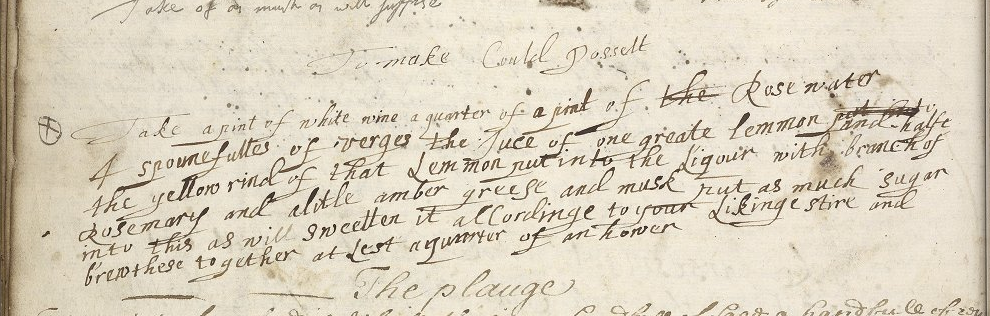
Take a pint of white wine a quarter of a pint of the Rose water
4 spounefulles of verges the Juice of one greate lemmon put into and halfe
the yellow rind of that Lemmon put into the Liqour with branch of
Rosemary and alitle amber greese and musk put as much sugar
into this as will sweetten it accordinge to your Likinge stire and
brew these together at Lest a quarter of an hower

Just as Ms Codex 252 is a mix of medicinal and culinary recipes, so too does the “Could Possett” straddle the categories between comestible and cure. In William Shakespeare’s Macbeth, Lady Macbeth informs the audience that she has incapacitated King Duncan’s guards by contaminating their posset: “The surfeted Groomes doe mock their charge / With Snores. I haue drugg’d their Possets” (1623). Robert Herrick’s poem “To Phillis to love and live with him” promises a beloved posset, among other delicacies: “Thou shall have Possets, Wassails fine, / Not made of Ale, but spiced Wine” (1648). The Oxford English Dictionary defines a “posset” as a “drink made from hot milk curdled with ale, wine, or other liquor, flavoured with sugar, herbs, spices, etc., and often drunk for medicinal purposes.” Recipes for “ordinary plain wholesome posset” and “sack posset” in Ms Codex 252 fit this description well. Our “could possett” recipe does not call for hot, curdled milk, but it does bear a resemblance to some of the other medicinal waters in the volume.

This recipe calls for a few relatively exotic ingredients. “Verges,” or “verjuice,” is a sour beverage made from immature grapes that is still available today, but somewhat difficult to find. We found our posset to be quite tart without adding the verjuice. “Amber greese,” or ambergris, and musk are both more associated with scent and perfumery these days than with beverages, although they were widely used in punches and tinctures in the early modern era. We debated adding angostura bitters instead, but decided that the rosemary and rose water were sufficiently flavorful on their own. Since wine was far sweeter in the seventeenth century than it is today, we used a fairly sweet prosecco that we had on hand as as the base alcohol for the drink. It also added some festive bubbles! For a tasty, alcohol-free version of this recipe, substitute a liter of sparkling water, tonic water, or fine ginger ale for the wine and adjust the sugar accordingly.

Our Recipe

serves 8

1 bottle white wine, on the sweet side (still or sparkling)

1/4 cup rose water

juice of one lemon

peel of half a lemon, cut into long strips

4 sprigs of rosemary

1/2 cup sugar (adjust to taste)

Mix the ingredients in a large serving jug or punch bowl. Stir until the sugar dissolves. Taste to check sugar levels and adjust as needed. Allow to sit for 15 minutes before serving.

The Results

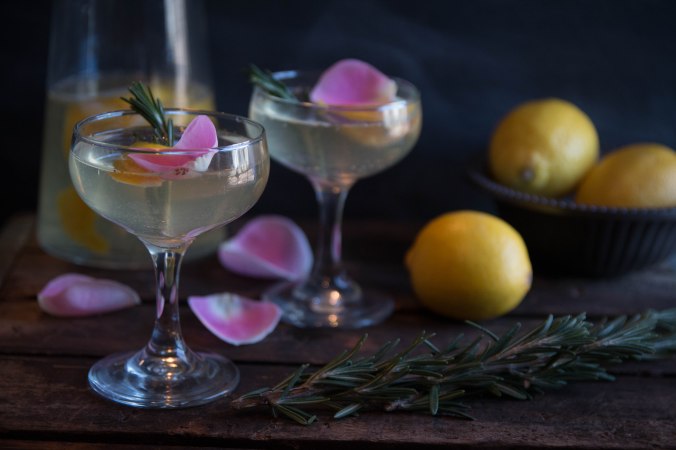
A tart, highly quaffable summer beverage. It looks lovely in the glass and stands up to flavorful food. We sipped it alongside Maccarony Cheese  and a side of bitter greens. The wine and lemon flavors dominated, while the rosemary and rosewater added fresh, vegetal notes. This is a great recipe for a summer picnic, barbeque, or dinner party.

Maccarony Cheese


CookingArchives-4288

Photo by Carley Storm Photography http://www.carleystormphotography.com

For our inaugural recipe, we thought, why not start with an eighteenth-century mac-and-cheese?  It’s a modern-day American classic and perhaps the ultimate comfort food.

This recipe comes from UPenn Ms. Codex 1038, a collection of recipes most likely written and bound between 1765 and 1830. (Thanks to Mitch Fraas for pointing us to this particular “maccarony cheese.”)

The Recipe

Maccarony Cheese

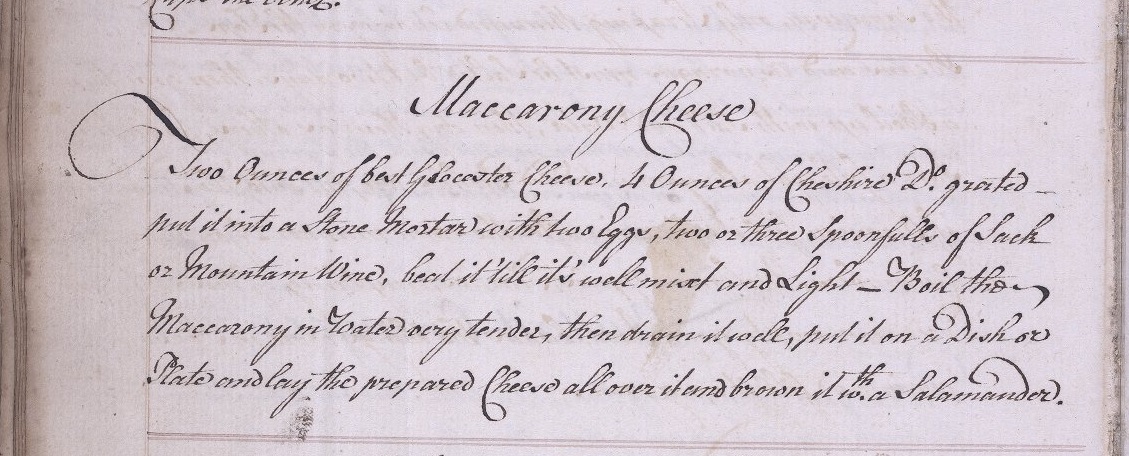
Two Ounces of best Glocester Cheese, 4 Ounces Cheshire Do. grated – put it into a Stone Mortar with two Eggs, two or three Spoonfulls of Sack or Mountain Wine, beat it ’till it’s well mixt and Light – Boil the Maccarony in Water very tender, then drain it well, put it on a Dish or Plate and lay the prepared Cheese all over it and brown it with a Salamander.

This recipe, unlike some others to be featured, discussed, and puzzled over here in the next few months, features no ingredients that are mysterious, challenging to obtain, or downright unappetizing. Cheese, eggs, and macaroni are all familiar. Even sack wine can be approximated. Defined in Samuel Johnson’s 1737 Dictionary as “A kind of sweet wine, now brought chiefly from the Canaries.” Also known as “Canary wine,” sack identified a few varieties of sweet, fortified light wine. One of these later became known as “sherry,” so sherry is what we turned to here. For Gloucester cheese, we substituted a sharp, aged cheddar; for Cheshire, a milder cheddar.

Note that although the recipe provides specific measurements for all ingredients of the cheese sauce, the amount of macaroni is left unspecified. Based on the amount of cheese sauce, we determined that approximately half a pound of pasta (ex. fusili) would most likely have been used.

Early modern cooks used salamanders to brown dishes. A salamander was a piece of cast iron with a handle attached; it would be heated in the fire and then held on top of a dish to warm it. Essentially, a salamander was a hand-held broiler. We debated using a culinary torch but decided that an oven would provide more even cooking.

So, our modern version of the recipe looked like this:

2 oz. sharp/dry cheddar

4 oz. mild cheddar

2 eggs

2 tsp. sherry

8 oz. dried pasta

Heat oven to 350F.

Grate the cheeses and beat together with eggs and sherry. Add salt and pepper to taste. Cook and drain pasta.

Transfer pasta to oven-proof dish and evenly distribute cheese sauce over the top. Bake for 15-20 minutes, until cheese is melted and lightly browned.


The Results

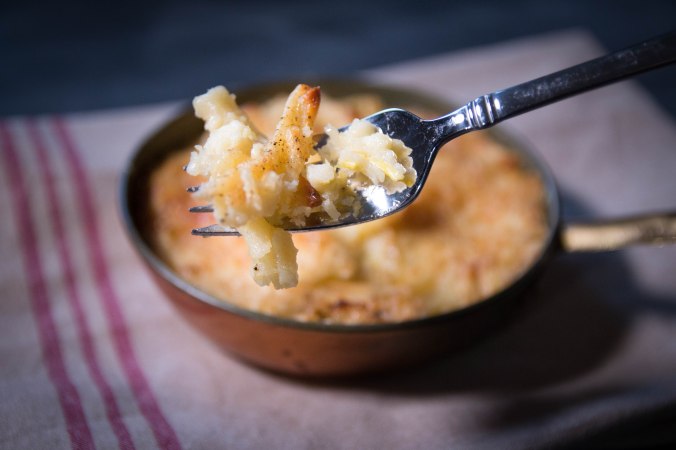
In a word: delicious. The eggs cooked with the cheese to form a dense, satisfying mac-and-cheese that was remarkably easy to make. And the sherry flavor came through in a unique, rich way. We both agreed that this would be an easy way to throw together a pasta dish for one or two people, using up any scraps of cheese. Even more impressive: unlike many modern recipes for mac-and-cheese, this one does not involve any milk or heavy cream.