To stew Pease the French way

When I’m not cooking archival recipes, I eat a lot of greens. Kale, spinach, chard, green beans, peas, escarole, cabbage, broccoli, or lettuce feature in most of my meals. But many of the vegetable recipes in the manuscripts we’ve consulted are for preserving vegetables for future use. We baked peas into a tart and pickled tomatoes, but we’ve featured fewer fresh vegetable dishes, like herb soup and this recipe “To stew Pease the French Way.” Alyssa and I were both excited to find this recipe for peas and cabbage in MS. Codex 644, a manuscript connected to the Frankland family that we’ve turned to for “Cheap Soupe” and “Oven Cakes.” We were also inspired by the note, “Excellent,” under the title.

If you’re looking for a new way to eat your greens, a recipe to use up that partial head of cabbage lingering in your fridge,  or even searching for a last-minute Thanksgiving side, read on!

The Recipe

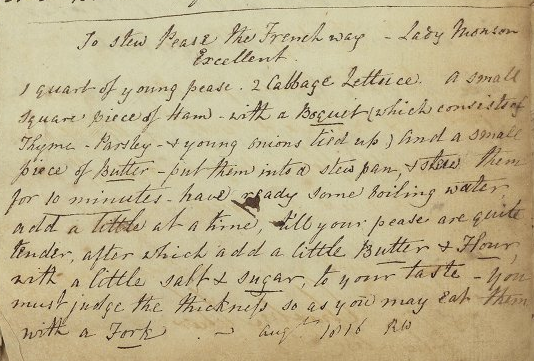
pease the french way

To stew Pease the French way – Lady Monson
Excellent.
1 quart of young pease. 2 Cabbage Lettuce. A small
square piece of Ham – with a Boquet (which consists of
Thyme – Parsley – & young onions tied up) and a small
piece of Butter – put them into a stew pan, & stew them
for 10 minutes – have ready some boiling water,
add a little at a time, till your pease are quite
tender, after which add a little ButterFlour,
with a little salt & sugar, to your taste – you
must judge the thickness so as you may Eat them
with a Fork. ~ Aug[u]st. 1816 RLS

The bundle of herbs and smoky meat pair beautifully with the sweet peas and the savory cabbage. The addition of a roux thickens the cooking liquid into a delicious sauce.

The source of the recipe, “Lady Monson” may be Lady Anne Monson (1726-1776). Monson traveled to India soon after marrying Colonel George Monson of Lincolnshire in 1757 and spent her last decades living in Calcutta and traveling South Asia collecting botanical specimens. It’s tempting to link the Monsons and the Franklands given their shared history in India and South Asia, but I have not been able to confirm the connection.

Our Recipe

1 quart (4 c.) peas, fresh or frozen
1 large green cabbage, sliced thinly
4 stalks thyme, 4 stalks parsley & 4 scallions, tied up with butcher’s twine
1 slice ham or 2 slices bacon, chopped into small pieces
3 T butter (1 first, 2 for roux)
1/2 c. boiling water
2 T flour
salt and pepper to taste

Brown ham or bacon in butter.
Add cabbage, peas, herb bouquet, water, salt, and pepper. Cook for 5 minutes.
Blend 2 T butter, softened and flour, add slowly to the vegetable mix. Cook for 5 more minutes until the vegetables are cooked, but haven’t lost all their crunch.

(You may need to adjust the cooking time if you are using frozen peas.)

The Results

This is a delicious way to eat your peas. We chopped up the scallion and parsley to garnish our servings and I liked the bites that included the herbs best. You could easily leave out the smoky meat to make a vegetarian version of this dish. Smoked salt or a sprinkle of paprika might add that savory note to a vegetarian version.

We also think this would taste delicious with roast turkey, potatoes, and stuffing, which is why we’re sharing this recipe with you today. Let us know how it turns out, whenever it happens to grace your table!

Rice Pudding Two Ways 

We wrote a version of this post over on The Recipes Project.

Rice pudding is simple. Neutral in color and mild in taste, rice pudding has a minimal list of ingredients and always pleases a crowd. It’s also familiar – most of us have  encountered rice pudding at one time or another. So, when we kept seeing lists of rice pudding recipes in manuscript recipe books from many centuries, we wondered: why rice pudding? And what, if any, differences were there between past and present versions? So, we decided to make not one but two distinct rice pudding recipes. A rice pudding face-off!

While in the twenty-first century the ingredients required to make rice pudding are pantry staples – rice and sugar are readily available, as is dairy – in seventeenth- and eighteenth-century English households, rice pudding was probably a more exotic affair. After all, England does not produce any of its own rice. We asked another question: where did this rice come from?

This sent us on a hunt for early modern England’s rice suppliers. Today, as in the past, the majority of the world’s rice is produced in Asia. Until the later decades of the seventeenth century, England’s rice came from Asia through overland routes or through overseas trade. (For more information, see Renee Marton’s Rice: A Global History and Rice: Global Networks and New Histories, ed. Francesca Bray et al.) The rice that made its way into England’s kitchens in the later seventeenth and eighteenth centuries would likely have come from British colonies in South Carolina. Carolina Gold Rice was developed from African seed stock and is distinct from Asian varieties.* It thrived in the Low Country, anchored South Carolina’s economy, and was largely cultivated by African slaves. Scholars of American history and food are currently debating the theory of “Black Rice,” first proposed by Judith Carney, which argues for the centrality of West African women’s agricultural knowledge to the successful cultivation of rice in the Carolinas. *[Correction: Naomi Duguid pointed out that Carolina Gold Rice is neither from Africa nor indigenous to the Americas. It most likely arrived on a ship from Madagascar or the East Indies. See her book, The Seductions of Rice, on this topic.]

Chefs and food writers often refer to this meeting of cultures, climates, and ingredients as the Carolina Rice Kitchen. Rice was the foundation of a local cuisine and an important export. Non-aromatic but nutty, Carolina Gold Rice was world-renowned. The PBS show Mind of a Chef included this animated history of Carolina Rice in an episode where Chef Sean Brock makes a passionate case for recovering lost food traditions. For more information about Carolina Gold Rice and southern heritage foods, take a look at these resources: Carolina Gold Rice Foundation, the Southern Foodways Alliance, Anson Mills, and food historian David Shields’ new book, Southern Provisions. The recipes we decided to cook for this rice pudding-off were both included in manuscripts from a particular historical moment: the moment when the rice supply-chain changed and Carolina Gold Rice arrived in England’s kitchens.

Our rice puddings come from LJS 165 and MS Codex 631. Each recipe is just one in a cluster of rice pudding recipes, demonstrating cooks’ variations on a base recipe that we’ve seen with other dishes like jumballs and syllabubs.  (Rice pudding could also be turned into other recipes: two rice pudding recipes in MS Codex 631 include instructions for adapting them to almond puddings instead.) For contrast, we chose to cook one recipe that started with whole rice and another that used rice flour as a base.

Indeed, we were intrigued, even surprised, to see rice flour in an eighteenth-century recipe. More and more modern cookbooks are exploring a wide range of flours, but what was the place of rice flour in early modern cooking? Rice flour (often “rice flower” or “flowre”) was used as a thickening agent in a range of early modern dishes. Seventeenth-century print cookbooks like The Compleat English and French Cook (1690) and Joseph Cooper’s The Art of Cookery (1654) both call for rice flour in “Cream with Snow” (sweetened cream thickened with rice flour and eggs, then topped with more cream). They also use rice flour in Almond Cream and Rice Cream, as does The Compleat Cook (1694), which also provides a recipe for “Custard without Eggs” using rice flour. The Gentlewomans Cabinet Unlocked (1675) tells how to make Rice Milk. Other rice flour puddings can be found; some add chopped dates and/or currants to the mixture, while others top the pudding with a pastry crust. The use of rice flour as a thickening agent continued well into the eighteenth century: print cookbooks like A Collection of above Three Hundred Receipts in Cookery, Physick and Surgery (1714), The Court and Country Confectioner (1770), and Amelia Chambers’ The Ladies Best Companion (1775?) often use rice flour in cheesecakes and in the filling for chocolate tarts.
IMG_4764

The Recipes

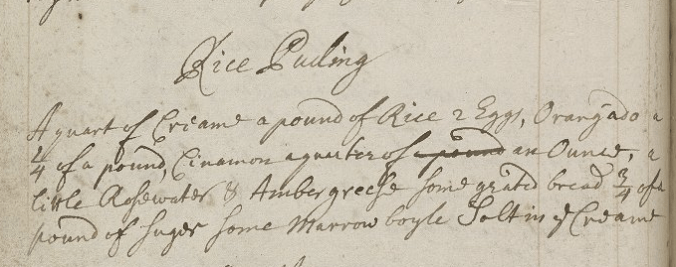
A whole grain rice pudding from LJS 165.
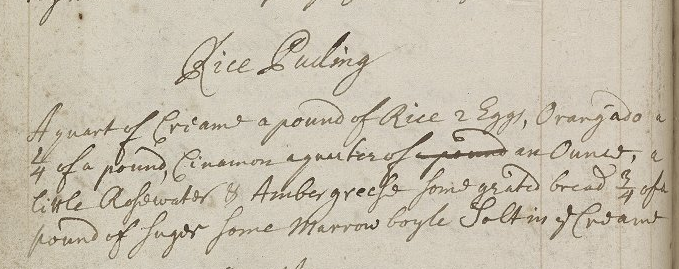
rice puding

Rice Puding
A quart of Creame a pound of Rice 2 Eggs, Orangado a
1/4 of a pound, Cinamon a quarter of a pound an Ounce, a
little Rosewater & Ambergreese some grated bread 3/4 of a
pound of suger some Marrow boyle Salt in the Creame

Apparently it is still trendy to flavor rice pudding with cinnamon and orange because a quick search turned up this Food Network recipe. I made two small changes to this recipe: I halved it (and it still made a huge amount) and I didn’t add aromatic ambergris and bone marrow to the mixture.  In retrospect, I also wonder if a combination of milk and cream might work better here than cream and the water I added to stop the rice from sticking. After all the talk about Carolina Gold Rice, I’m almost ashamed to admit that I tried this recipe with Jasmine Rice instead. It’s what I had to hand and it worked, although I’m sure Carolina Gold Rice would add a distinctly nutty flavor to the pudding.

2 cups heavy cream
2 cups water
3/4 cup sugar (3/8 lb. or 165 g.)
1/2 tsp. cinnamon
1/2 tsp. rosewater
1/4 tsp. salt
3-4 strips of orange peel
1 cup and 2 tbsp. rice (1/2 lb. or 225 g.), preferably Carolina Gold Rice
1 egg
1 small piece of bread, grated. Or 2 tbsp. bread crumbs.

Heat the cream, sugar, and seasonings: cinnamon, orange peel, and rosewater.
Add the rice and bring to a boil. Cover and cook for 45 min-1 hour until the rice is tender. Stir frequently (every 5-10 minutes) to keep the rice from sticking. Add additional water if the  liquid is very low and the rice is still hard.
When the rice is cooked, stir in the egg and bread. Cook for 5 more minutes.


Rice flour puddings from MS Codex 631.

rice flour pudding

To Make a Rice Pudding

Take six ounces of Rice flower a quart of milk set them over [th]e fire & stir them well
together while they are thick, then put in half a pound of Butter six eggs one nutmeg sweeten
it to y[ou]r tast, Buter y[ou]r Dish that you Bake it in /

I halved this and used ground nutmeg because that’s what I had; otherwise, I followed the original recipe closely.

3 oz. rice flour (~1/2 c.)
2 c. milk
1 stick butter, diced
3 eggs
1/2 tsp. nutmeg
1 tbsp. sugar

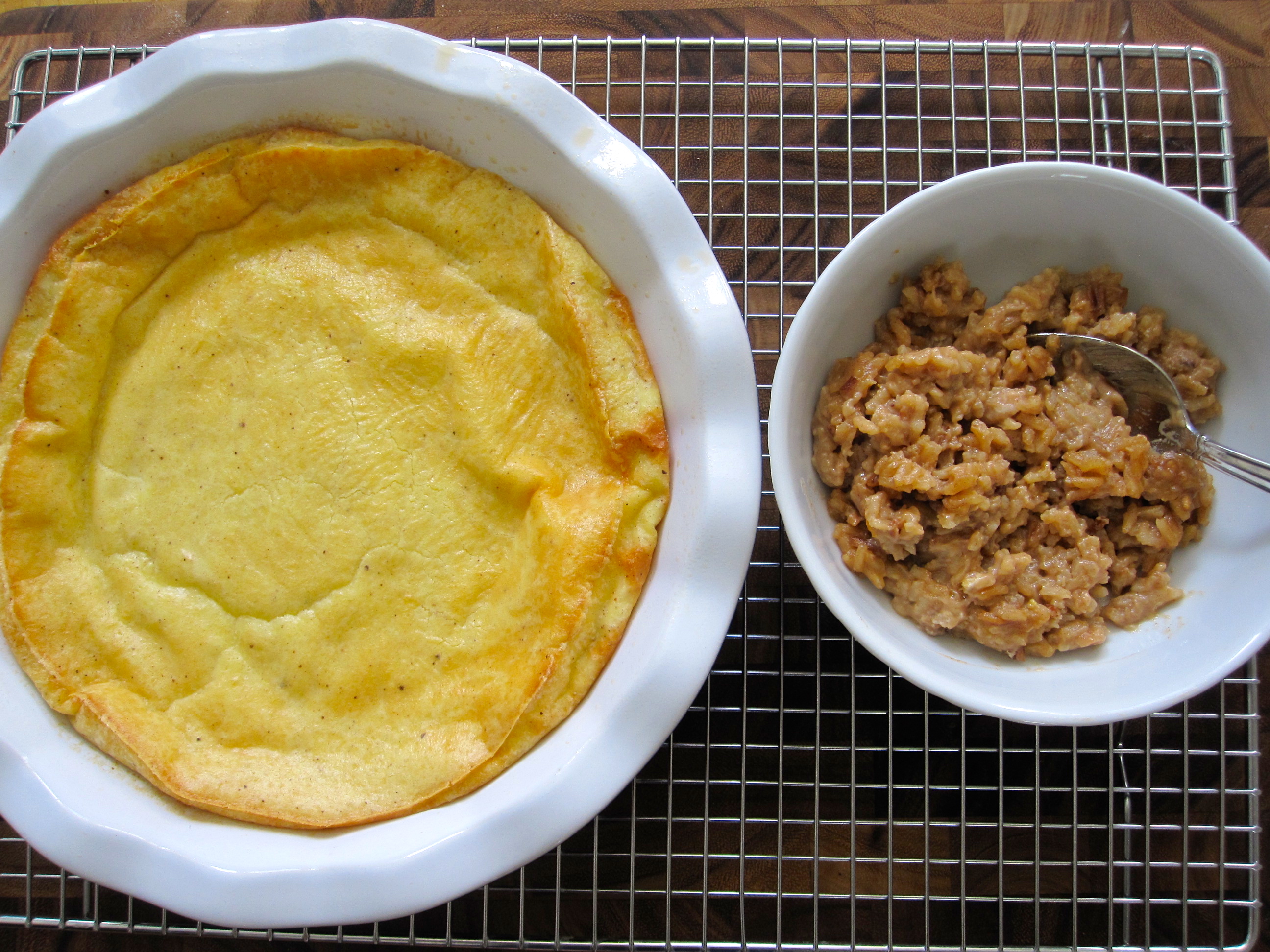
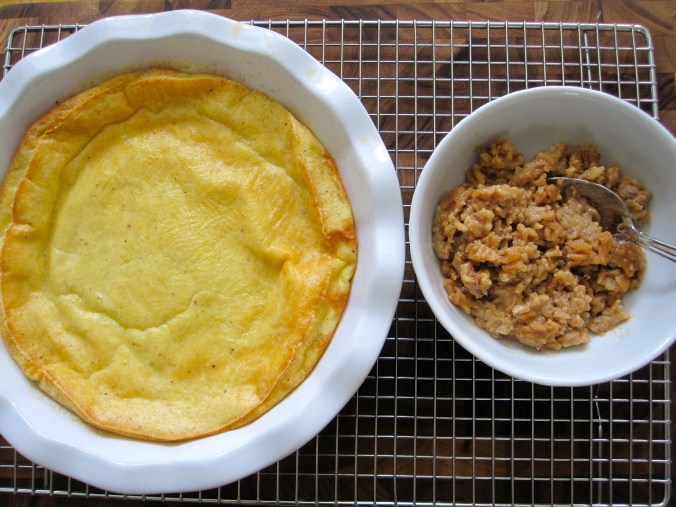
Preheat the oven to 350F and butter/spray a 9″ pie dish or similar baking dish. Combine the rice flour and milk in a saucepan; cook over low-med. heat, whisking frequently. The mixture will thicken quite suddenly, so be attentive! Off the heat, stir in the butter, eggs, nutmeg, and sugar. Bake for 40 mins., until top is puffed and golden brown. Let cool on a wire rack and serve warm or at room temp.


 The Results

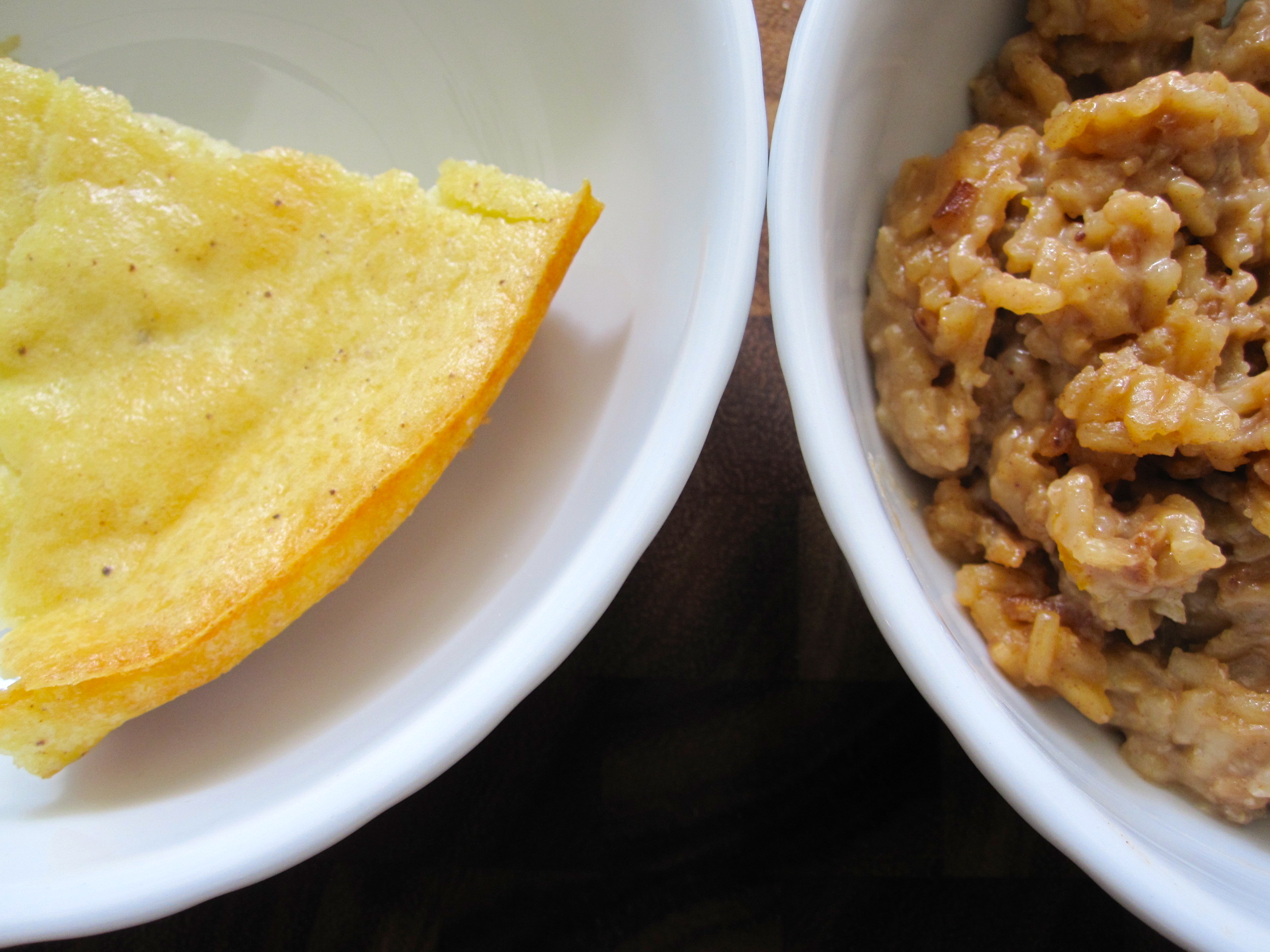
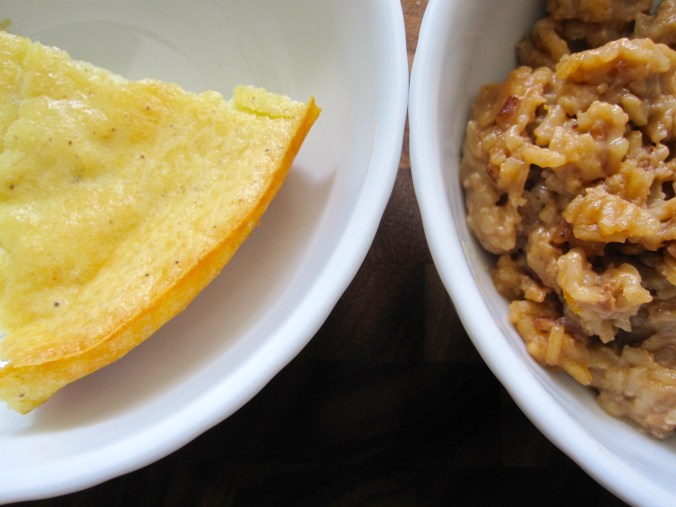
Our rice pudding-off was a success! These rice pudding couldn’t look or taste more different. The “whole grain” rice pudding  from LJS 165 is toothsome, with surprising depth of flavor from the caramelized  sugar and rosewater. The cinnamon adds a spicy note, but the orange flavor is harder to identify. We might switch out the rosewater for orange flower water next time. (If you are not a fan of rosewater, you can probably leave it out altogether.) This rice pudding is especially thick. Even before we added the egg and the grated bread the mixture was already dense. The eggs and bread may have been intended to add bulk to the dish, as rice was certainly more expensive than stale bread!

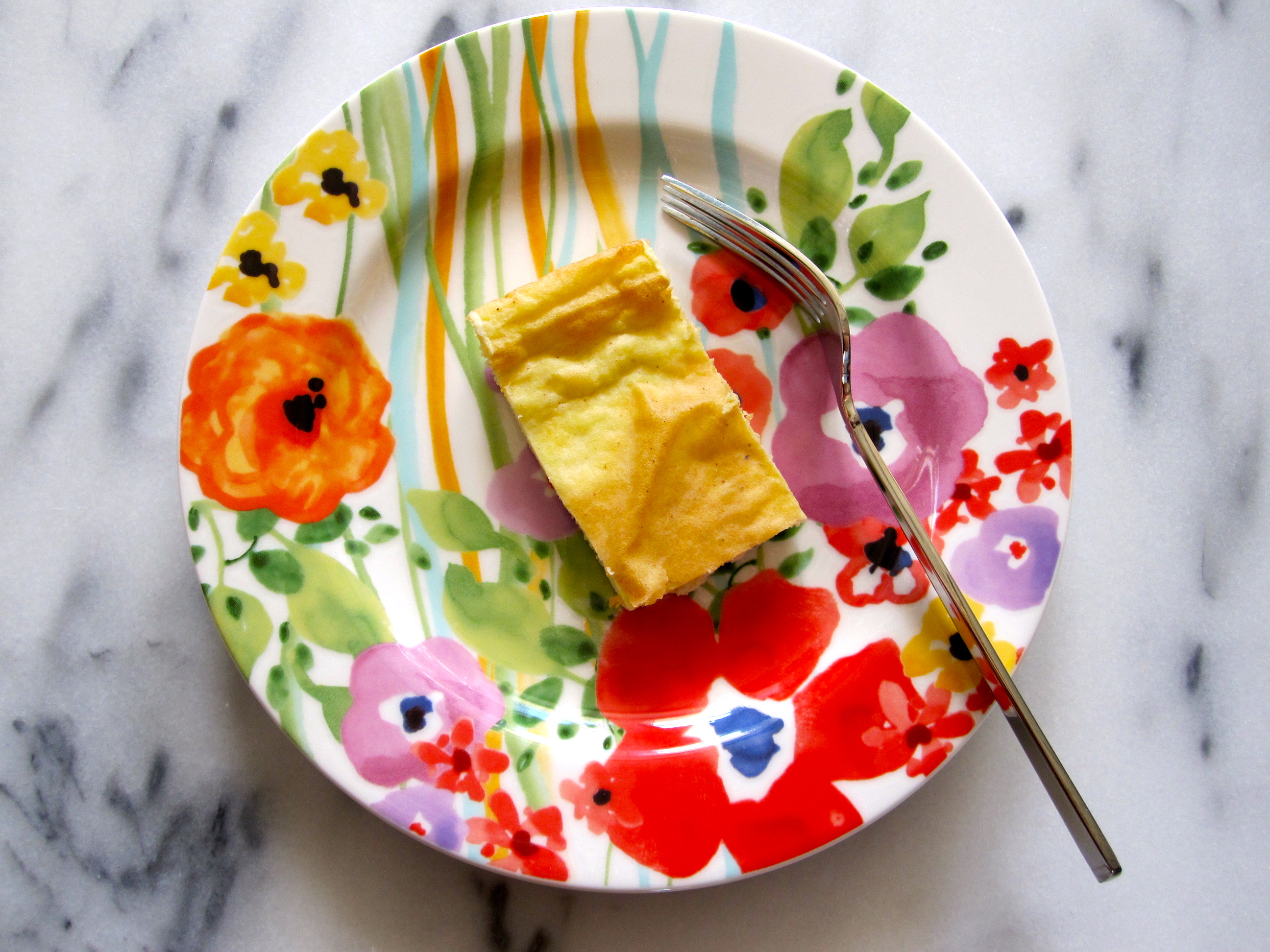
The rice flour pudding, on the other hand, is fairly bland. Nutmeg is the primary seasoning; even the strong notes of nutmeg don’t cut just how creamy this pudding tastes. (Note: some more sugar or some honey might be welcome. However, this doesn’t seem meant to be overly sweet, unlike the whole grain version.) It reminded us of buttermilk pie and South African milk tart, with an even firmer baked texture. It would form a good base for other tastes: served with fresh or stewed fruit, for instance, or with additional flavors added to the pudding.

In the eighteenth century, rice pudding represented the world in a bowl. Rice from West African seeds was cultivated in American soil by enslaved Africans in the Carolinas and shipped east across the Atlantic to England. The sugar probably came from the Caribbean. Nutmeg and cinnamon from places like the Moluccas made their way west through Asian and European ports. Oranges imported from Seville and other warmer climates scented the dish. The eggs, milk, cream, and bread are the only ingredients early modern cooks would have been able to source locally. These ingredients rely on both trade and labor – their production depended on plantation agriculture and their presence in England came from a highly developed global transport network. It’s not as if these structures don’t underpin many – if not all – of the recipes we’ve cooked so far. However, paying particular attention to this single ingredient, rice, has  challenged us to consider how ingredients entered early modern kitchens in the first place, even before they became the recipes in a household manuscript.

What surprised us most about making these dueling rice puddings was not the questions of culinary and  economic history they raised up, but the true difference in taste. In both, the taste of the rice remains – even through the single note of nutmeg in the rice flour pudding and the dense combination of flavors in the rice grain pudding. The taste difference, furthermore, is deliberate: the presence of multiple rice pudding recipes – similar but distinct – within the same manuscript recipe book indicates attempts to explore the versatility of this ingredient, to incorporate other flavors into a recipe that has one umbrella name but many flavorings and techniques. We’d be curious to taste these again using heritage rices, direct descendants of the Carolina Gold Rice these cooks and their contemporaries would most likely have used. In both cases, we were able to follow the ingredients and techniques fairly closely (minus ambergris and marrow), so what we tasted in our dueling rice puddings seems, to us, a likely descendant of these puddings as they were originally prepared.
IMG_4756

To Make a Potatoe Pudding

[Note: You can now follow us on Twitter, Instagram, and Facebook! See links to the right.]

Recently, Marissa and I faced off … over rice pudding. We each made a different eighteenth-century rice pudding recipe and compared results, which we’ll discuss in an upcoming crossover post here and on The Recipes Project.  (Spoiler: we declared a draw.)

A few of the early modern recipe books contain handy tables of contents, but most don’t, and obviously none are text-searchable (if only!), so hunting for a specific recipe like rice pudding can prove a challenge. Judeth Bedingfield’s recipe book (UPenn MS Codex 631) from the 1730s and 40s has become one of my go-to sources because of its comprehensiveness – and sure enough, it turned up not one but four rice pudding recipes. In this hunt for rice pudding, I was reminded of the astonishing range of other puddings in her book: orange (x3), “green quaking” (with spinach), carrot (x2), apple, potato, caraway, oatmeal (x2), calves’ foot, hasty, barley, marrow (x2), “quaking,” “shaking,” green, liver, white (x3). A pudding bonanza! We made Bedingfield’s carrot pudding early on in the project and still count it among our favorites, so I was ready to try another one. I chose potato because I was curious to taste it – curiosity is the driving force in most of my early modern recipe selections!

The Recipe

potatoe pudding

To Make a Potatoe Pudding

Take one pound of Potatoes, Boyle them till they peel, pound them in a morter, melt half a
pound of butter, a quarter of a pint of sack, put into them, take six eggs, leave out half [th]e
whites, sweeten it to y[ou]r tast, stirr it all together, grate a Little nutmeg in it when you bake it
butter y[ou]r Dish very well, three quarters of an hour will bake it /

IMG_4775

Our Recipe
[halved from the original*]

1/2 lb. potatoes (about 1 large), peeled and cubed
1/4 lb. butter (1 stick), melted
1/4 c. white wine
3 eggs, separated (3 yolks, 1.5 whites)
1 tbsp. sugar
1/4 tsp. nutmeg

Preheat oven to 350F. Butter or spray a small baking dish (or ramekins)**.

Boil potatoes until they can be pierced with a fork (about 10 mins). Transfer to a food processor, then add the melted butter, white wine, egg yolks + whites, and nutmeg. Pulse until completely smooth. Pour mixture into baking dish and smooth the top with a spatula. Bake for 30 mins, until top is puffed and golden brown. Let cool on a wire rack and serve warm or at room temp.

*Note: Why do we halve most of these recipes? Because they often make a large quantity, because usually we’re feeding just a few people, and, most importantly, because they’re experiments. Neither of us wants to waste ingredients, so wherever possible, we make a smaller quantity to see how it turns out.

**Note: I used a 6.5″ square Corning Ware casserole “borrowed” (um, several years ago) from my mom, who received it as a wedding gift in the 70s. The pudding layer was fairly shallow in this small dish – probably too shallow for an 8″ square – so ramekins would work nicely too.

The Results

Carrot pudding still comes out the winner for me in our Great (and ongoing) Pudding Experiment, but potato pudding was interesting. While the carrot pudding recipe includes a specified amount of sugar and candied peel AND instructs the cook to sweeten it to taste, this one simple directs the cook to sweeten it to taste. The white wine and nutmeg produce a flavor profile not quite sweet or savory (especially given that the recipe doesn’t call for any salt), so how much sugar you add can alter the taste considerably. It tastes recognizably of potatoes – in fact, I’d perhaps try this with sweet potatoes, since I really like their natural flavor – and bakes up quite firm, more so than the carrot pudding. I’d had enough after a few bites. The potato plus some tang from the wine plus the earthiness of the nutmeg didn’t quite add up to something I’d be eager to try again. But it’s very easy to make and requires few ingredients, making it a simple dish to prepare. This ease might explain the prevalence of all varieties of pudding in early modern cooking – they’re easy, usually inexpensive, and can be scaled to large quantities. Stay tuned for the rice pudding report!

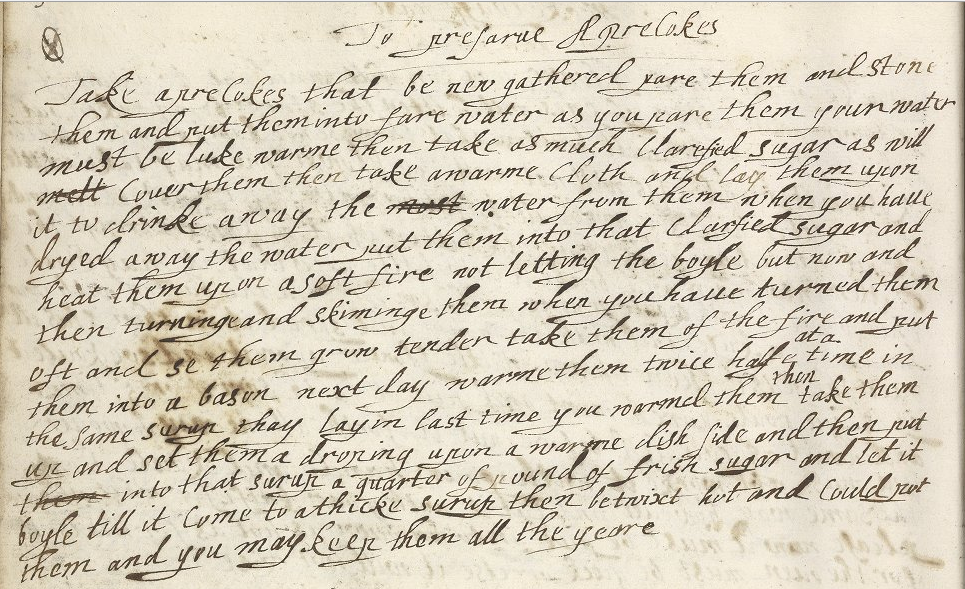
To presarue Aprecokes

I wanted to try this recipe as soon as I saw it. Although I often have this reaction to beautiful photos of food on blogs or Instagram, when I’m reading three hundred-year-old culinary manuscripts online it’s a different story. I’m curious, puzzled, intrigued, but rarely inspired to drop everything and prepare Fish Custard immediately. I was flipping through one of my favorite manuscripts in the collection, MS. Codex 252, and had an this uncharacteristic reaction: I needed to preserve some apricots right away. This recipe has a lot of elements that I like — stone fruit, very few ingredients, and a low-stakes preserving method. I also had a good reason to believe that it was a particularly reliable or tasty recipe.

preserve apricots, detail

This circle and X marking next to the recipe title indicates that someone cooking from this book prepared preserved apricots and the recipe, most likely, worked. I first learned about these circles, checks, ticks, fleurons, and other marks in recipe books when I heard Wendy Wall deliver a lecture about Shakespeare and early modern women’s medicinal knowledge. (I’m excited to read her new book, Recipes for Thought, when it comes out this fall. ) Wall and other historians of food and medicine consider markings like these part of the progression of scientific knowledge in the kitchen. They are the handwritten remains from many otherwise undocumented experiments. Cooks tried recipes and made (a few) notes about how they turned out. In this same manuscript the recipe for Could Possett was also marked and we loved how that refreshing drink turned out!

Whoever marked this recipe for preserving apricots– the compiler, a household cook, a member of the family from a later generation — was completely correct. This recipe works beautifully and the preserved apricots are a versatile and delicious ingredient to put up as the cold months approach.

The Recipe

preserve apricots

X                             To presarue Aprecokes
Take aprecokes that be new gathered pare them and stone
them and put them into fare water as you pare them your water
must be luke warme then take as much clarefied sugar as will
melt cover them then take a warme cloth and lay them upon
it to drinke away the must water from them when you haue
dryed away the water put them into that clarfied sugar and
heat them upon a soft fire not letting the boyle but now and
then turning and skiminge them when you haue turned them
oft and se them grow tender take them of the fire and put
them into a bason next day warme them twice halfe at a time in
the same surup thay lay in last time you warmd them then take them
up and set them a droping upon a warme dish side and then put
them  into that surup a quarter of pound of frish sugar and let it
boyle till it come to a thicke surup then betwixt hot and could put
them and you may keep them all the yeare

Our Recipe

It’s simple: peel and pit the apricots, wash them, cook them in their own juices with a bit of sugar, cover them with sugar syrup.

Our recipe is for a small amount of fridge-stable, not shelf-stable, preserved fruit. When we acquire a proper canning set-up here at Rare Cooking, we’ll start preserving everything in sight in large quantities. In the mean time, we’re sticking to fridge pickles, freezer jam, and small batches. The apricots should last for a few weeks in the fridge (if you can stop yourself from devouring them all at once.) If you’re a canning whiz and decide to try your hand at this recipe, please share your method in the comments for other interested readers.

Ingredients:

Part 1: To cook the apricots
8 apricots
1T sugar

Part 2: To make the simple syrup
1/4 c sugar
1/4 c water

Method:

Part 1: To cook the apricots
Peel the apricots and remove the pits. Quarter or halve the apricots, depending on their size and your preference. Wash them and let them dry completely on a dish cloth. (I set them aside for about an hour and did other things, but I also think you could skip this step if you are in a hurry.)

Put the apricots in a small pot and sprinkle them with sugar. Cover with a lid and begin to cook on a low heat. After a minute, check and see if the apricots are releasing their own juice. If they’re sticking or the mix isn’t juicy, add 2T water. Cover and cook the apricots for about five more minutes. The apricots should be tender, but still hold their shape. Remove the apricots from the heat and leave in the pot to cool.

Part 2: To make the simple syrup
In the original recipe, the apricots  rest in their juice overnight before they are stored in syrup. Since I wanted to serve them as part of desert that same night, I let them sit for about three hours.

Sterilize a mason jar. Here are a few ways to do this: fill the jar with boiling water, heat the jar in an oven, or wash the jar in a dishwasher.

Return the pot to the stove and heat the apricots in their juices on a low heat.

In a separate pot, make a simple syrup. Mix water and sugar and bring to a boil until all the sugar crystals are dissolved.

Pour the apricot mix into your prepared mason jar. Cover with the hot simple syrup. Label your jar. Allow the apricots to cool before you dig in.

The Results

These apricots taste like summer in a jar. They’re sweet, but not cloying. Alyssa came over for dinner and we ate these spooned onto Dolcezza brown butter gelato. They’re delicious with plain yogurt. When I’ve used all the fruit, I’m going to stir the remaining syrup into sparkling water and sparkling wine.

With minor variations, this recipe would work for most summer stone fruits. Peaches and plums come to mind immediately. Unlike apricots, they’re still available at the farmer’s market in Philly and I know that their season is almost over. The simple syrup component is also ripe for innovation. By infusing the liquid with fresh herbs and dried spices and then straining, these apricots could be seasoned with cinnamon, rosemary, or even coriander.

Now that I’ve fulfilled my apricot craving, I might preserve some peaches with a thyme-infused simple syrup this week before the peaches disappear and my thyme plant goes into hibernation.

Bread and Butter Puddings

Reunited in the kitchen! Marissa has returned to Philadelphia from the west coast, and we’re cooking together again. (Yay.)

Many early modern recipes provide intriguing experiments – I made portugal cakes because I couldn’t quite imagine what they’d taste like (delicious), for instance, and artificial potatoes because I wondered if they’d look like actual potatoes (maybe/sort of). Some recipes we try end up with a taste surprisingly similar to familiar modern recipes, like the snickerdoodle-esque shrewsbury cakes. But with a few exceptions like one of our earliest and tastiest experiments, maccarony cheese, we don’t often come across recipes with an immediately apparent modern counterpart. Therefore, when I was leafing through my recent favorite, MS Codex 205, and spotted the recipe for Bread and Butter Puddings, it went straight to the top of my to-try list. We both love bread pudding (and bread generally), so this version from the 1770s or 80s seemed like a great way to celebrate cooking in the same place once more.

The Recipe

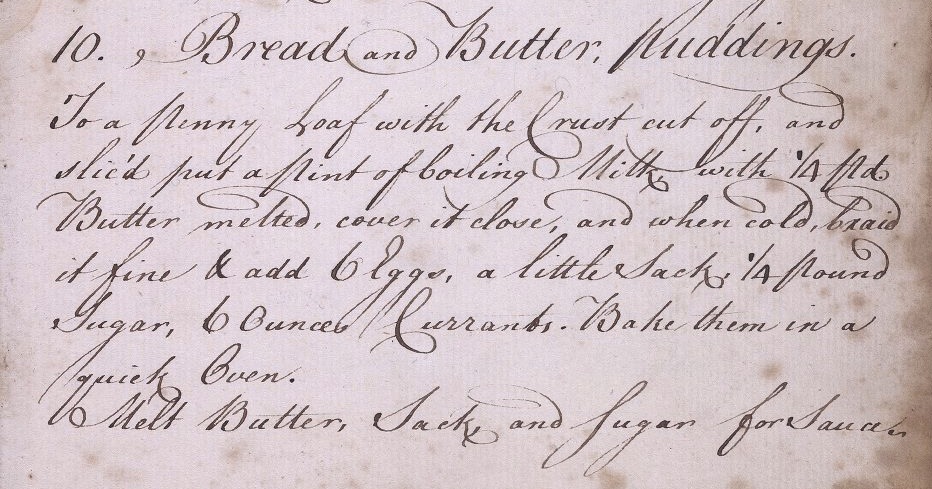
bread and butter puddings

10. Bread and Butter Puddings

To a Penny Loaf with the Crust cut off, and
slic’d put a Pint of boiling Milk, with 1/4 Pd.
Butter melted, cover it close, and when cold, braid
it fine & add 6 Eggs, a little Sack, 1/4 Pound
Sugar, 6 Ounces Currants. Bake them in a
quick Oven.
Melt Butter, Sack, and Sugar for Sauce.

Our Recipe

This is a fairly straightforward recipe: all of the ingredients are readily available (substitute raisins if you can’t find currants), the instructions are clear, and most of the measurements are precise. One direction brought us up short: to “braid” the soaked bread mixture. Braid it? I can’t even manage a french braid, let alone bread that has been soaking in milk and butter for a few hours! I’m glad that we went to the OED before attempting a hilariously messy plait: the dictionary suggests that “braid” could be a corruption of “bray” (“to beat small”). We interpreted this as cutting the soaked bread into smaller pieces. (Though why the dry bread couldn’t just be cut into smaller pieces before soaking is unclear.) The other interpretation would be to layer the soaked bread tightly before adding the egg mixture, perhaps because the slices were soaked in a single layer? But we’d already layered the bread before soaking it. But really, however you cut it and/or layer it, the bread will soak up the milk and egg mixtures and bake together into a delicious final product.

10-14 slices commercial white bread (14-20 oz. any bread), crusts removed*
1/4 lb. (1 stick) butter, melted
1 pint (2 c.) milk
6 oz. (1 1/2 c.) currants
4 oz. (heaping 1/2 c.) sugar
6 eggs
1/4 c. white wine

Arrange bread in a pyrex or other heatproof container – tear some of the slices in half to make them fit more closely. (You’ll be cutting the bread up more finely and transferring it to a baking dish, so don’t worry too much about careful arrangement.) Heat the milk just until bubbles form at the edges, add the melted butter, and pour over the bread. Gently press down on the top layer of bread with a fork to make sure it is evenly saturated. Cover container and set aside to cool to room temperature. (I hurried this step along by cooling it slightly and then transferring it to the fridge.)

Once bread mixture has cooled and the liquid has been mostly absorbed, cut the bread into smaller pieces by making an X motion with two table knives, just as you’d cut butter into pastry dough. Combine wine, eggs, and sugar and whisk lightly. Pour over bread mixture and add currants, then stir until everything is evenly distributed.

Heat oven to 350F. Transfer bread mixture to a well-greased 9×13″ baking dish** and bake for 60-70 mins., until puffed and golden brown. Cool on a wire rack and serve warm or at room temp.***

*Note: Determining how much bread to use was a little tricky. The early modern penny loaf was a small loaf of bread that cost – you guessed it – a penny, but the size of the loaf varied based on the cost of flour. So, based on the amount of liquid the recipe called for and by comparing it to modern bread pudding recipes, we used 10 slices of a commercial loaf of white bread. (We chose this because it was easy to pick up while we were getting the other ingredients; other bakery breads would also be great.) Before removing the crusts, the 10 slices weighed 14 oz. This amount of bread made for a delicious but very, very wet bread pudding; we agreed that another few slices would have made a good difference in texture. So, you could use anywhere from 14 to 18 or even 20 oz. bread (before removing the crusts), depending on what texture you prefer. There’s enough liquid that 20 oz. of bread should work; more than this might make for an overly dry pudding. And if you can plan ahead and use slightly stale bread, it will absorb the liquid even better.

**Note: We tried baking this in a 9″ pie dish but had to remove some of the mixture into two ramekins and bake them separately to avoid overflow. A larger baking dish avoids this problem. You could also distribute the bread mixture into ramekins or other smaller baking dishes: the ramekins did bake up adorably.

***Note: While the original does call for a sauce of butter, wine, and sugar, the bread pudding was so moist and rich that we didn’t feel like it needed the enhancement. If you’re feeling particularly decadent, however, by all means add the sauce!

The Results

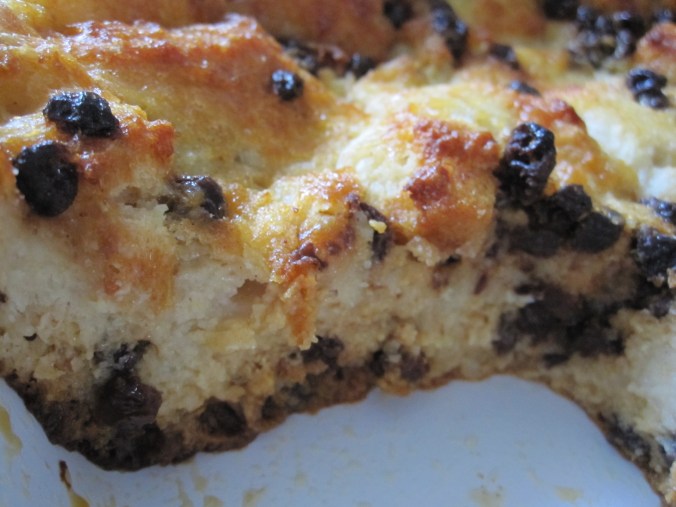
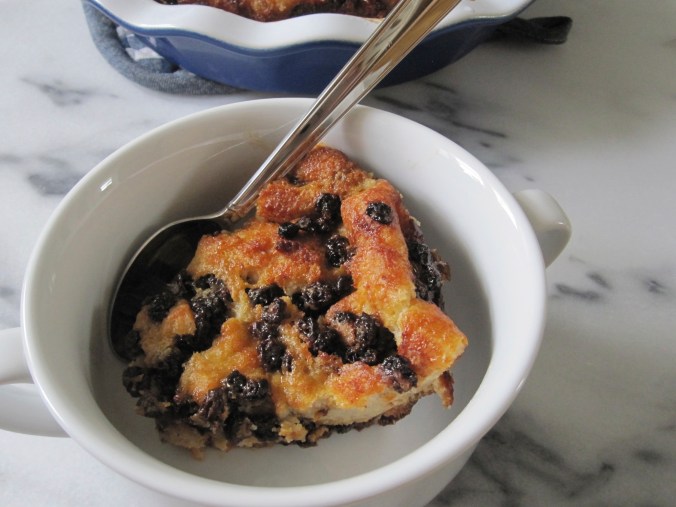
It’s bread pudding. And therefore awesome. Need I say more? (I’m partial.) The white wine adds a slight tang to the milkiness, and the currants provide sweetness that isn’t overbearing. It’s good the day of baking (once cooled a bit) and as leftovers, too.

We sprinkled in some cinnamon because we like it. You could also add nutmeg, a little ginger, a splash of vanilla, some orange zest – whatever flavors you enjoy.

Solid Sillibubs

August: month of ok-fine-I’ll-have-another-salad-just-to-avoid-turning-on-the-oven. So, what better time to experiment with syllabub? A popular dessert in the seventeenth and eighteenth centuries – so popular that it was often served in dedicated pots and glasses – syllabub is a sweetened mixture of cream and wine. I returned to UPenn MS Codex 205, home to the excellent Beer Cakes, to try out “Solid Sillibubs.”

Leafing through these recipe books provides an ongoing education in how common certain dishes were in early modern cooking. Some, like fried cream or (ahem) fish custard, seem to occur only rarely. Others, like jumballs or various puddings, appear time and again. Selecting one recipe to try in these cases is something like settling on a chocolate chip cookie recipe today: you happen to have chosen that one, but there are numerous others out there. I thought syllabub would be a great test case to show what one dish can look like across multiple recipe books.

The syllabub recipes below all combine cream, white wine, and sugar, then thicken the mixture. Proportions of cream to wine vary. Some “solid” syllabubs are left to sit until the cream and clear portions separate by themselves; other “whipped” syllabubs strain the froth over a sieve, then dollop the thickened mixture on top of white or red wine. (This vocabulary isn’t entirely consistent, and other adjectives like “ordinary” and “excellent” complicate matters.) Recipe books might contain one or two or even, in Judeth Bedingfield’s case, three syllabub recipes. (Print cookbooks contained even more: Mary Cole’s The Lady’s Complete Guide; or Cookery in All Its Branches [1788] details five, ranging from “lemon” to “everlasting.”) The handful of syllabub recipes below allow us to consider how cooks write out similar instructions in different ways, vary or omit steps, create flavor twists, and put their own mark on a somewhat standard recipe.

Syllabub / Sillibub / Silly Bub: A Survey

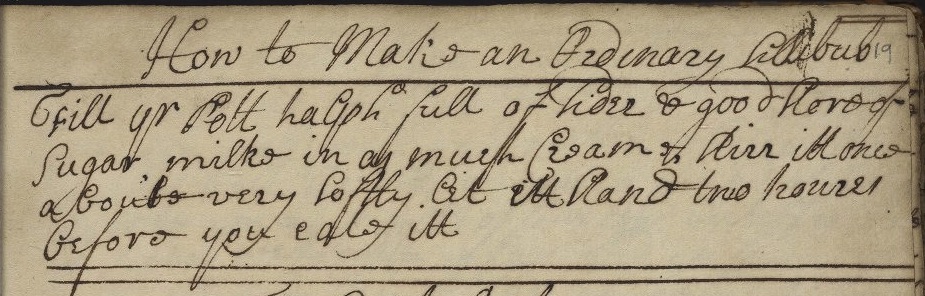
ms753 ordinary syllabub{from MS Codex 753}

How to Make an Ordinary Sillibub

Fill yr Pott halph full of of Wien & good share of
Sugar, milke in as much Cream & Stirr itt once
about very softly. Let itt stand two houres
before you eate itt

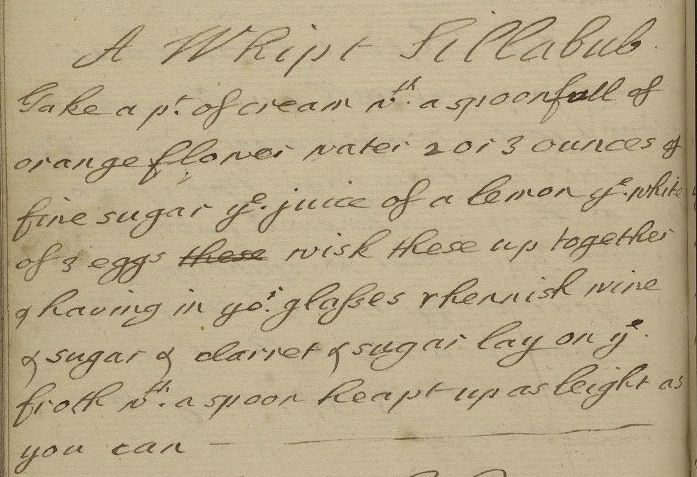
ms625 whipt sillabub{from MS Codex 635}

A Whipt Sillabub

Take a p[in]t of cream w[i]th a spoonfull of
orange flower water 2 or 3 ounces of
fine sugar [th]e juice of a lemon [th]e white
of 3 eggs these wisk these up together
& having in yo[u]r glasses rhennish wine
& sugar & clarret & sugar lay on [th]e
froth w[i]th a spoon heapt up as leight as
you can

ms642 silly bub{from MS Codex 624}

A silly bub

Sweeten a quart of cream take a pint of renish wine & poure it thro
a narrow mouth bottle into [th]e cream let it stand a while before you stir
it.

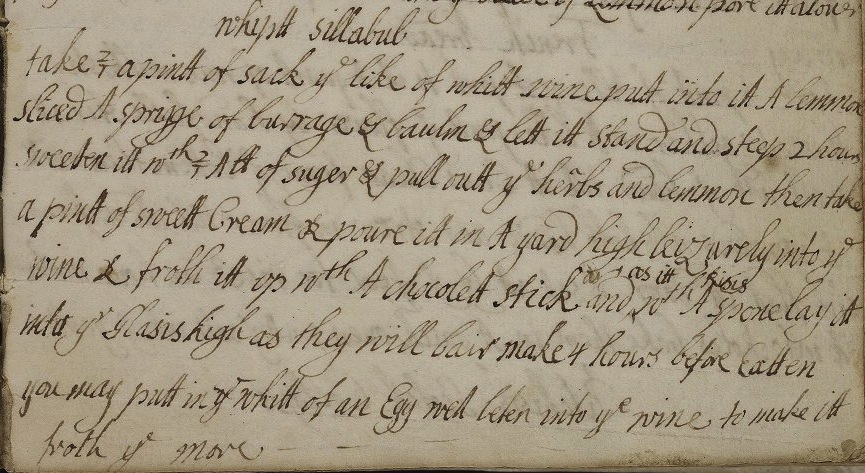
ms624 whipt sillabub{also from MS Codex 624}

whiptt sillabub

take[th] a pintt of sack [th]e like of whitt wine putt into itt A lemmon
sliced A sprigge of burrage & baulm & lett itt stand and steep 2 hours
sweeten itt w[i]th [th]Att of suger & pull outt [th]e herbs and lemmon then take
a pintt of sweet Cream & poure itt in A yard high leizurely into [th]e
wine & froth itt up w[i]th A chocolett stick and (as itt risis) w[i]th A spone lay itt
into [th]e Glases high as they will bair make 4 hours before Eatten
you may putt in [th]e whitt of an Egg well beten into [th]e wine to make itt
froth [th]e more

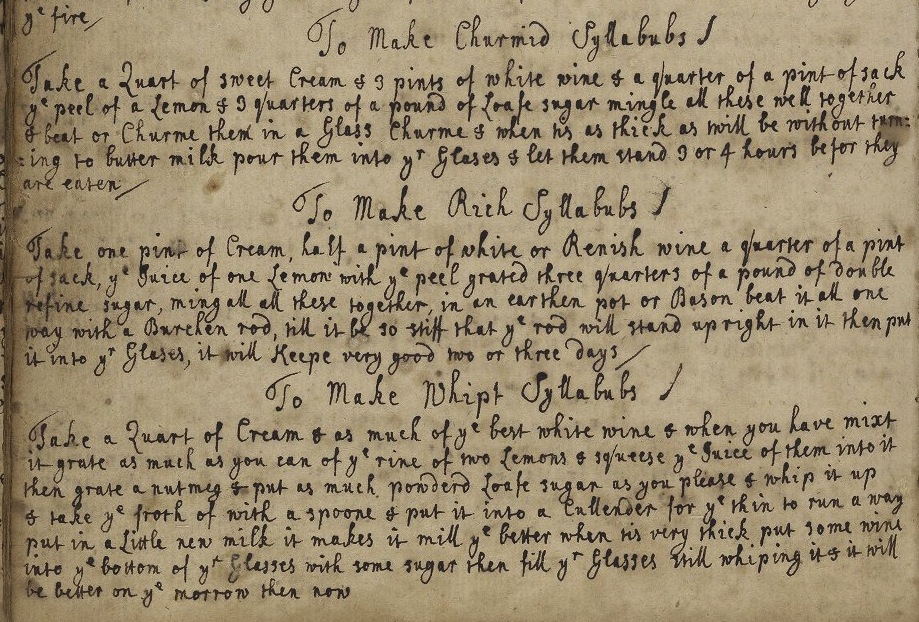
ms631 3 syllabubs{from MS Codex 631}

To Make Churn’d Syllabubs

Take a Quart of sweet Cream & 3 pints of white wine & a quarter of a pint of sack
[th]e peel of a Lemon & 3 quarters of a pound of Loafe sugar mingle all these well together
& beat or Churne them in a Glass Churne & when tis as thick as will be without turn:
:ing to butter milk pour them into y[ou]r Glases & let them stand 3 or 4 hours before they
are eaten /

To Make Rich Syllabubs

Take one pint of Cream, half a pint of white or Renish wine a quarter of a pint
of sack, [th]e Juice of one Lemon with [th]e peel grated three quarters of a pound of double
refine sugar, mingall all these together, in an earthen pot or Bason beat it all one
way with a Burchen rod, till it be so stiff that [th]e rod will stand upright in it then put
it into [th]e Glasses, it will keepe very good two or three days /

To Make Whipt Syllabubs

Take a Quart of Cream & as much of [th]e best white wine & when you have mixt
it grate as much as you can of [th]e rine of two Lemons & squeeze [th]e Juice of them into it
then grate a nutmeg & put as much powderd Loafe sugar as you please & whip it up
& take [th]e froth of with a spoone & put it into a Cullender for [th]e thin to run a way put in a Little new milk it makes it mill [th]e better when tis very thick put some wine
into [th]e bottom of y[ou]r Glasses with some sugar then fill y[ou]r Glasses still whiping it & it will
be better on [th]e morrow then now

Many printed cookbooks contain syllabub recipes, too. My personal favorites? The recipes that call for making syllabub in perhaps the most efficient way imaginable: straight from the cow. In a 1796 edition of The Art of Cookery, for example, Hannah Glasse details how “To make a Syllabub from the Cow” – and thoughtfully provides variant instructions if you lack a cow and need to approximate one (!):

Make your syllabub of either cyder or wine, sweeten it pretty sweet, and grate nutmeg in; then milk the milk into the liquor: when this is done, pour over the top half a pint or a pint of cream, according to the quantity of syllabub you make. You may make this syllabub at home, only have new milk; make it as hot as milk from the cow, and out of a teapot, or any such thing, pour it in, holding your hand very high, and strew over some currants well washed and picked, and plumped before the fire.

I was tempted to try this technique in my cow-less kitchen, but I stuck with the instructions from MS Codex 205.

The Recipe

ms205 solid sillibubs

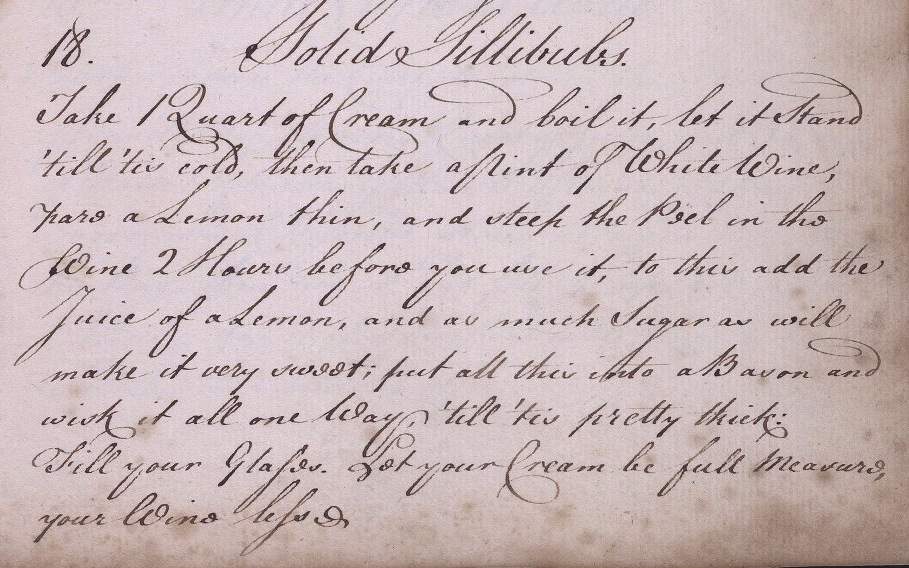
18.                      Solid Sillibubs.

Take 1 Quart of Cream and boil it, let it Stand
’till ’tis cold, then take a pint of White Wine,
pare a Lemon thin, and steep the Peel in the
Wine 2 Houres before you use it, to this add the
Juice of a Lemon, and as much Sugar as will
make it very sweet; put all this into a Bason and
wisk it all one Way, ’till ’tis pretty thick:
Fill your Glases. Let your Cream be full Measure,
your Wine less so

Our Recipe
[halved from original]

1 pint (2 c.) heavy cream
1 c. white wine
1 lemon: rind peeled in thick strips, then juiced
1/2 c. sugar

In a small saucepan, bring cream to a boil; let boil gently for 2 mins. Remove pan from heat or pour into heatproof bowl and let cool.

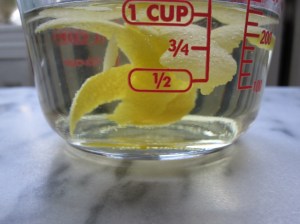
Meanwhile, place the lemon rind in the wine and let sit for 2 hours. Remove the rind, then add the lemon juice and sugar.

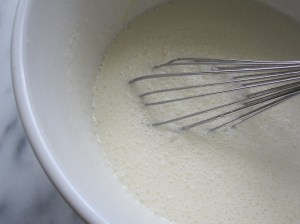
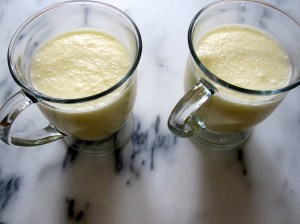
Combine the cream and wine mixtures and beat with a stand or electric mixer or by hand* until frothy and slightly thickened. Pour into 2-4 glasses and refrigerate 4 hours or overnight; the cream will thicken and a small layer of liquid will appear below.

*At first I beat the mixture by hand and assumed that my arm power was the reason it didn’t thicken significantly. But when I transferred it to the stand mixer, the thickness remained the same. It should become frothy and be well-combined, but it won’t thicken like whipped cream.

The Results

This wasn’t my favorite, though I’m glad I made it and I can certainly see the appeal. The cream mixture is extremely rich – lemony and sweet – and the liquid underneath is a tart contrast to that. I think there should have been more liquid; I boiled the cream for about five minutes to let some water evaporate (in hopes of making a noticeably “solid” syllabub), but I think that was too much, so I’ve adjusted the recipe above. The topmost layer of cream becomes quite solid and mousse-like, while below about 1″ it remained softer. I dug through the layers with a spoon, but a straw would be even better! (As would smaller glasses: juice glasses or small mason jars would make more reasonable servings.)

A word about methodology: without reading up on other syllabubs, I wouldn’t have known to let the mixture sit. And I feel fairly certain that it should sit. Almost all the syllabub recipes, both handwritten and printed, that I read called for the mixture to be strained or to sit. A thickened layer of cream on top of a more liquid wine layer is characteristic of syllabub. So why not specify that step in this recipe? I think this is a good instance of a step being left implicit because the cook doesn’t think twice about it. It made me think of what we leave unspoken in our own recipes. Have you ever written down a well-loved and much-made recipe for someone else, then paused and added in more steps and specifications for someone making it for the first time? I think that’s what happened here. This first-time syllabub-maker didn’t know any better, even if the recipe writer would have.  Without letting the mixture sit, the whole thing is creamy but very liquid, not thick or “solid” at all.

I didn’t like this quite enough to keep experimenting with other syllabubs – plus, there are other refreshing liquid desserts to tackle before the end of the summer. Shrub! Posset! But if anyone feels moved (er … moo-ved?) to try “Syllabub from the Cow,” please report back.

Portland Cakes, Cooking in the Scripps Archives Part 4

This is the fourth and final post featuring a recipe from the Earl of Roden Commonplace Book held at the Scripps College, Denison Library. Read the first post here for information about this manuscript.

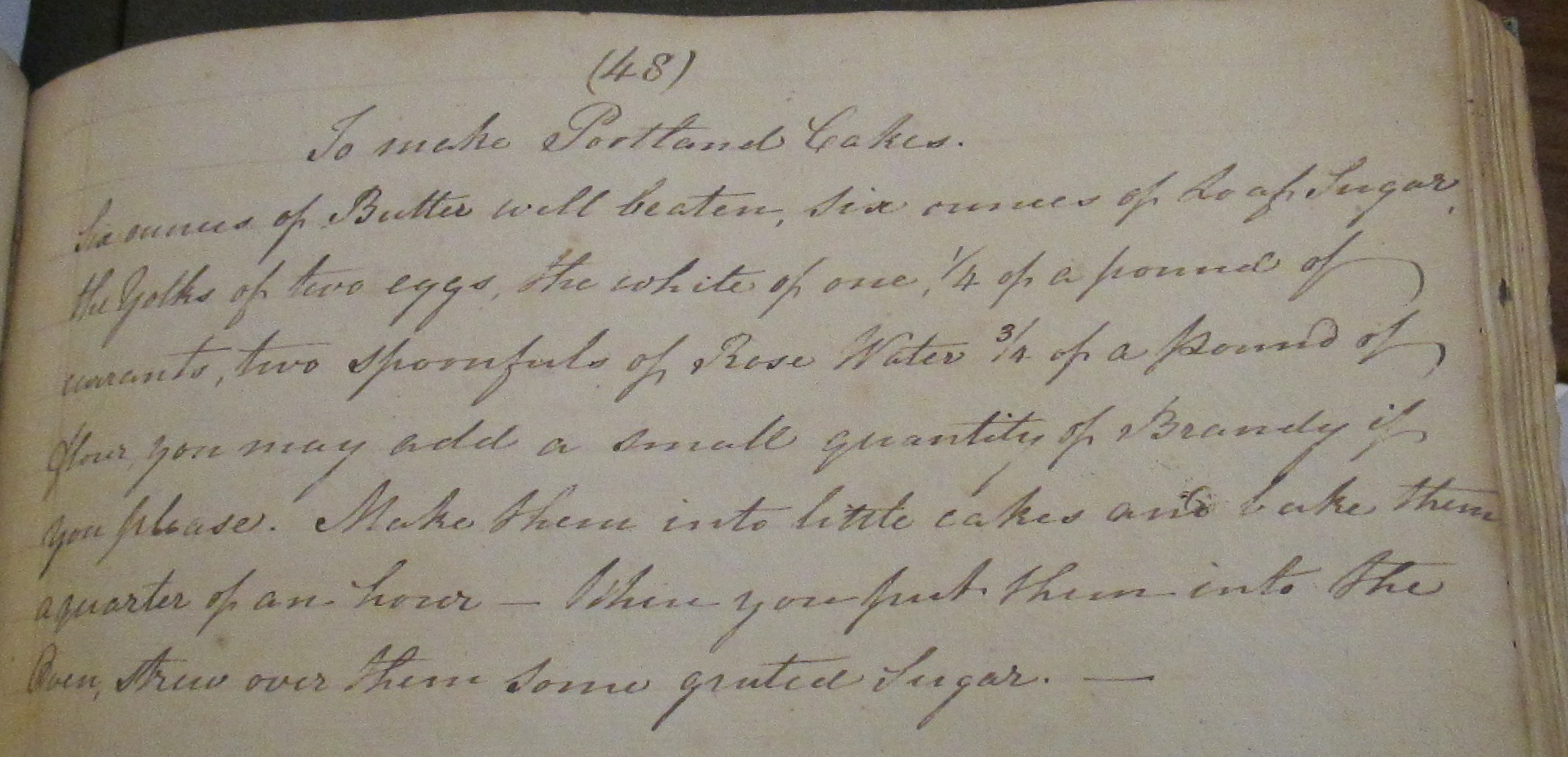
Flipping through the Earl of Roden Commonplace Book in the Denison Library at Scripps a few months ago, I paused when I saw a recipe for “Portland Cakes.” They looked so familiar! These buttery, sweet cakes are flavored with rosewater and brandy and dotted with currants, just like the “Potingall/Portugal Cakes” Alyssa wrote about a few months ago. The “Portland Cakes” in the Earl of Roden  fall into the broad category of “Portugal” cakes seasoned with fortified wines like brandy and sack that were imported to the British Isles from the Iberian peninsula.

The Recipe

portland cakes

To make Portland Cakes.

Six ounces of Butter well beaten, six ounces of Loaf Sugar,
the Yolks of two eggs, the white of one, 1/4 of a pound of
currants, two spoonfuls of Rose Water 3/4 of a Pound of
flour, you may add a small quantity of Brandy if
you please. Make them into little cakes and bake them
a quarter of an hour __ When you put them into the
Oven, strew over them some grated Sugar. ___

Our Recipe is basically the same.

6 oz butter, softened
6 oz sugar (additional sugar for sprinkling)
2 egg yolks
1 egg white
1/4 lb currants
2 t rosewater
3/4 lb flour
2 t brandy

Preheat oven to 350F.

Cream together butter and sugar. I used my stand mixer for this recipe, but it could work with a hand mixer or a large bowl and a sturdy spoon.  When the mixture is pale and fluffy, add rosewater and brandy. Separate and beat the eggs before adding them to the mix. Add the flour. When the flour is completely incorporated, add the currants.

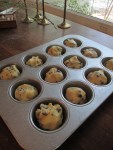
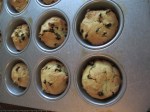
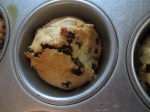
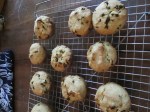
Divide the mixture into 12 cakes and bake in a greased muffin tin for 40 minutes. If you’d like to make smaller cakes (I plan to next time) divide the mixture into 18 or 24 parts and bake in two greased muffin tins for approximately 25 minutes, until golden brown.

As you can see from the photos, I completely forgot to dust these with sugar before I put them in the oven, but they were toothsome all the same.

The Results

Portland Cakes are sweet, dense, and fragrant. I enjoyed one hot from the oven with a cup of tea. I brought the rest to a picnic and they were a big hit with adults and kids alike.

Next time I’ll make smaller cakes in a muffin  pan (or even try a Madeline pan like Alyssa) because the crunchy exterior was my favorite part. I might also add a pinch of salt and cut the sugar a bit.

But mostly I think a Potingall/Portugal/Portland Cake bake-off is in order. Alyssa and I are going to arrange a taste-test and let you know which recipe we like best!

To Pickle Tomatas, Cooking in the Scripps Archives Part 3

This is the third post featuring a recipe from the Earl of Roden Commonplace Book held at the Scripps College, Denison Library. Read the first post here for information about this manuscript.

It’s tomato season, dear readers. The farmer’s market stalls and supermarket shelves are laden with sweet, tangy, luscious tomatoes that I can’t resist eating out of the container on my walk home. Other bloggers are also fueling my tomato-craziness with tasty recipes like this one. Our recipe for pickled tomatas captures tomatoes in their prime. It doesn’t require any special canning equipment beyond a clean jar so have no fear! Read on!

We haven’t always celebrated the tomato or even considered it edible. The tomato is a new world fruit. At first, Europeans and American colonists didn’t eat them at all for fear of a poisonous, painful death. Later, English gardeners would grow especially garish varieties to display as beautiful objects, gorgeous examples of horticultural prowess and cosmopolitanism. These two books document our slow conversion from a tomato-fearing to a tomato-loving food culture : Andrew F. Smith’s The Tomato in America and David Gentilcore’s Pomodoro! A History of the Tomato in Italy. This Modern Farmer article offers a more condensed history.

This recipe for pickled tomatoes is from the late eighteenth or early nineteenth century based on the history of the manuscript . The compiler notes Count Puzzi as a source, but I haven’t been able to track down a count by this name. (I did find Giovanni Puzzi, a celebrated horn player who resided in London in the nineteenth century, but, alas, I see no way to connect him to our tomato recipe.)

Not only was I excited to see a tomato recipe from relatively early in this history of European consumption of nightshade vegetables, but it also reminded me of an appetizer I’ve ordered many times at a favorite restaurant. Union on Yale serves a mason jar overflowing with vinegary heirloom cherry tomatoes, burrata, and basil-infused olive oil with lovely pita bread toasts on the side. I’ve never said no to burrata and I’ve come to love the way the sharp tomatoes compliment the luscious cheese.

The Recipe

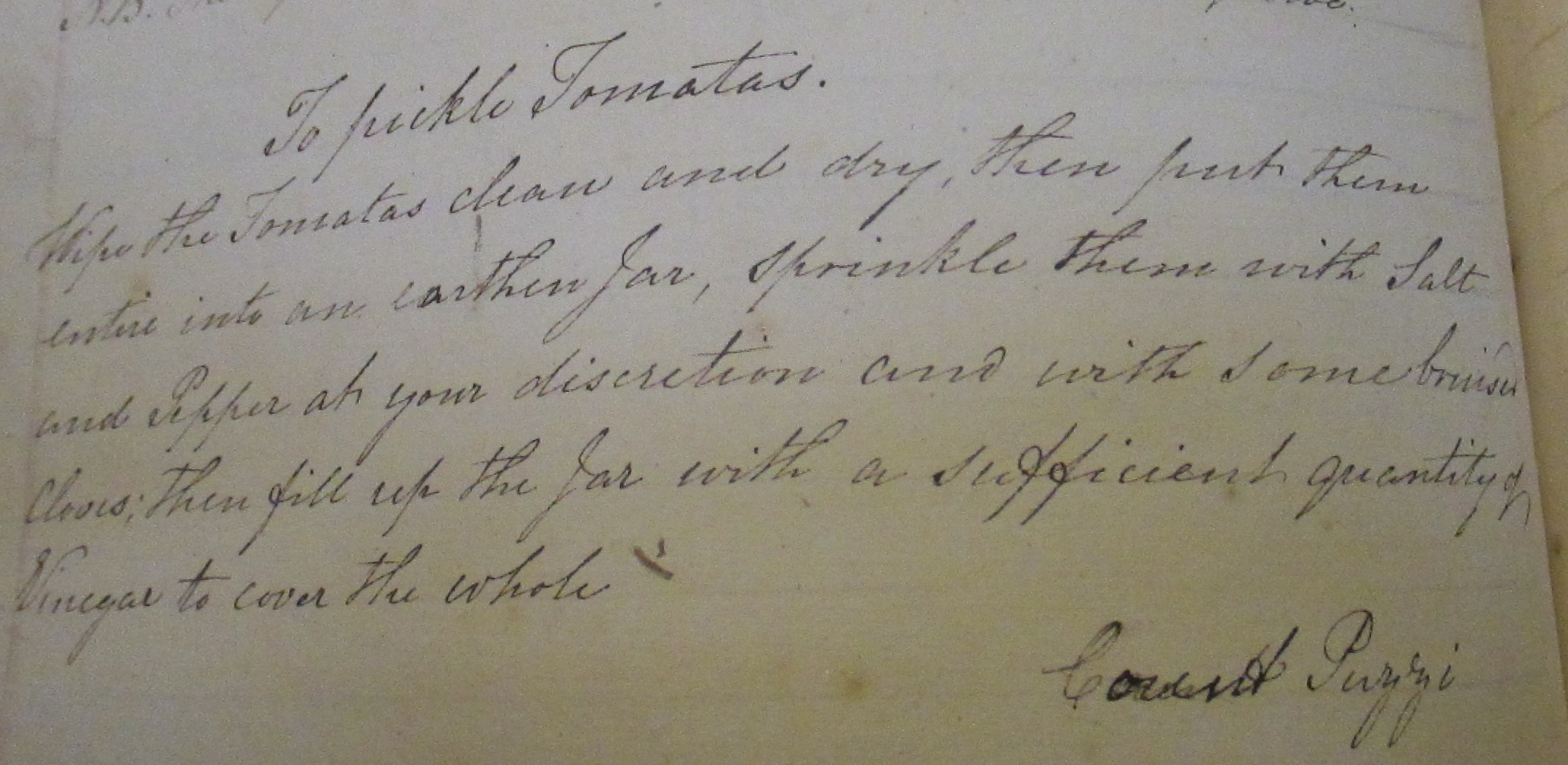
To pickle Tomatas

Wipe the Tomatas clean and dry, the put them
entire into an earthen Jar, sprinkle them with Salt
and Pepper at your discretion and with some bruised
Cloves; then fill up the Jar with a sufficient quantity of
Vinegar to cover the whole x
Count Puzzi

This recipe is perhaps equal parts pickled and fermented tomatoes. Like any lover of kimchi, sauerkraut, kombucha, or even sourdough bread knows, when you put a lot of tasty veggies in an earthenware crock you’re inviting natural yeasts and microbes to transform your food into something new. For our recipe, I turned to what I know about making fridge pickles as a compromise between proper canning and crock fermenting. I frequently make batches of string-bean, cauliflower, fennel, and beet fridge pickles to add to salads or compliment a cheese platter so this method is what felt natural to me. If you try this in an earthenware jar or properly can a batch and like what you taste, please let us know!

Our Recipe
1half lb tomatoes (whole, small tomatoes like cherry, grape, or sugar plum will work best)
3 twists black pepper
1 t cloves
1/2 t salt
1 c apple cider vinegar
a 2 cup mason jar, thoroughly washed

Put about a half pound of tomatoes in the mason jar. Fill to the top, but leave some space at the neck of the jar. Add seasonings. Fill with vinegar until the tomatoes are completely covered. Firmly affix the lid and label the jar. Leave in refrigerator for 1-2 weeks. I tried this batch after 10 days.
Consume pickled tomatoes within a month of opening the jar.

The Results

Pickled tomatoes are tart, juicy, and remarkably fresh. As I’d hoped, they tasted wonderful with cheese. The clove and vinegar seasoning combination reminded me of fancy homemade or artisanal ketchup. Next time,  I might consider flavoring them with coriander, fennel, or caraway seeds instead. I like cider vinegar, but I think red or white wine vinegar or even sherry vinegar would also work as a base.

Beer Cakes

CookingArchives-4173

Photo by Carley Storm Photography http://www.carleystormphotography.com

We’re sometimes asked how the early modern recipe books we cook from ended up in library collections. It varies: some were purchased directly by the library, others were gifts. However they made it into holdings like the Kislak Center’s, we feel fortunate that they did. As I looked over the provenance notes for UPenn Ms. Codex 205, I saw a familiar name. The book was a gift from Esther Bradford Aresty, part of the Esther B. Aresty Collection of Rare Books on the Culinary Arts. Aresty (1908-2000) was a culinary historian and cookbook collector who donated her collection of 576 printed volumes and 13 manuscripts, ranging from the fifteenth to twentieth century, to the University of Pennsylvania. (For more on Aresty’s remarkable life and collecting, see here and here. Penn also holds Aresty’s papers, which I’m looking forward to digging into soon.) Aresty’s collection has already informed this project: of the recipe books we’ve cooked from so far, UPenn Ms. Codices 252, 625, 627, and 631 were also her gifts.

In her first book, The Delectable Past: The Joys of the Table – from Rome to the Renaissance, from Queen Elizabeth I to Mrs. Beeton. The Menus, the Manners – and the most delectable Recipes of the past masterfully recreated for cooking and enjoying today (1964), Aresty transcribed and updated over 700 recipes from the volumes in her collection in order to make them widely accessible: “The more I wandered around in those precious volumes, the more I wanted to share them with others” (9). The chapters begin with “Antiquity to the Middle Ages – The Delicious Beginnings” and end with “Late 19th-Century America – Cooking Lessons Well Learned,” each detailing several recipes and images. Aresty didn’t include any recipes from Ms. Codex 205, but it’s listed in the index as part of her collection at the time. She describes The Delectable Past as “the result of my adventuring through their pages.” Adventuring through the pages: what a perfect way to describe the experience of reading old cookbooks, or encountering older texts more generally.

Aresty characterized her method as one of updating: “I’ve tried to adapt the recipes in the simple style that made them such a delight to read and follow. … With few exceptions, they are all easy to prepare, and rely on a subtle twist, or nuance, or combination, rather than laborious preparation. Though canned soups and other commercially prepared products have not been specified, they may be substituted wherever you deem proper.” And she encouraged experimentation: “You may arrive at some individual effects of your own while using the recipes in The Delectable Past. All have been tested in my kitchen, but your imagination can take over in many of them. After all, the same recipe will produce varying though equally good results in different hands. Yours may be better than mine” (12). As I read Aresty’s words, with Ms. Codex 205 sitting to one side, I felt like I’d found a kindred spirit. I’m looking forward to more adventuring in Aresty’s collection.

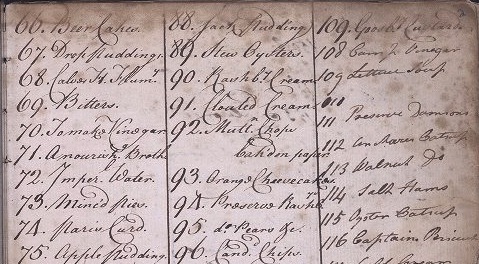
UPenn Ms. Codex 205 begins with a handy table of contents of its recipes. I looked no further as soon as I saw #66: Beer Cakes. Beer Cakes? I had to try these.

205 tofc

This recipe book was probably compiled from the last few decades of the eighteenth century into the first of the nineteenth. Recipe #130 is dated 1791; #162 is dated 1801. The last page of the book details the diet plan “Mr. Whilby of Wallington Norfolk” used to raise his calves in the winter of 1777. (Now, there’s a sentence I’ve never written before.) There is also a loose letter tucked into the volume, dated February 1808, from “AB” to Mrs. Edward Browne, copying the recipe for “A Sweet Jar” that’s also written into the book. The first 109 recipes (including the Beer Cakes) are written in one hand, then the rest of the book continues in at least six hands.

The Beer Cakes call for “old Beer” – a very efficient way to use beer that might be past optimal drinking stage. Interestingly, this is the first early modern baking recipe I’ve noticed that calls for beer. I’m now curious about how common this was, so I’ll be on the lookout for more. The beer used would probably have been purchased; by the late eighteenth century, the earlier prevalence of home brewing had been largely displaced by industrialized beer production. (For more background, see, e.g., The Oxford Companion to Beer, ed. Garret Oliver [2011], and I. S. Hornsey, A History of Beer and Brewing [2003].)

I wasn’t the only one who found these Beer Cakes delicious, apparently: note the bookworm holes in the upper right-hand corner of the recipe page.

The Recipe

beer cakes

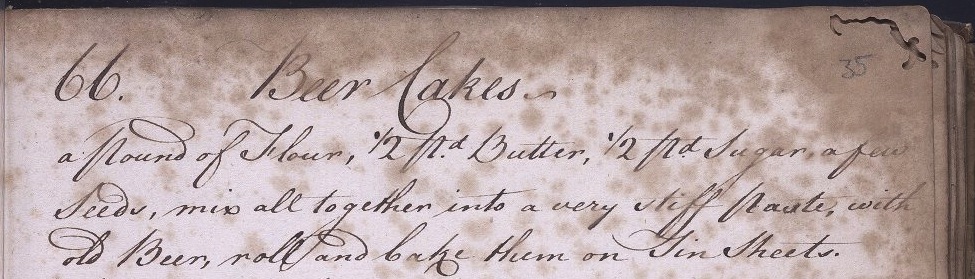
66. Beer Cakes

a Pound of Flour, 1/2 Pd. Butter, 1/2 Pd. Sugar, a few
Seeds, mix all together into a very stiff Paste, with
old Beer, roll and bake them on Tin Sheets.

IMG_4548

Our Recipe

[halved from the original]

1/2 lb. flour (I used half white whole wheat and half all-purpose flour, about a scant 1 c. each)
1/4 lb. sugar (1/2 c.)
1/4 lb. butter (1 stick), room temp.
1 tsp. caraway seeds*
scant 1/2 c. beer, added in increments**

Heat oven to 350F. Line two baking sheets with parchment.

Combine all ingredients except the beer in a large bowl and mix with a spatula until relatively smooth. (You could easily do this in a stand mixer. I was feeling old school.) Add about half the beer and blend, gradually adding more as needed until you have a cohesive, stiff dough. It should be just wet enough to hold together but not so wet that it becomes soft and sticky. If it’s too wet, just add a bit more flour.

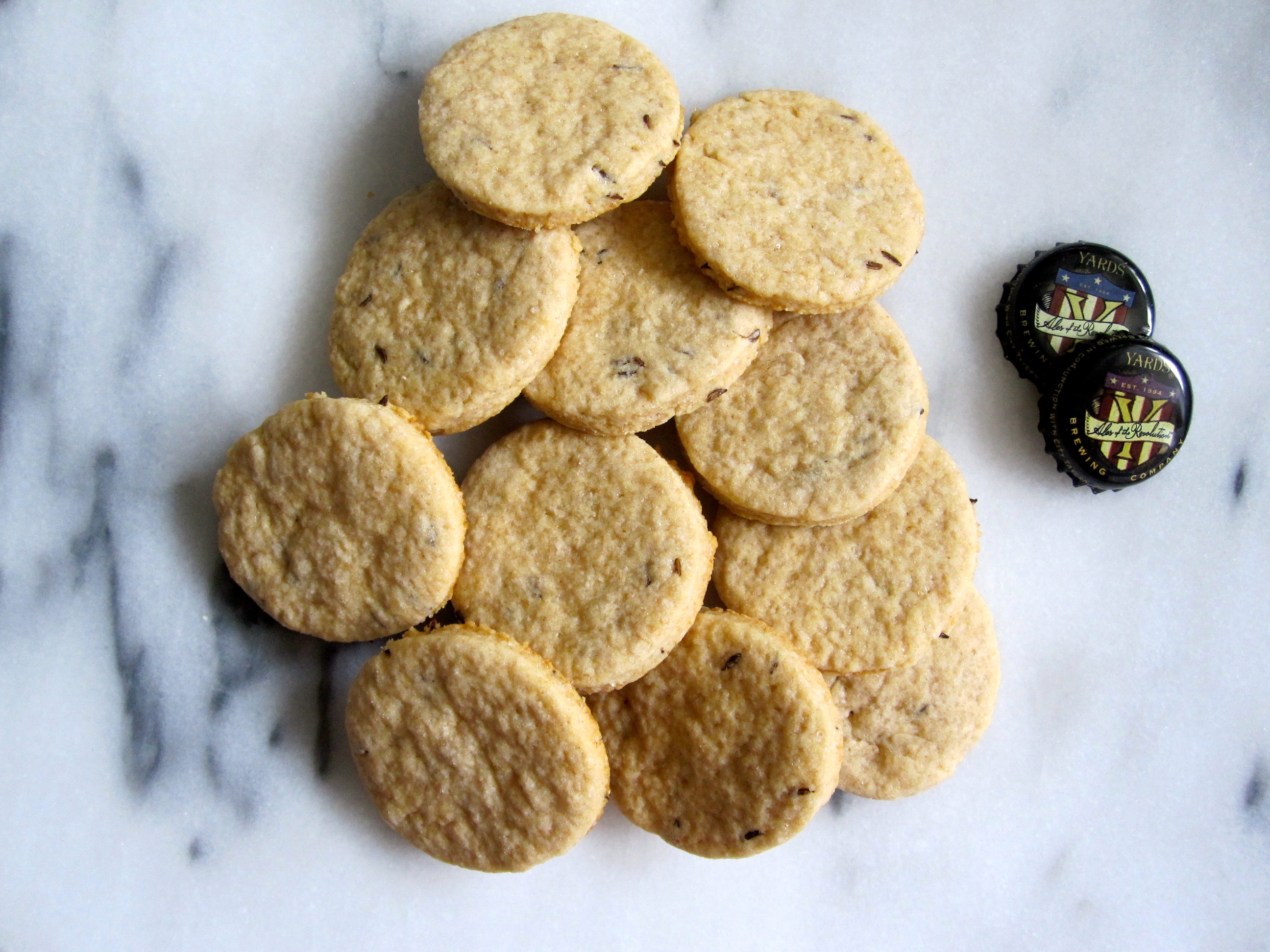
Lightly flour your surface and rolling pin, then roll out the dough to about 1/4″ thickness. (The day I made these was pretty humid – see: Philadelphia summertime – so I found that refrigerating the dough for about 10 mins. before rolling it out made the process of transferring cookies onto the baking sheets much easier.) Cut them out in shapes of your choice. My handy 2″ circle yielded 46 cookies. Transfer to lined baking sheets and bake for 12 mins., or until dry to the touch and golden brown on the bottom. (Your kitchen will smell like beer. Not at all unpleasant.) Remove to a wire rack and let cool.

*A note about “a few Seeds”: Other “seeded” recipes we’ve made have called for caraway seeds. I also looked at several print and manuscript recipes for Seed Cakes, all of which use caraway. So, I feel fairly certain that caraway seeds are accurate for the Beer Cakes. However, you could certainly experiment – poppy? Sesame?

**A note about the beer: I didn’t have any “old Beer” lurking at the back of my fridge – just as well, because I knew exactly which beer I wanted to use for this recipe. Philadelphia’s very own Yards Brewing Company produces three Ales of the Revolution, based on colonial brewing recipes. I was curious about how much the flavor of the beer would come out in the cookies, so I experimented by splitting the batch and making half with Thomas Jefferson’s Tavern Ale and half with Poor Richard’s Tavern Spruce. (I also made another batch with a lager, for additional experimentation. Same results.) I couldn’t really taste a difference, probably because the amount of beer in the recipe isn’t that large and the caraway seeds dominate; I definitely couldn’t taste the piney-ness that characterizes the Tavern Spruce. But I didn’t mind having the leftover beer with my cookies.

The Results

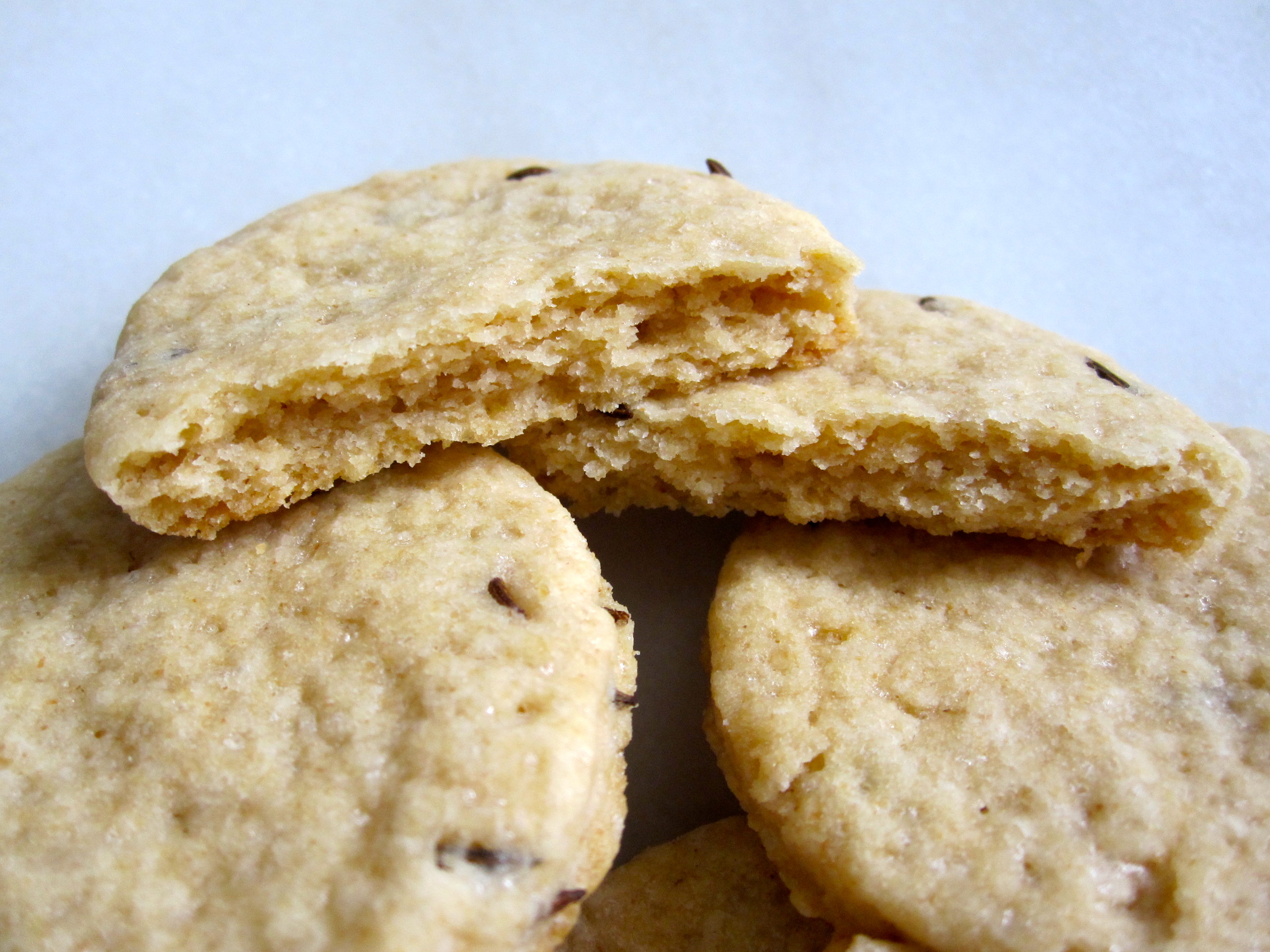
Favorite recipe since Maccarony Cheese! Of the other “cakes” recipes we’ve tried, they’re most similar to the Desart Cakes, which I also liked very much. But the addition of butter and especially of beer give these a depth and richness that can be unusual for early modern cookie-cakes. (They’re still beige, of course. Marissa and I have started thinking of this project as the realm of beige baked goods.) They don’t really taste like beer, but they have a richness and a nice crumb that’s less dense than the Desart Cakes. I’ll be making these again.

Esther Aresty, I raise a beer cake to you and your adventuring. Thank you.

IMG_4542

To Make fry’d Cream

Confession: I don’t love rosewater. Or orange flower water. To me they’re like cilantro – I’m just happier without them. And yet, because of this project, flower waters have become a fixture in my baking rotation, flavoring treats like Portugal Cakes and Artificial Potatoes. (Early modern recipes use flower waters when we might more readily use vanilla extract, for instance, which would have been cheaper and more readily available.) So, this time I decided to give myself a little vacation from floral tastes. Something easy, something that didn’t make me sigh and reach for the rosewater again.

I also wanted to check out a recipe book we hadn’t explored yet. It’s easy to play favorites – I’m looking at you, Ms. Codex 1038 – but the Kislak Center’s holdings include many others. I recently spent a pleasant morning going through some of these, including UPenn Ms. Codex 830. Unlike most of the recipe books we’ve cooked from so far, it is identified as the property of one person, Eliz. Kendrick. The title page displays her name, 1723, and a striking calligraphy drawing of a bird.

Eliz Kendrick bird

Kendrick’s book includes a higher than usual concentration of recipes for wines: damson, balm, raisin, elderflower, sage, lemon, gooseberry, birch. I’m not feeling quite adventuresome enough – yet – to turn to winemaking, but my curiosity about the taste of sage wine might eventually win out. Kendrick also includes many recipes for baked good like “Appel flitters [i.e., fritters],” “Biskets Cousins Hobbs way,” and “A Rich Cake,” which calls for 25 eggs. (The “Exelent Cake” on the same page only calls for 20 eggs, in case you’re feeling stingy.) I added a few of these to my to-be-made file but stopped short when I flipped to a recipe “To make fry’d Cream.” Fried cream? SOLD.

The Recipe

fry'd cream image

To Make fry’d Cream

A poynt of cream [th]e yolks of 4 Eggs a glas of wine, Nutmeg and Sugar
Mix them all to goather, Stir it oufer [th]e fier till it is hott [then] take
It of, and putt in thin Slices of bread lett it ly in half an hour
take it out in [th]e wole Slices, whet as much of [th]e Cream upon it
as you Can then it, as it is a frying power the rest of [th]e Cream
Upon it if aney be lost

Our Recipe

[halved from the original]

1 c. heavy cream
2 egg yolks
1/2 c. white wine
1 tbsp. sugar
scant 1/8 tsp. nutmeg
6 slices bread (thicker slices, around 1/2″, will hold together better than thin slices)

Arrange the bread slices in a pie dish or other heatproof vessel, even a rimmed baking sheet. Depending on the size of your vessel, they might overlap, but try not to have more than two layers. Heat all other ingredients over low-med. heat, whisking frequently, just until small bubbles form along the edges of the pan and the mixture is hot to the touch. Pour slowly over the bread slices, trying to distribute the liquid evenly. Press down gently on the bread with a fork to soak each piece; cover loosely with foil or plastic wrap and let sit 30 mins. Flip the slices and press down on them a few times while they’re soaking to make sure each piece is saturated.
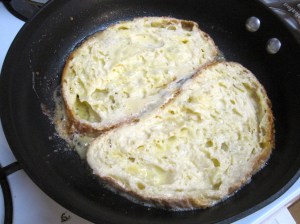
Heat a nonstick frying pan or griddle on med. heat. Carefully lift one slice of bread at a time and place it in the pan; once you have fit as many slices as possible, pour a few tablespoons of the soaking liquid over them. Fry for 3-4 mins. on one side, flip over, then fry for 2-3 mins. on the other side, until they’ve picked up some color, like french toast. Serve warm.

The Results

Not surprisingly, fried cream turns out to be like a very rich, slightly boozy, soft french toast. The white wine and high proportion of heavy cream make this a heavy-hitting dish; I’m no lightweight when it comes to rich food, but I managed about half a slice before needing a breather. The main difference between fried cream and french toast is that fried cream has a higher cream-to-egg ratio, producing a softer, wetter result.

It’s unclear when in the day Kendrick and her contemporaries might have eaten this fried cream. We think of french toast as a breakfast/brunch option, and fried cream would certainly work for a decadent brunch, alongside fruit and coffee. Minus the sugar, it would also make a simple dinner with a green salad plus vinaigrette. (Whenever you eat it, I think some acidic accompaniment to cut the richness would be helpful.) I really liked the tangy addition of white wine to the soaking mixture – something a little different from other boozy french toasts made with bourbon or liqueurs like Grand Marnier.

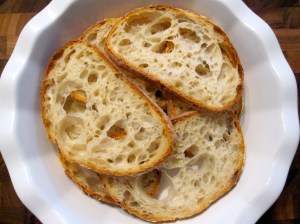
I used sourdough in 1/4″ slices, but these were really too thin to hold together well after soaking; I think the thicker 1/2″ slice would be easier to work with. A denser white or multigrain loaf, even challah, would work well – anything you’d like for french toast.

It would be easy to play with the spices here, adding other flavors to the nutmeg. Cinnamon would work, of course, and ginger in the winter might be nice. You could also infuse the cream with a vanilla bean, cinnamon sticks, or another flavor before adding the other ingredients. Some orange zest would be lovely. And while I have no qualms about heavy cream, substituting milk for maybe half of the cream might lighten things up a bit. Just a bit – the recipe IS called “fry’d Cream,” after all. Light it isn’t.