Herb Soop

A few weeks ago, thanks to my old friend George Leader, I was lucky enough to visit an archaeological dig at an eighteenth-century farmhouse on The College of New Jersey’s campus. I’d never been to a dig site before, so the technical details alone were fascinating: the reasoning behind determining where to dig in the first place, the standing sieve to strain buckets of earth for artifacts, the practice of wrapping fragile artifacts in foil (who knew!), the technology used to date wooden architectural features. I really dug it. (Sorry. Couldn’t resist.)

Seeing the farmhouse, getting to hold some of the artifacts unearthed that day – a metal button, a shard of blue and white pottery, and a small clay sphere that we theorized might have been a marble – made me think about this project and what we can uncover. I’m used to engaging with the past through words on a page. The archives always feel a little bit magical to me: these texts still exist centuries later, and I get to touch them, smell them, read them. I felt a similar tug at the dig, seeing artifacts being unearthed and thinking about our access to the past through what happens to have been left behind. At a basic level, archaeological investigation and archival literary research give us physical access to fragments of past lives, preserved deliberately or accidentally. You figure out where to look, but you don’t always know what you’re going to find.

This project is one of reconstruction from a distance and with pieces missing: the recipes are vestiges of what did get recorded, leaving little behind of what didn’t. Cooking from the archives creates a powerful bridge between me and the past. I will never stand in a kitchen without refrigeration, without even the possibility of electric lights, without having spent my whole baking life reaching automatically for ingredients like vanilla extract and uniform sticks of butter, but I can still approximate how Naples biscuits would have tasted nearly three hundred years ago.

There’s always a gap, though, related to how just far that bridge can reach. Working on this project has brought me up short at this gap time and again: reading handwritten manuscripts begs to know more about the person who wrote them, but there’s often little headway to be made. We can decipher handwriting, but identities are harder. This impulse isn’t just personal – it’s a question that comes up often for me and Marissa, of who wrote these recipes down, of what we know about them. Usually, not much. But this recipe left a faint trace of one of the individuals behind it.

This Herb Soop comes from UPenn MS Codex 1038, home to some of my favorites, like the Maccarony Cheese and Desart Cakes. The volume contains at least three separate hands, and we still don’t know anything about these writers. This handwriting is the second in the volume, probably written down sometime in the 1790s or early 1800s. The end of the recipe attributes it to “Lady Laroche.” (She is probably the source and not the writer of this recipe, since several subsequent recipes in the same handwriting are attributed to other women.) It is nearly impossible to know anything about the other women whose names accompany their recipes – the Mrs. Baker who gave the writer her recipe for Curd Cheescakes, the Mrs. Fordham who told her how “To make Flumery,” or the Mrs. Turner who showed how “To Dress a real Turtle as the[y] do in the West Indies,” for instance. “Lady,” however, provides direction in a way that “Mrs.” often cannot.

It turns out that this “Lady Laroche” can be one of only two women. James Laroche, a Bristol politician and slave-trader, was created baronet in August 1776. Since the baronetcy became extinct when he died in 1804 without any male heirs, this Lady Laroche has to have been one of his two wives. The first Lady Laroche was born Elizabeth-Rachel-Anne Yeamans in Antigua. An heiress (she brought at least one plantation to the marriage) and widow, she married James Laroche in 1764 and moved to England with him. After Elizabeth-Rachel-Anne died in 1781, James remarried; his second wife may also have been named Elizabeth. We know nothing else of her except that she survived her husband and died in Wales in 1824. Can we know how or even if this recipe writer and either Lady Laroche knew each other? What else they might have talked about, why this particular recipe was the one shared? No. But sometimes, even this small glimpse into archival identities feels like uncovering something satisfying.

The Recipe
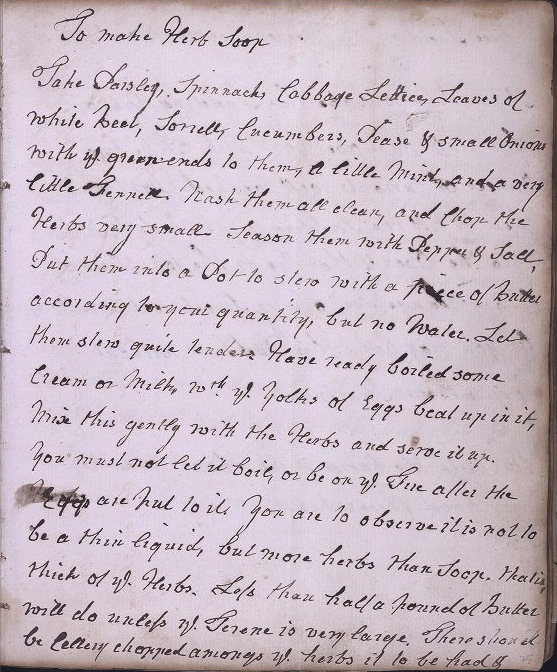
Herb soopHerb soop contd

To make Herb Soop

Take Parsley, Spinnach, Cabbage Lettice, Leaves of
White Beet, Sorrell, Cucumbers, Pease & small Onions
with the green ends to them, a little Mint, and a very
little Fennell. Wash them all clean, and Chop the
Herbs very small. Season them with Pepper & Salt,
Put them into a Pot to stew with a piece of Butter
according to your quantity, but no Water. Let
them stew quite tender. Have ready boiled some
Cream or Milk, with the Yolks of Eggs beat up in it,
Mix this gently with the Herbs and serve it up.
You must not let it boil, or be on the Fire after the
Eggs are put to it. You are to observe it is not to
be a thin liquid, but more herbs than Soop. that is,
thick of the Herbs. Less than half a pound of butter
will do unless the Terene is very large. There shoud
be Cellery chopped amongs the herbs if to be had &
—-
other herbs you like but not strong of any one in particular.
Some leave out the Fennell, as it is apt to be too strong.
Lady Laroche.

Our Recipe

3 generous handfuls of spinach (about 1 1/2 c. chopped)
1/2 c. parsley, chopped
a few mint leaves, chopped
1 large or 2 small cucumbers, diced (I also seeded mine)
1-2 celery stalks, sliced thinly
1 c. chopped cabbage
3/4 c. green peas (fresh or frozen)
3 scallions, sliced thinly
1/2 tsp. salt
a few grinds of pepper
1 tbsp. butter
1/2 c. milk
1 egg yolk

In a medium saucepan, combine all ingredients except for the milk and egg yolk. Cook them over low-medium heat, stirring often enough to prevent the greens from sticking. Cook until the greens are all wilted and the cucumbers are translucent; for me, this took about 20 minutes. (Though you could probably let them “stew” even longer.) Heat the milk in the microwave or on the stove until quite hot. In a small bowl, whisk the egg and then, still whisking, add the hot milk in a steady stream. Remove the herb mixture from the heat and stir in the milk. Serve immediately.

The Results

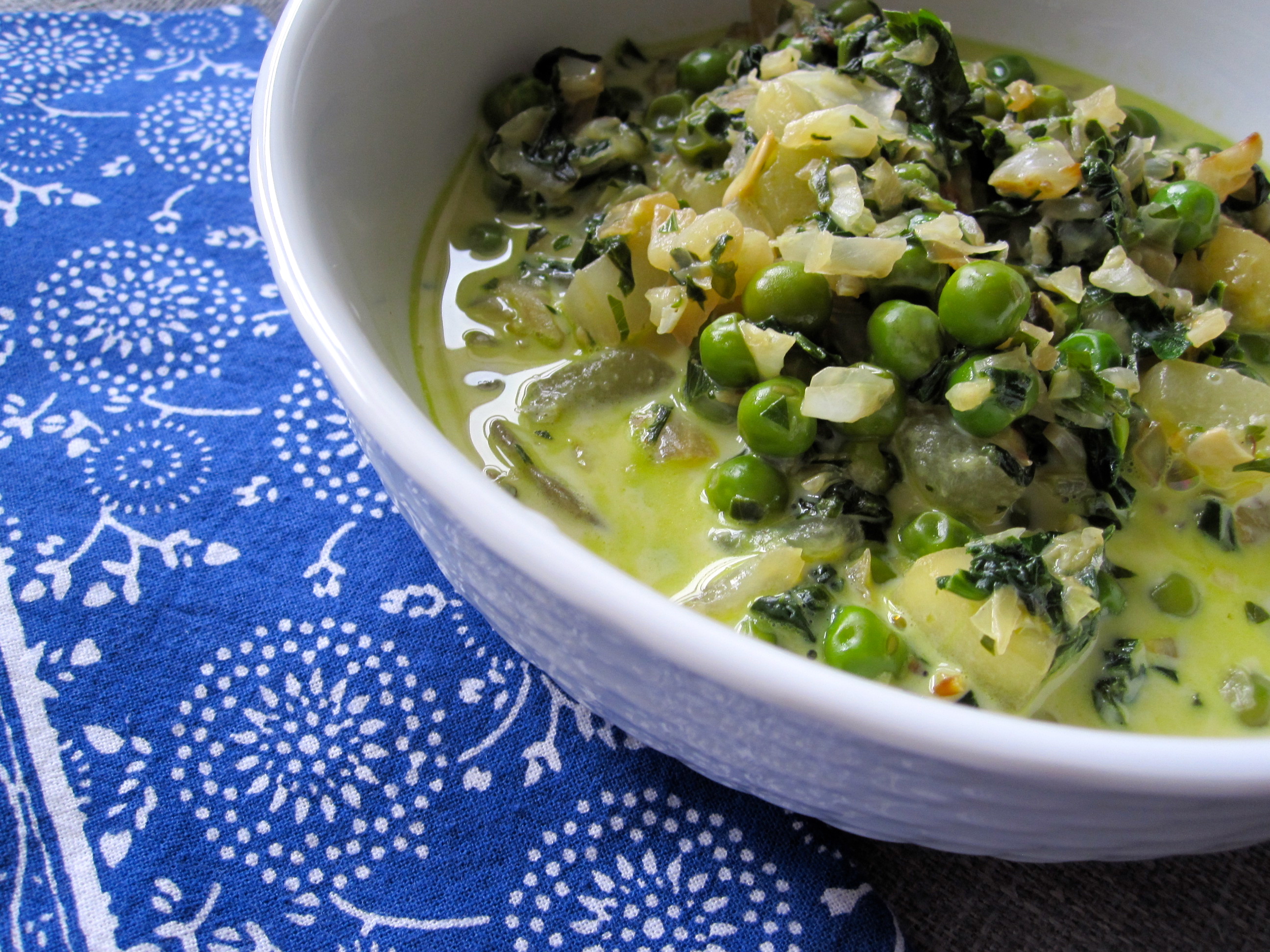
The Soop tasted green: stewed together, the herbs and vegetables made a pleasantly flavorful whole. I’d never had cooked cucumbers before and was curious – they softened but held their shape, rather like zucchini, and provided nice texture in the soup. I liked the zip from the scallions and the chewiness of the cabbage (even if cooking it did make my kitchen rather … fragrant). In its piling together of many different herbs and vegetables, the Herb Soop felt like a precursor to some of Yotam Ottolenghi’s recipes. I found it satisfying that what I was tasting was probably pretty close to some of the results this recipe would have yielded for eighteenth-century cooks: all of the ingredients remain available, the cooking technique was easily duplicated in my kitchen (albeit with the ease of a gas stove), and the methodology was specific enough that I could follow the recipe’s instructions closely.

In fact, this Herb Soop recipe is quite detailed in its ingredient list and instructions – it’s very helpful to know, for instance, that the end result should be “more herbs than Soop” – more so than many of the other recipes we’ve engaged with, like Artificial Potatoes. But it provides few precise measurements. I guessed at these proportions, determining them largely based on what I had and what I liked. (I don’t love fennel, so I’m one of those “some” the recipe mentions who “leave [it] out.” And my little produce market doesn’t carry sorrel, so I didn’t use it.) And I imagine that’s what early cooks did as well, making the soup slightly differently each time based on what needed to be used or what was available.

What else could you toss in here? Leeks, zucchini, basil, cilantro, green bell peppers – really, anything green that happens to be lurking in your crisper could make its way into this soup. Some hot pepper flakes would liven things up. I see the appeal behind the milk-and-egg liquid choice: it’s a rich addition and adds some depth to the greens. However, I might substitute some vegetable broth or chicken stock for a lighter soup. Basically, this recipe provides a wonderful alternative idea for using up the leftover greens that I normally toss into a grain salad, a stir-fry, or baked eggs.
IMG_4511

Oven Cakes

Alyssa once called me a “yeast whisperer.” I love baking with yeast — no-knead bread and flatbreads make regular appearances in my kitchen and challah, herb-speckled dinner rolls, baguettes, and babka emerge from the oven on special occasions. A few weeks ago I was looking over the recipes I’ve made over the course of this project and I realized I hadn’t pulled out my yeast once. It was high time to correct this oversight.

This recipe for “Oven Cakes,” fluffy leavened rolls, comes from Ms Codex 644. I wrote about this manuscript a few weeks ago about in our “Cheape Soupe” post and these rolls would certainly pair with that soup.

The Recipe

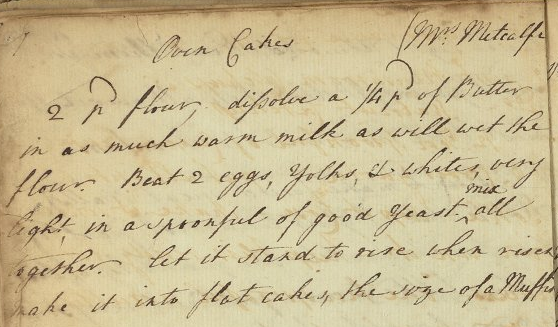
oven cakes

Oven Cakes                            Mrs: Metcalfe

2 pound flour, dissolve a 1/4 pound of Butter
in as much warm milk as will wet the
flour. Beat 2 eggs, yolks, & whites very
light, in a spoonful of good yeast mix all
together. let it stand to rise when risen
make it into flat cakes, the size of a Muffin

Our Recipe

This recipe makes a delicious and versatile roll that could accompany soup, add to a dinner spread, provide a foundation for a fierce sandwich, or make a mean midnight snack. As a yeast baking aficionado, I need to do additional research on the status of yeast in the eighteenth century, before Pasteur identified it as a living organism. My normal sources had very little information on how one would add a “spoonful of good yeast” to this recipe in the 1700s. I assume wild yeast and something like a sourdough starter may have been involved. The dried yeast I rely on certainly would not have been available. In addition, what we now call “English muffins” are (still) simply called “muffins” in the UK. I flattened the cakes into round disks based on what I know about muffins and the recipe’s clear instructions.

The only thing I added to this recipe was salt. (And, honestly, I’ll likely add some more salt the next time I make them.) I halved the original here and it made eight rolls.

1lb flour (3 2/3 c)
1/8 lb unsalted butter (4 T)
1 egg
1 c milk
1 t yeast
1/2 t salt (I plan to try 1 t next time.)

Measure all ingredients. Melt the butter, heat the milk, and lightly beat the egg. In a large bowl, mix together flour, butter, and milk until combined. Add the egg, then the yeast. The mixture will be sticky, moist, and somewhat unmanageable. I didn’t knead this dough, but I did stir it vigorously. When everything is well-combined and the dough is smooth, if unwieldy, cover with a towel and leave to rise in a warm place for an hour and a half.

When the dough has risen and springs back to the touch, preheat oven to 400 F. My dough didn’t quite double in size, but it did plump up nicely. Divide the dough into eight rolls and pat into round disks. Butter two baking sheets. Leave ample room between rolls.

Bake for 10-15 min, until golden on the top and firm on the bottom. Try to let the rolls cool down before eating them. Serve warm.

The Results

I devoured these. I ate the first one hot out of the oven. It smelled vaguely yeasty, but it was buttery and delightful. After the first few bites, I brought out my current favorite spreads: Lydia Pyne‘s strawberry jam and “Three Citrus Marmalade” made by the local Fallen Fruit from Rising Women project. I ate some rolls with almond butter for breakfast: I ate some more with leftover chilli for dinner. This is a recipe that will make a return appearance in my kitchen. I look forward to making a batch with chopped fresh herbs, nuts and dried fruit, sprinkled with seeds, and/or brushed with an egg glaze.

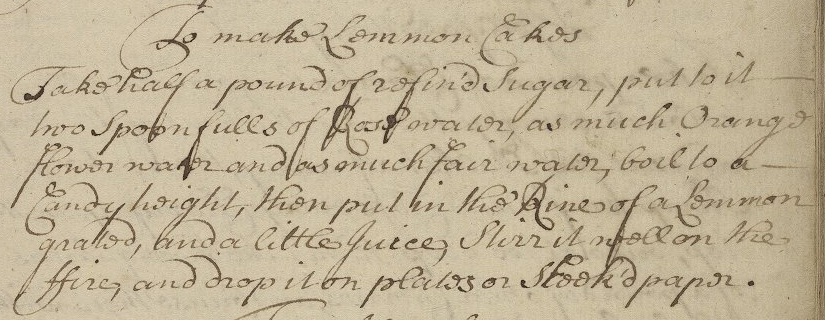
To make Lemmon Cakes

Not all recipes are original. Flipping through MS Codex 785 I was intrigued by this recipe for “Lemmon Cakes.” These lemony sweets are candies, not cakes! But with a little research into the recipe’s ingredients and methods (fair water? candy height? sleek’d paper?) I located its origin: This recipe is a verbatim transcription from Hannah Woolley’s cookery book The Queen-like Closet or Rich Cabinet: Stored with all manner of Rare Receipts For Preserving, Candying and Cookery. Very Pleasant and Beneficial to all Ingenious Persons of the Female Sex (1670).

Woolley was already known for her earlier cookery books and this one was reprinted a few times in the last decades of the seventeenth-century. (The full text of the second edition is available here.) It also seems to have been a common book in early American kitchens (more on this here). Woolley’s recipes were certainly a touchstone for cooks in the early decades of the eighteenth-century when this manuscript was most likely compiled. Moreover, our manuscript compiler not only copied the recipe for Lemmon Cakes, but also for a range of other recipes for preserves, biscuits, and other dishes. In the early sections of the manuscript the order matches Woolley’s exactly.

It is not uncommon for manuscripts materials in the seventeenth and eighteenth centuries to include substantial extracts from printed works. Recipe books are no exception. MS Codex 785 is an intriguing patchwork of recipes from an array of sources, some that I plan to track down soon.

The Recipe

lemmon cakes

To make Lemmon Cakes

Take half a pound of refin’d sugar, put to it –
two spoonfulls of Rose water, as much Orange
flower water and as much fair water, boil to a –
Candy height, then put in the Rine of a Lemmon
grated, and a little Juice, Stirr it well on the
ffire, and drop it on plates or sleek’d paper.

 Our Recipe

Our recipe is very similar. As I mentioned above, with some basic searching it became clear that “fair water” is a  synonym for “clean water”; “candy height” is the moment when the sugar is dissolved but begins to re-form crystals on the sides of your pan; and “sleek’ed paper” is made “slick” in preparation for the hot candy. Woolley also includes a recipe for “plates” or wafer-like bases for candies.

1/2 lb sugar
2T rosewater
2T orange blossom water
2T water
zest of one lemon
juice of half a lemon
baking parchment (or other appropriate surface)

(I made a half batch.)

Put the sugar, scented waters, and water into a small saucepan. Heat until the sugar is melted and crystals begin to form on the side of the pot. Add the lemon zest and juice. Heat through and stir.* Pour candy mix onto baking parchment to set. Cut, break, or use another method to shape bite-size candies.

The Results

I am not a skilled candy-maker: I messed up on this one. My “lemon cakes” were more of a caramelized, sweet, lemony brittle. They were relatively tasty to suck on like a lozenge, if in a tangy (partially burned) sort of way. If you know how a thing or two about working with hot sugar, or a least own a candy thermometer, you may fare better with this recipe. I’d be curious to see how other citrus or floral waters and zests would flavor these candies.

Regardless, I’ll be coming back to more recipes from MS Codex 785 and Hannah Woolley’s cookbooks.

*This is the point in the recipe where I think a candy thermometer (or skill) might help.


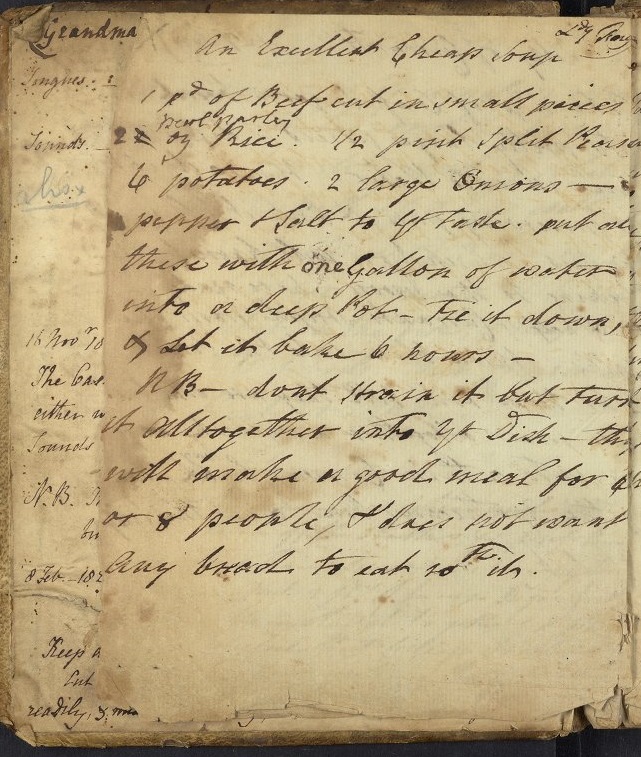
An Excellent Cheap Soupe

It’s soup season. I live in southern California and I have absolutely no complaints about winter weather, but I did get a good dose of cold when I visited Alyssa in Philadelphia this month to work on project planning and to prepare for our forthcoming profile in frankie magazine (out April 2015). In any case, who doesn’t enjoy a good bowl of soup?

This recipe comes from Ms. Codex 644. Penn’s catalogers suggest that the manuscript was compiled between 1750 and 1825 and attribute this book primarily to a Lady Frankland with some additions in other hands. A note inside the front cover the manuscript entitles the volume “Grandmama Lady Frankland’s Receipt Book.”

grandmama lady frankland

This manuscript may be a product of the household of Sir Thomas Frankland, fifth baronet (1718–1784). This is a preliminary speculation, but one I hope to research in more detail. I’ve linked to wikipedia above because it’s freely accessible, but I’m also drawing on information from the Oxford Dictionary of National Biography. 

Sir Thomas Frankland married Sarah Rhett of South Carolina (1724-1808) in 1743 and she may very well be the “Grandmama Frankland” who compiled and used this recipe book. The family likely lived at the Frankland estate in Mattersey, Nottinghamshire while Frankland traveled between England and the West Indies where he was involved in the Atlantic slave trade, among other commercial ventures. The couple had many children (somewhere between thirteen and nineteen according to various accounts), and nine lived long enough to be mentioned in Frankland’s will. This recipe for cheap soup would certainly feed a crowd.

If this volume truly is a product of the Frankland family, my preliminary biographical research leaves me with many questions about the volume: What kind of history can these recipes possibly reveal? Can the volume provide a window into the history of slavery? Does it have anything to tell us about southern foodways, transatlantic communication, and global recipe exchange? For example, Frankland was born in the East Indies, possibly in India, and that connection to South Asia may explain the presence of a recipe for Indian Curry in the volume.

Stay tuned for more on Ms. Codex 644 as we continue to research its provenance and try out its intriguing recipes!

The Recipe

cheap soup recipe

Lady Fagg
An Excellent Cheap Soupe
1 pound of Beef cut in small pieces
perl p[b?]arley
2 2 oz Rice. 1/2 pint split Peas
6 potatoes. 2 large Onions —
pepper & salt to the taste. put al[l]
these with one Gallon of water
into a deep Pot – Tie it down,
& Let it bake 6 hours –
NB – dont strain it but turn
it alltogether into the Dish – th[is]
will make a good meal for 6
or 8 people, & does not want
any bread to eat with it.

This is a straightforward recipe and it required minimal modification to work in my kitchen.

The soup recipe, like many others in the volume, is attributed to Lady Fagg in a small note at the top right corner of the page. Other sources noted in the manuscript include – Lady Monson, Lady Roche, Miss Colville, Miss Bedingfeld, Miss Bowles, Richard Jebb, Mrs. Cowslade, Baroness Philetsen, Dr. Addington, Dr. Bateman, Dr. Reynolds, and Dr. Darwell.

The final paragraph is a note that adds extra information to Lady Fagg’s recipe. “NB” stands for the Latin phrase nota bene, roughly translated as “take note.” This phrase that was used in books as a mnemonic aid to mark passages, thoughts, instructions for future use. It appears in many places throughout the manuscript.

Our Recipe

1 lb stewing beef, cut into 1-2 inch cubes
4 T butter, for browning beef
2 large yellow onions, chopped
2 oz pearl barley, rinsed and sorted
7 oz split peas, rinsed and sorted
6 potatoes, chopped into 1-2 inch cubes
cooking liquid: 1 cup chicken stock & 2 quarts water (This was the maximum amount of liquid my largest pot could hold. If you have a big stock pot, you should be able to accommodate a full gallon of cooking  liquid. I recommend using 1/3 vegetable or meat-based broth and 2/3 water.)
salt and pepper to taste

Preheat your oven to 325F. Measure, chop, and prepare all ingredients.

Heat 2 T butter in an oven-safe stock pot or dutch oven. Brown the beef cubes in butter to seal-in their flavor. Add the other 2 T of butter as needed. When the beef is mostly browned, add the onions and allow them to soften for 1-2 minutes. Add the barley, peas, potatoes, and cooking liquid (stock and water) and cover. When the soup has come to a rolling boil, add salt and pepper to taste. Then transfer the pot to the oven to cook for approximately 2 hours. Check every 45 minutes or so to make sure the grains have not absorbed all the liquid and add water as needed.

The Results

This soup is tasty, warm, and filling. It could easily feed a large group or provide delicious leftovers for future meals.

The leftovers fed me, and my spouse Joseph, for a few meals. He even thought it tastier leftover because the flavors deepened. Although the recipe note insists that the soup does not need to be served with bread on the side, bread did make it a more substantial meal. Our batch produced ten servings (with bread) and if we’d had a larger pot we could have made an even greater volume. This soup is economical even in 2015 with its smart use of cheap cuts of beef and filling, healthy grains and legumes.

A sprinkling of fresh herbs like sage or parsley would add extra flavor to each bowl. I would suggest serving this soup on a cold night with warm bread, a green salad with a kale or spinach base, and a nice bottle of  your favorite stout or porter.

Artificial Potatoes

This recipe has been on my mind for a while. What are Artificial Potatoes? And WHY are they? I wanted to solve the mystery of the Artificial Potatoes. (The Mystery of the Artificial Potatoes: title for my first novel?) I couldn’t quite imagine from the recipe even what they would look or taste like, which is the perfect justification for a culinary experiment.

This recipe comes from Ms. Codex 1038, home to one of my favorites thus far: the Desart Cakes (which I mentally pronounce as “DeSART Cakes,” just because it’s fun). This is one of the first recipes in the book. Potatoes were introduced into England by the late seventeenth century, so the writer of this late-eighteenth-century recipe would have been familiar with “real” potatoes.

While we frequently notice recipes that crop up across multiple cookbooks (particularly for puddings), we haven’t come across another one for Artificial Potatoes. Curious, I ran a search through Eighteenth-Century Collections Online, an invaluable digital database of texts published between 1700 and 1800. And I found something interesting. Even with variant searches, only one recipe for Artificial Potatoes comes up, in Eliza Smith’s The Compleat Housewife: or, Accomplish’d Gentlewoman’s Companion (1742, 11th ed.; the recipe appears through the 18th ed., 1773). While I’m sure there are other Artificial Potatoes recipes out there in manuscript and in print, this scarcity is striking. Our manuscript recipe is worth comparing with Smith’s:

Artificial Potatoes for Lent: A Side-DishSecond Course.

Take a pound of butter, put it into a stone mortar with half a pound of Naples-bisket grated, and half a pound of Jordan almonds beat small after they are blanched, eight yolks of eggs, four whites, a little sack and orange-flower-water; sweeten to your taste; pound all together till you don’t know what it is, and with a little fine flour make it into a stiff paste, lay it on a table, and have ready about two pounds of fine lard in your pan, let it boil very fast, and cut your paste the bigness of chesnuts, and throw them into the boiling lard, and let them boil till they are of a yellow brown; and when they are enough, take them up in a sieve to drain the fat from them; put them in a dish, pour sack and melted butter; strew double-refin’d sugar over the brim of the dish.
(E[liza] Smith, The Compleat Housewife [London, 1742, 11th ed.], 131-32)

That Smith identifies these Artificial Potatoes as a Lenten dish is intriguing. I don’t know of a reason why real potatoes might be off-limits during Lent, or why these fried dough balls should be particularly suited to Lent. (Any insights are welcome!) It’s also good to note that Smith identifies these as “a Side-Dish; Second Course” – not, in other words, as dessert. What we might think of as a dessert because of its ingredients (ground almonds, biscuit crumbs, sugar, flower water) wasn’t necessarily so for eighteenth-century eaters.

Smith’s recipe raises another question: what should these Artificial Potatoes look like? I assumed that they would be small and round, like new potatoes, “the bigness of chestnuts,” as Smith’s recipe directs. But the Ms. Codex 1038 recipe writer directs the cook to “Cut them into what shapes you like,” which sounds more like a flat roll-out cookie. As we’ll see, I tried both ways. But before shaping the Potatoes, I had to gather the ingredients.


Recipe within a Recipe: Naples Biscuits

As if these Artificial Potatoes weren’t mysterious enough on their own, they required some additional sleuthing for one of their ingredients. The recipe calls for “Naple Biscuits,” or Naples biscuits, but doesn’t provide a recipe. Research time! Naples biscuits are rosewater-flavored dry biscuits baked in small rectangular tins, similar in texture and size to our ladyfingers. Naples biscuits feature in a range of early modern recipes – for puddings, mince pies, even a possett drink. (Biscuit-crumb-enhanced cold possett? We might need to try that one.) They’re typically grated into crumbs and used as a thickening agent rather than left whole. But how to make them? Ms. Codex 1038 doesn’t contain a recipe, so I turned again to ECCO to search for Naples biscuits (or biskets). Interestingly, while a lot of eighteenth-century cookbooks call for Naples biscuits, sometimes in as many as eight recipes, they almost never include a recipe for them. My search yielded only a few recipes. This suggests either that the basic recipe was so well-known that it didn’t need to be given or, more likely, that cooks would buy Naples biscuits already made, just as we often do with ladyfingers.

I used Elizabeth Cleland’s New and Easy Method of Cookery (1759) for reference:

To make Naples Biscuits.

Take a Pound of fine Sugar pounded and sifted, a Pound of fine Flour, beat eight Eggs, with two Spoonfuls of Rose-water; mix in the Flour and Sugar, then wet it with the Eggs, and as much cold Water as will make a light Paste; beat the Paste very well, then put them in Tin Pans. Bake them in a gentle Oven.
(Elizabeth Cleland, A New and Easy Method of Cookery [Edinburgh, 1759])

My version, which halves Cleland’s:

4 eggs
1 tbsp. rosewater
1/2 lb. sugar
1/2 lb. flour

Beat eggs and rosewater (by hand or with a mixer) until frothy; add sugar and flour and beat thoroughly, until lighter in color and very well blended. If dough seems too heavy or dry, add 1 tsp. cold water at a time. (My batter held together nicely at this point, similar to a pound cake batter. Since another Naples biscuit recipe I looked at didn’t call for the addition of cold water to thin the batter, I left it out. I might try it next time to see if the water produces a slightly lighter biscuit, but these turned out just fine.)

Bake in greased madeleine pans, filled with 2 tbsp. batter each, for 14 mins. at 350F. They should be firm to the touch, lightly browned around the edges and on the scalloped bottoms, but the tops won’t have much color. Turn onto a wire rack and cool completely. Makes 20 madeleines. (Mini-muffin tins would also work.)

These Naples biscuits aren’t showstoppers, and they don’t clamor to be eaten by themselves, though I nibbled on one while making the Artificial Potatoes. They’re dense, dry, and nicely rosewater-y, and that’s about it. I understand why they were used more often as ingredient than eaten as a stand-alone treat.

IMG_4459


The Main Recipe

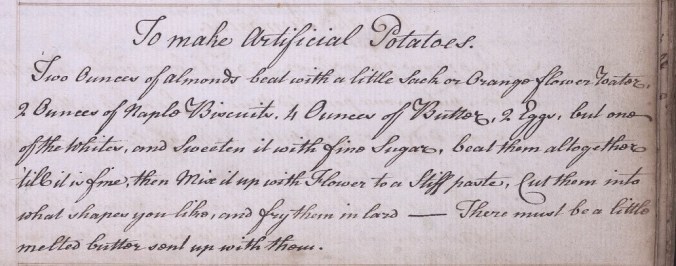
artificial potatoes
To make Artificial Potatoes.

Two Ounces of Almonds beat with a little Sack or Orange-flower Water,
2 Ounces of Naple Biscuits, 4 Ounces of Butter, 2 Eggs, but one
of the Whites, and Sweeten it with fine Sugar, beat them altogether
’till it is fine, then Mix it up with Flower to a Stiff paste, Cut them into
what shapes you like, and fry them in lard — There must be a little
melted butter sent up with them.


Our Recipe

2 oz. (heaping 1/2 c.) ground almonds
2 oz. Naples biscuits [2 madeleines], grated or pulsed in a food processor into crumbs*
3/4 c. flour
4 oz. (1 stick) butter, softened
4 tbsp. sugar
1/2 tsp. orange flower water (optional; you could also use sherry or rosewater)
1 egg
1 egg white
oil for frying**

Combine dry ingredients (almonds, biscuit crumbs, flour) and set aside. Cream the butter and sugar, then add the orange flower water, egg, and egg white and mix until well-combined. Dough should hold together and be soft but not too sticky.

Shape dough in one of two ways:

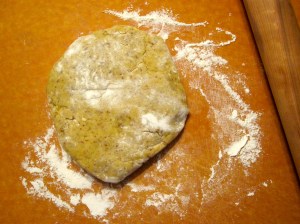
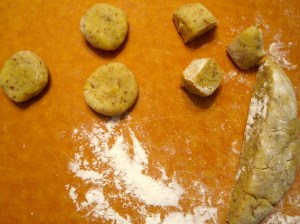
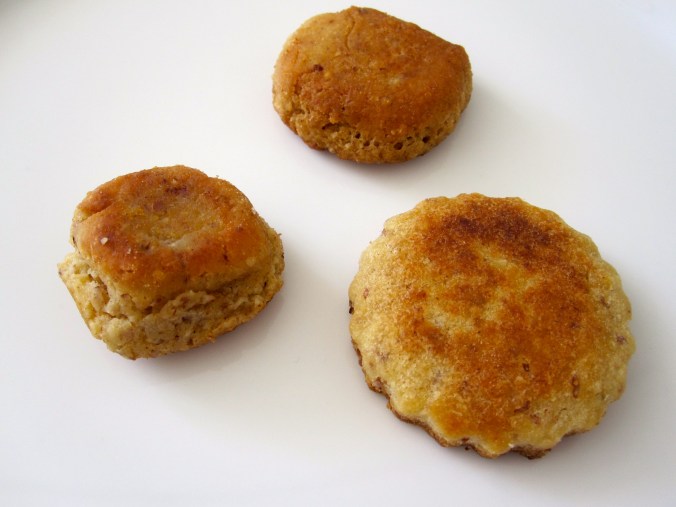
1) Cut or pinch off about a tbsp. of dough and roll it in your hands until fairly round. Repeat. (I also flattened these round balls slightly for one round of frying; they cooked through somewhat better.)

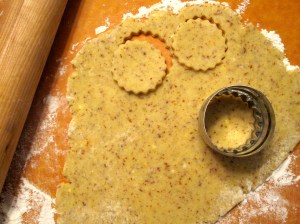
2) Chill dough for 10 mins. to let it firm up a bit, then roll it out on a floured board to about 1/4″ thick; punch out rounds with a cookie cutter. Smaller rounds (1.5 to 2″) are best.

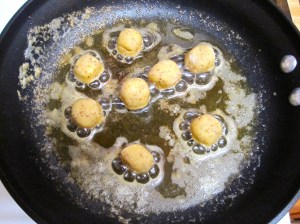
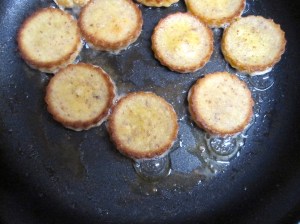
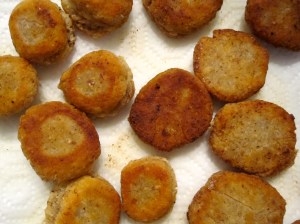
Line a plate with paper towels. Heat 2 tbsp. oil (see **Note) in a skillet at medium-high heat and fry the Potatoes in batches, giving them a few minutes on each side, until golden-brown. As the Potatoes are done, place them on the lined plate to absorb excess oil. I didn’t think they needed the flourish of extra melted butter on the side, but then again, melted butter never hurt anything.

*Note on pulverizing the biscuits: I grated mine on a box grater, but since the edges are quite hard, the process was pretty messy and I ended up with uneven crumb size (powdery from the edges, larger from the softer centers). I’d use a food processor next time.

**Note on frying: The original recipe calls to fry the Potatoes in lard, but I don’t exactly keep lard on hand. I fried the first batch in butter, which gave them a lovely browned-butter taste … until, of course, the butter solids started burning. I switched over to oil and had more success. So, fry in your preferred fat.

Clockwise from left: round ball, flattened ball, cut-out round


The Results

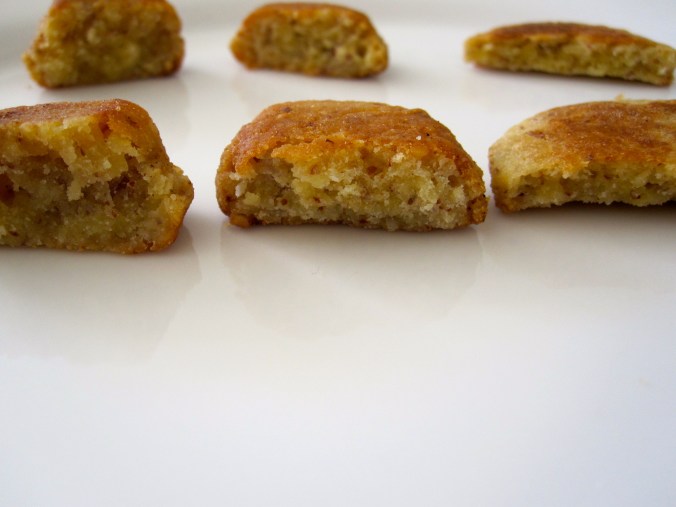
As sometimes happens with long-anticipated recipes, these were somewhat underwhelming. I’m still not sure what they should look like: it makes the most sense that they would look like small potatoes, but rolling and cutting them out bakes them more thoroughly and avoids a doughy center. Whatever shape, taste-wise they’re fairly bland. They’re also slightly greasy from being fried; I might actually try this recipe again but bake the rounds, just to see if they would work as cookies.

However, this experiment has taken the edge off my Artificial Potato curiosity. And now I have more than a dozen Naples biscuits in my freezer just waiting to thicken more dishes down the line.

to make an orange puding

It’s citrus season in southern California. My weekly farmer’s market is full of varieties I’ve never seen before. On the freeway this week, I drove past a truck pulling two caged trailers almost overflowing with small oranges. It inspired me. Later that day I decided to try this recipe for an “orange puding” from Ms. Codex 252 because I had all the ingredients in my kitchen: navel oranges, eggs, sugar, and butter. I also had some leftover pastry in the freezer, but making a batch from scratch would only add salt and flour to that ingredients list! This dessert is somewhere between a modern pudding and a custard pie and it captures the powerful taste of oranges.

The Recipe

orange puding

to make an orange puding

Take the rinds of 3 oringes boyle them in 3 watters ore 4 till they be tender
then beat them in a morter put to them 5 eggs leaue out 2 whitts; halfe a pound
of sugar and halfe a pound of butter beat all together tell it be well mixt then put
it in a Dishe with a littell puffe paest Crust one the top and the Bottom

Our Recipe

I made very few changes to this one. I halved the quantities to try it out in a smaller pan, so I’ve included full and half ingredients below. I also decided to make a lattice top for the pie instead of completely enclosing the custard. This allowed me to keep an eye on how it was cooking. It also allowed the top of the custard to form a beautiful, crunchy crust that added a great texture to each bite.

Full                                                                         Half

3 oranges                                                               1 1/2 – 2 oranges, depending on size
5 eggs (3 whole, 2 yolks)                                     3 eggs (2 whole, 1 yolk)
1/2 lb sugar (1c)                                                   1/4 lb sugar (1/2 c)
1/2 lb butter, soft (2 sticks or 16 T)                  1/4 lb butter, soft (1 stick or 8T)
1 batch pastry (Use your favorite pie crust recipe here. I used Mark Bittman’s recipe from How to Cook Everything)

Prepare your pastry and follow instructions on chilling or resting.

Preheat the oven to 350 F.

Peel the oranges carefully, avoiding the bitter white pith. Put the orange rinds into a small saucepan with a cup of water, cover, and bring to a boil. Simmer until the rinds are tender. Set aside to cool.

Butter an ovenproof pie dish. Roll out the pastry and place the bottom crust in the ovenproof dish.

When the rinds are slightly cooled, blitz them in a food processor until they form a bright orange paste. If the food processor is large you may need to scrape down the sides a few times. A mortar and pestle (as the original recipe instructs) or simply chopping the peels finely will also work here.

Cream together the butter and sugar. Either do this by hand, use a standing mixer, or a handheld mixer. Add cooked orange rinds and eggs. Mix until the custard becomes slightly fluffy. Pour into the prepared crust.

Top with a lattice crust, a full crust, or simply leave the custard open.

Bake for 45 minutes. (I checked at 30 minutes and checked every 5 minutes thereafter.) The pie is cooked when the crust is golden and the custard sets –a tester inserted in the center should come out clean.

The Results

At first I wasn’t sure about this one. When I sliced the pie and took my first bite the butter from the custard and the crust was completely overwhelming. But the next day I had friends over to try some archival desserts (stay tuned for more) and my second slice was divine. A day later, the orange flavor had deepened and the butter no longer dominated. I refrigerated the pie overnight, but let it come to room temperature before I served it the second day. This would be a great recipe to make a day in advance of a dinner or gathering.

Although I’m never one to say no to pastry, I think this pudding might be tastier as a crust-less custard like the “carrot pudding” we made a few months ago. This variation would also inevitably decrease the amount of butter in the dish and perhaps render my previous comment irrelevant.

Whether you have too many oranges on your hands or just want to cook something with citrus that tastes bright and fresh, “orange puding” is a quirky winter treat.


Potingall/Portugal Cakes

This recipe has also been featured in the Washington Post, in Sarah Kaplan’s wonderful article on our project.

Check it out here.

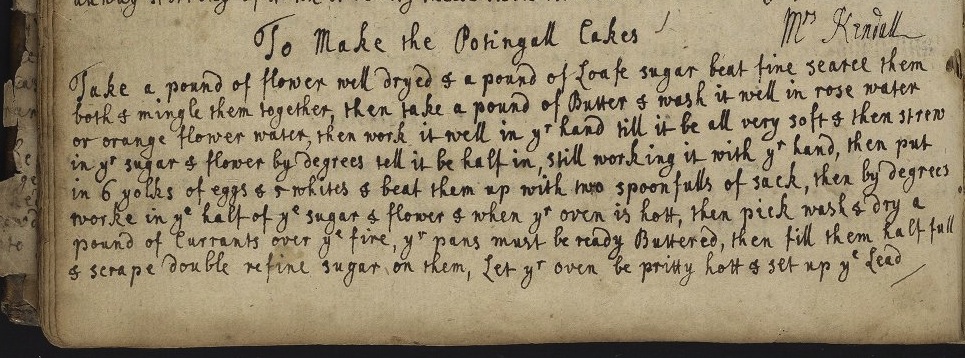
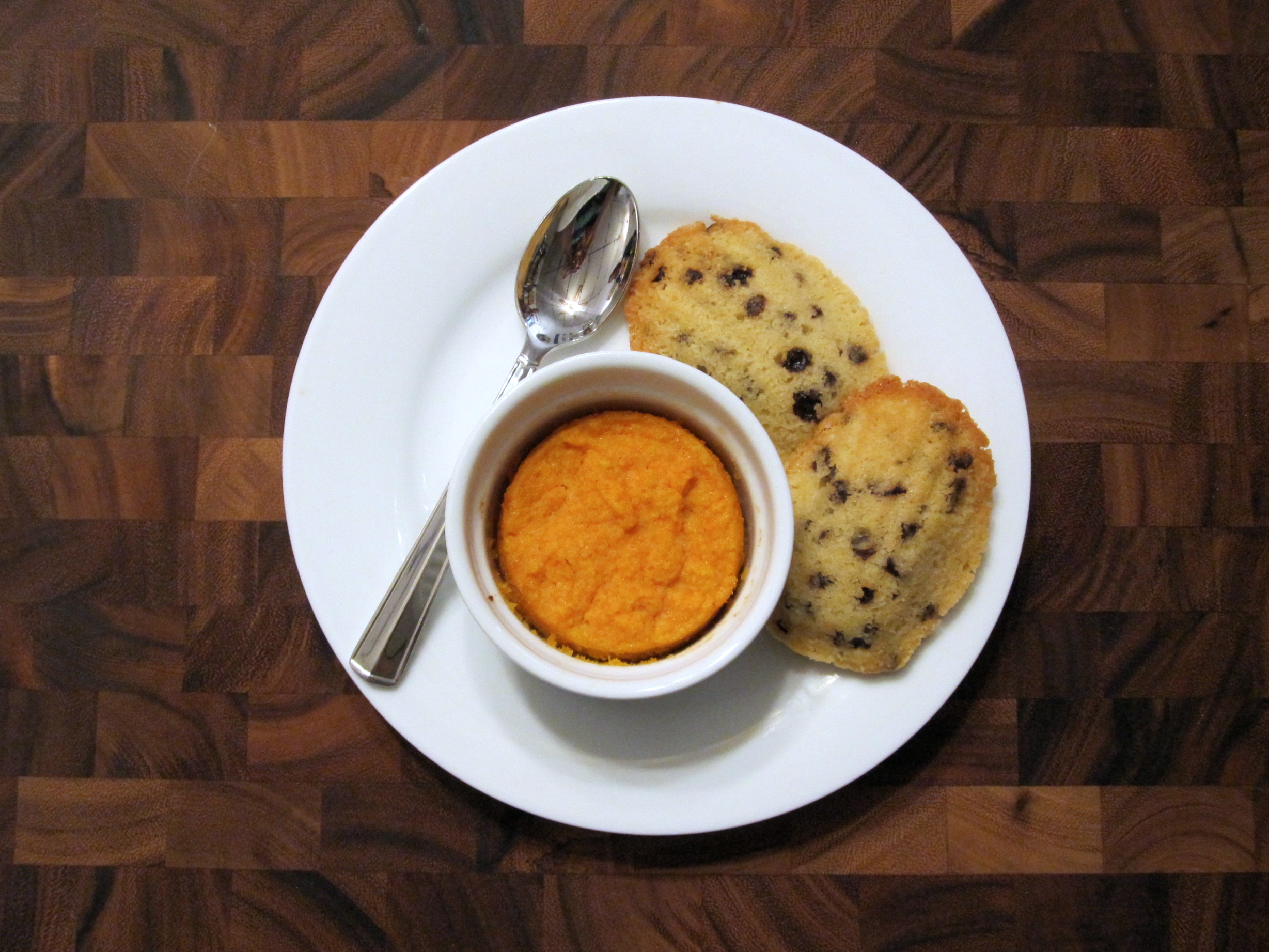
Like the fantastic Desart Cakes, these Potingall Cakes caught my eye because of their intriguing name and relatively simple ingredient list. Unlike the Desart Cakes, which are what we would call cookies, these are little cakes. And pretty tasty ones at that.

This recipe comes from the first volume of UPenn Ms. Codex 631, dated 1730. (This two-volume collection has become one of our favorites.) “Potingall” is probably a stand-in for “Portugal,” since the recipe closely resembles the fairly common recipe for “Portugal cakes” found in many seventeenth- through nineteenth-century cookbooks. Getting “Potingall” from “Portugal” doesn’t seem unreasonable: the two words are visually similar, and the writer copying the recipe into Ms. Codex 631 could have been working from another recipe that was difficult to read or itself mistaken. (Like an eighteenth-century game of telephone!) “Portugal” named a type of orange in the period and might refer to the recipe’s use of orange flower water. However, Portugal cakes’ name more probably relates to one of their ingredients: sack, a sweet, fortified white wine originally produced in Portugal.

The Recipe

potingall cakes

To Make the Potingall Cakes

Take a pound of flower well dryed & a pound of Loafe sugar beat fine searce them
both & mingle them together, then take a pound of Butter & wash it well in rose water
or orange flower water, then work it well in your hand till it be all very soft & then strew
in your sugar & flower by degrees tell (i.e. till) it be half in, still working it with your hand, then put
in 6 yolks of eggs & 5 whites & beat them up with two spoonfulls of sack, then by degrees
worke in the half of the sugar & flower & when your oven is hott, then pick wash & dry a
pound of Currants over the fire, your pans must be ready Buttered, then fill them half full
& scrape double refine sugar on them, Let your oven be pritty hot & set up the Lead

Our Recipe

[Note: I halved the recipe because these cakes taste best within one to two days.]

1/2 lb. all-purpose flour

1/2 lb. granulated sugar

pinch of salt

1/2 lb. [2 sticks] unsalted butter

1 tsp. rosewater or orange flower water*

2 whole eggs + 1 egg yolk

1 tbsp. sherry**

scant 1/2 lb. currants

optional: sugar for sprinkling on top

Preheat oven to 350F. Butter, coat with cooking spray, or line your pans.***

Mix together flour, sugar, and salt; set aside.

In a stand mixer or with a hand mixer****, cream the butter and flower water until light and fluffy.

With the mixer running at low speed, blend half of the flour mixture into the butter mixture; scrape down the bowl. Add the eggs and sherry, then mix at low-medium speed until combined; scrape down the bowl again. With the mixer at low speed, add the rest of the flour mixture; mix until the batter looks uniform. Add the currants and mix at low speed until they are distributed evenly.

Spoon batter into your pans (a cookie scoop works nicely here) and even out slightly with a buttered spatula. The cakes won’t rise much during baking but bake best as smaller cakes, so fill madeleine pans to the top, mini-cupcake pans nearly full, and cupcake pans 1/2 to 3/4 full. Optional: lightly sprinkle granulated sugar on top. (This adds a slight sparkle to the cupcakes but isn’t essential to their taste.)

Bake until cakes are firm to the touch at the center and golden brown around the edges. (A toothpick inserted into a cake should come out clean.) This will take around 12-14 mins. for mini-cupcakes, 14-16 mins. for madeleines, and 18 mins. for cupcakes. Let cool in pans for 3-5 mins., then remove onto cooling racks.

NOTES:

*Note on flower water: I tried these with both rosewater and orange flower water; I preferred the rosewater version because the flavor was subtler, but both flavorings played nicely with the currants.

**Note on sherry: I replaced sack (a sweet, fortified white wine) with the similar and more readily-available sherry. If you prefer a non-alcoholic cake, orange juice or white grape juice (or water) would most likely be a fine substitute. Raisins could also substitute for currants in a pinch.

***Note on pans: This recipe works best as small cakes: cupcakes, mini-cupcakes, or madeleines, for example. Use whatever combination of pans you’d like. The recipe yields approx. 18-32 cakes: 12 large madeleines (filled with 3 tbsp. batter each) + 6 cupcakes / 12 small madeleines (filled with 2 tbsp. batter each) + 10 cupcakes / 24 mini-cupcakes + 8 cupcakes.

****Note on mixing: In the spirit of updating this recipe to modern kitchens, I used a stand mixer rather than blending the dough by hand. However, the original method would also work – and be satisfyingly messy.

The Results

These are not light and fluffy cakes. They’re moist and dense, like a weightier muffin, with a rich flavor from the flower water, sherry, and currants. I liked them best as madeleines because that shape provides the highest edge-per-bite ratio – the crisply browned edges are particularly tasty. They also made an excellent snack alongside our old favorite, carrot pudding.

IMG_4455

To make maccarons of valentia Almonds

Today’s Cooking in the Archives post is also published on ABO-Public: An Interactive Forum for Women in the Arts, 1640-1840. Check out a slightly longer version of this post here.

What do ladies bake? Ladies bake macaroons, tasty almond macaroons.

This recipe “To make maccarons of valentia Almonds” is from MS Codex 627 The delights for ladys: to adorne there persons beautyes stillyris banquits perfumes & wators. MS Codex 627 is designed to look like a printed book and includes a title page with the date 1655, a full table of contents, and a running header “The delights” on the verso and “for ladies” on the recto of on each opening. We’ve only worked with one other manuscript with these features in this project to date: MS Codex 625 where we found “Shrewsbury Cakes.”

Another important feature of this manuscript is obscured, rather than revealed, by our digital images: its size. It’s very small! It fits in the palm of your hand. It could be easily carried in a pocket. As such, it may have also been somewhat difficult to use in the kitchen. Many of the other manuscripts we’ve surveyed have been substantially larger and would be easier to prop open on a table for kitchen use.

Although this manuscript is specifically designed as a book for women, it was likely written by a man. After all, the volume is modeled on Hugh Plat’s Delightes for Ladies (1602) which you can read about in more detail here. The introductory letter, partially missing from the manuscript, is signed by a Jose: Lovett and the hand is consistent throughout. This led the Penn cataloger to suggest that this may be Lovett’s book and written in his hand. However, the back of this book contains a reverse recipe book in a few hands signed “Mabella Powell Her Booke.”

Regardless of who wrote the bulk of this book, Mabella Powell was an owner, composer, and reader of its recipes.

The Recipe

To make maccarons
of valentia Almonds

Take one pound of blanched al-
monds and beat them in a marble
mortor with a woden pestill and in
beating of them now and then
about 12 times drop into them
a sponfull of red Rose water and
and when thay are small beaten
put into them one li [pound] of fine suger
well beaten & searsed then take
one grane of muske and a little
amber greece or siuet and dissolue
it in a little Red rose water
and mingled well a mongst it
then take up your past into a faire
Silu[er] or pewter dish and spread
it with a spoone all ouer the
dish and set it in an ouen

when your bread is new drawne &
when it dryes and begines to looke
white upon the topp then stirr it
& spread it againe and soe use it halfe
a dozen times and within one halfe
quarter of an howre it will bee drye
enough then take the whits of halfe
a dozen new layd eggs and straine
them through a fine Cloth and beat
them alittle and then mingle them
with the almonds & suger & soe
with a little slice lay them upon
a sheete of pure whit papor & set
them in the ouen, the ouen being
then in the sme temper it was in
when bread was newly drawne out
of it, and lay under them for feare
of borning some plate or some such
thing and soe bake them and keepe
them for your use in some cobbord
or some box not farr from the
fire.

This is a fairly simple recipe and the method for cooking it is explained in great detail.  It’s rare to see such specific instructions for the oven heat or cookie storage. Beyond halving the quantity I made very few changes.

 Our Recipe

1 1/3 C ground almonds (1/2 lb)
rosewater (1-2 T total)
2 T butter
1/2 C sugar
3 egg whites, lightly beaten
Preheat oven to 350 F.

Mix ground almonds with 6 drops rosewater stirring the mix after each drop (approximately 1T total.) Melt butter with a drop of rosewater. Stir aromatic butter into the ground almonds mix. Stir in sugar.

Spread the mixture on a baking sheet and bake for 10 minutes. Check at 5 minutes and stir to ensure the edges do not burn.

Return the fragrant, toasted almond mix to a mixing bowl. Stir in 3 lightly beaten egg whites. A sticky dough should form. Line a baking sheet with parchment paper. Use a 1 tsp spoon to scoop this sticky mix onto your baking sheet.

Bake for 15-20 minutes or until the bottom of a macaroon is brown and the top is beginning to brown slightly. Allow to cool for 5-10 minutes before eating. Although they will smell incredibly tempting.

Ladies (and gentlemen) these macaroons are delicious. They are fragrant and nutty. When I served them at a holiday party, my guests simply devoured them. But they are just as nice to eat in a more solitary manner with a nice cup of tea.

Since I used store-bought ground almonds, I imagine my mix was much less oily than it would be if ground from fresh almonds. I added 2T of butter to restore that oil and compensate for not using greasy ambergris, suet, or musk as suggested. The recipe talks about slicing, but there was no way I could slice my sticky cookie mix.

While I think that toasting the almond mix deepened the flavor, I think you could skip that step if you were in a hurry or concerned about burning the mix. However, I think either baking parchment or very well-greased pan is essential to getting these cookies onto a plate in one piece.

Try them with whole almonds or ground, with orange blossom water or other spices.

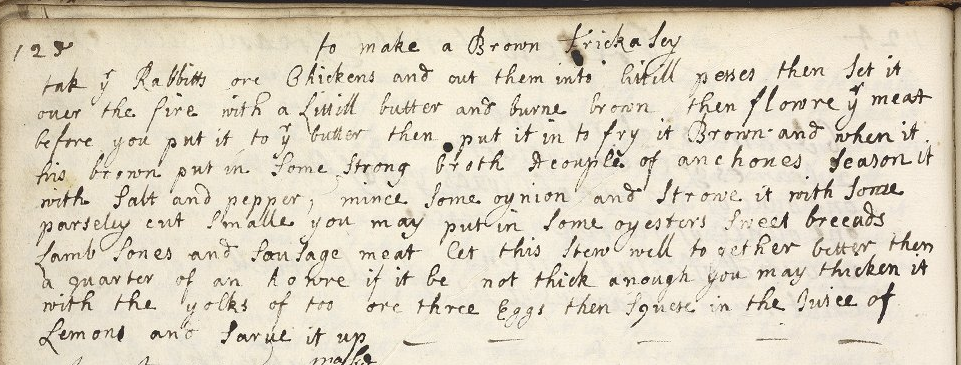
to make a Brown Frickasey

As the end of November approaches each year, I get increasingly excited about two things: Thanksgiving turkey and the annual re-run of the “Poultry Slam” episode of This American Life. Like it or not, November and December are the very height of poultry season. Unsurprisingly, there are lots of recipes for cooking poultry in Penn manuscripts from making chicken pot pie and fried chicken (two ways) to numerous instructions for roasting.

When I cooked this recipe last Tuesday it was raining in southern California. It was a major news event out here. It was also one of the first dark, chilly, and damp days I’ve seen in ages. I decided to try a recipe “to make a Brown Frickasey” from MS Codex 252 and it was a perfect dish to warm the house and the belly.

The Recipe

frickasy

to make a Brown Frickasey

tak the Rabbits ore Chickens and cut them into littill pesses then set it
ouer the fire with a Littill butter and burne brown then flowre the meat
before you put it to the butter then put it in to fry it Brown and when it
tis brown put in some strong broth A couple of anchoves season it
with salt and pepper, mince some oynion and strowe it with some
parseley cut smalle you may put in some oyesters sweet breeads
Lamb sones and sausage meat let this stew well together better then
a quarter of an howre if it be not thick enough you may thicken it
with the yolks of too ore three Eggs then squese in the Juice of
Lemon and sarue it up

This is a simple and delicious recipe with lots of room for variation: Brown a delicious mix of meats in butter then add more meat, stock, and flavors. Ken Albala’s Cooking in Early Modern Europe, 1250-1650 describes a fricassee as a method for frying meat and adding a flavorful sauce. As this recipe demonstrates, it is a very flexible method that works well with poultry and other meats. I decided to use chicken breasts, pork sausage, and chicken stock, but I also could have faithfully followed this recipe using rabbit, oysters, sweet breads, or other offal.

Our Recipe

3-4 T butter
2 chicken breasts, sliced into 2-inch strips
4 T flour (for coating chicken)
1/2 lb. pork sausage meat (either sausage removed from its casing or sausage meat sold uncased)
1  onion, medium sized, chopped
4 anchovies, chopped
1 1/2 -2 c chicken broth
salt and pepper (to taste)
the juice of half a lemon
2 T chopped parsley

Lightly flour the chicken strips by rolling them in a plate or bowl of flour. Finish chopping the onion and anchovies and readying the sausage meat . Make sure your stock is also ready to go if you’re defrosting it or using a concentrated boullion preparation.

In a dutch oven or large pot, heat the butter until it melts, smells nutty, and starts to darken in color. Add the strips of floured chicken slowly. Don’t worry if all the chicken doesn’t fit at the beginning because the strips will shrink as they cook. Turn the meat over so that it cooks on both sides. When the outside of the chicken starts to brown, add the sausage meat and cook for 1 minute. Add the chopped onion and anchovies and cook for 1 minute more.

Add the broth and simmer uncovered for 15-20 minutes. When the gravy is thick and everything is well cooked, squeeze the juice of half a lemon into the stew. Sprinkle parsley on top. Serve hot.

Results

My spouse and I devoured this delicious stew with some roast butternut squash, kale salad, and a bottle of fine, west-coast IPA. It was warming and satisfying meal. We both picked additional mouthfuls of sausage-y chicken out of the pot after we’d cleaned our plates.

I started by browning 2 T butter and added about 2 more as the chicken cooked. The sauce thickened into beautiful gravy on its own. I used homemade chicken stock that I (try to) always keep in my freezer. Homemade stock from pork bones would also be a delicious addition. Store-bought or concentrated stocks will work well here, too. But be sure to taste the mix before adding additional salt.

I can see how this method of preparation would work well for a variety of poultry and other meat. The strips of chicken stayed tender and flavorful, but this would be great with dark meat chicken. I used peppery pork breakfast sausage meat from a local farm. I think a pork and sage or even a pork and apple sausage would work well here. Finally, the anchovies added an unexpected note that was more umami than fishy. I suggest that you give them a try if you’re an anchovy skeptic, but not if you absolutely despise these small, flavorful fish. The lemon adds an essential bright note that complements the fat and savory flavors of the dish.


Notes towards roasting a lobster

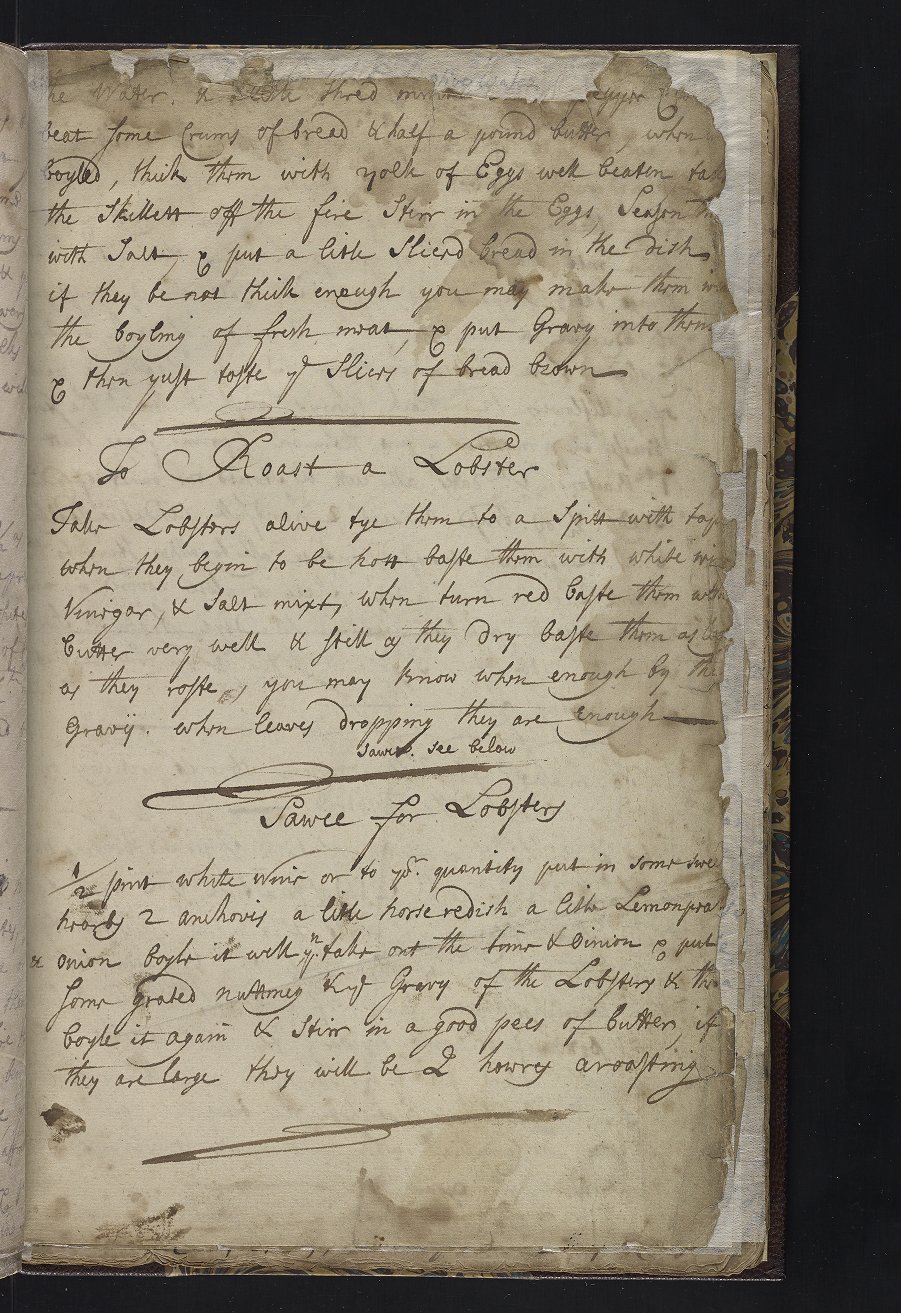
To take a break from roast poultry, I wrote about a recipe for roast lobster from MS LJS 165 for The Appendix Blog. You can click here to read the full post.

Since I haven’t yet tried the recipe and roasted a lobster in my own kitchen, this post does not follow our normal format. But I didn’t want you, dear reader, to miss out on a potentially delicious archival preparation for this mighty crustacean.  I’ve copied  my transcription of the recipe and a few notes below in case any of you are brave enough to give it a try. Let us know how it goes!

We’re working on some tasty holiday recipes to share with this season. Until then, consider roasting a lobster. Or give this brilliant Financial Times article about cooking traditional Christmas dishes with food historian Ivan Day a read.

roast lobster

To Roast a Lobster
Take Lobsters alive tye them to a spitt with tap[e]
when they begin to be hott baste them with white wine
Vinegar, & salt mixt, when turn red baste them with
butter very well & still as they dry baste them as l[on]g
as they roste, you may know when enough by the
gravy. when leaves dropping they are enough –

sawce see below

Sawce for Lobsters
1/2 pint white wine or to your quantity put in some swe[et]
hearbes 2 anchovis a litle horseredish a litle lemonpeal
& onion boyle it well then take out the time & oinion & put
some grated nuttmeg the gravy of the Lobsters and then
boyle it again & stirr in a good pees of butter, if
they are large they will be 2 howres aroasting

Tied to a stake, the lobsters are roasted over a fire and basted with butter for approximately two hours. An accompanying white wine and butter sauce, seasoned with anchovies, horseradish, lemon, onion, and nutmeg, complements the rich flavor of the lobster itself.