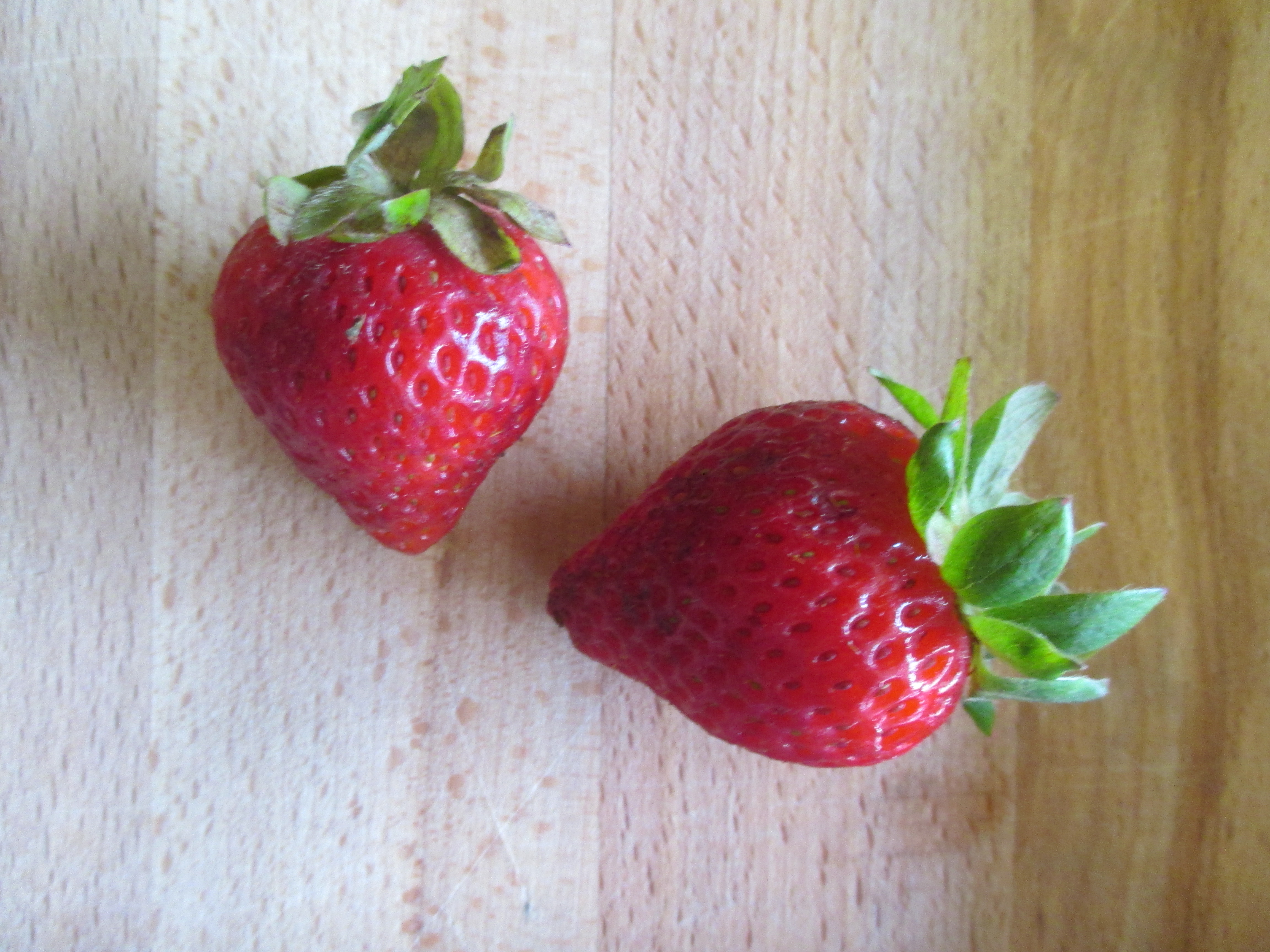
Tartes of strawberryes


I love strawberry season. If anything will prompt me to turn on the oven at the start of a June heatwave, it’s probably a favorite strawberry recipe. Over the years, I’ve tried various historical recipes for tangy strawberry preserves, a refreshing strawberry water beverage, and chilled snow cream served with strawberries. Yesterday morning, before it got too hot, I tried my hand at some strawberry tarts.

The Recipe
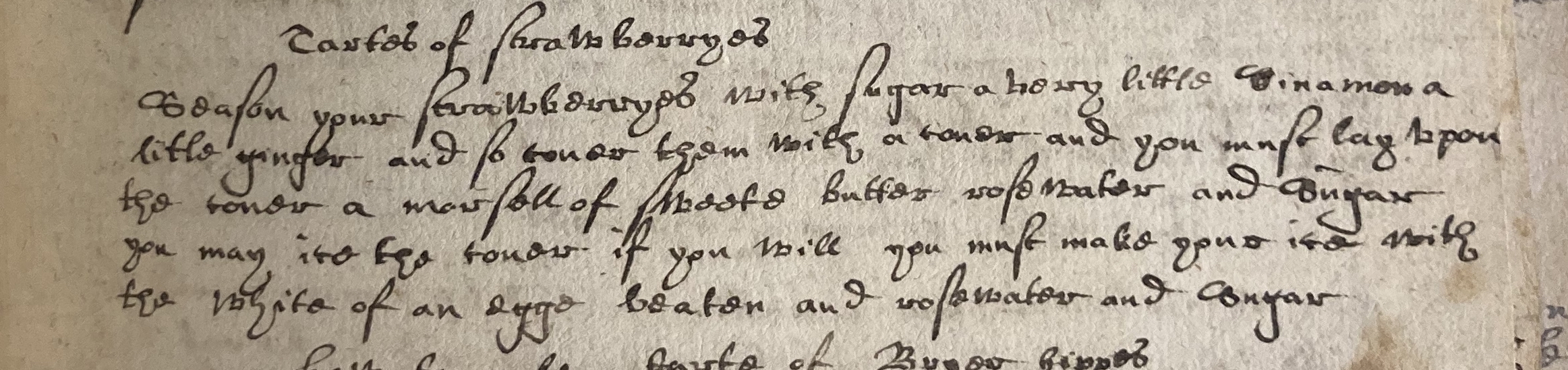
Image of strawberry tart recipe in original manuscriptTartes of strawberryes
Season your strawberryes with sugar a very little Sinamon a
litle ginger and so couer them with a couer and you must lay vpon
the couer a morsell of sweete butter rosewater and Sugar
you may ice the couer if you will you must make your ice with
the white of an egge beaten and rosewater and Sugar
(British Library, Add MS 28319, f. 16r)

This recipe for “Tartes of strawberryes” is from an early seventeenth-century manuscript cookbook now held at the British Library — Add MS 28319.* Culinary recipes and instructions for serving various courses fill the twenty leaves of this short manuscript this is written in a small, regular secretary hand. Earlier this summer, I had a chance to travel to the British Library and transcribe the entire manuscript (thanks to a Franklin Research Grant from the American Philosophical Society). As you’ve probably noticed, I haven’t been in the kitchen much this year. I’ve been at my desk writing about the recipes I’ve developed for my new book Shakespeare in the Kitchen (which will be out next year in this series) and, lately, I’ve been back in the library gathering more material for this book and my ongoing projects.  So I was even more eager to spend a morning in the kitchen engaging with this manuscript in a different way — cooking it.

* Although manuscripts are not currently available through the British Library catalog due to the cyberattack, a 2020 post on their medieval manuscripts blog includes a discussion of this cookbook.


Strawberries only appear twice in this manuscript — as the filling of these closed tarts and as a seasoning for stewed mullet where gooseberries or barberries might also add a sharp, acidic flavor (9v). The menus that begin the manuscript, however, show how central tarts were to the contemporary style of dining. Tarts like these would be served in the second spread of various dishes at dinner (the large midday meal) and supper (the lighter evening meal) alongside meat, vegetable, and fish dishes depending on the season or fish-day constraints (2r-3r). There are seventeen tart recipes in the cookbook, some lidded and some open-faced, that would allow a cook to serve a variety of tasty tarts throughout the year (15r-16r). Seasoned with spicy ginger and warm cinnamon, these strawberry tarts would hold their own against the strong flavors of venison, shrimp, gingerbread, duck, or fritters that might also have been served on the same table.

Updated Recipe

Makes about 20 tarts.** 

I tested these tarts with this pastry recipe and I have copied it into the instructions below. Feel free to use an historical or modern pastry recipe of your choice.

Pastry
1 3/4  cup flour (210 grams, 1/2 lb)
1 Tablespoon sugar
3/4 teaspoon salt
1 stick butter (113 grams, 8 Tablespoons, 1/4 lb)
1 egg
4 Tablespoons water (1/4 cup, added a spoonful at a time)

Filling
2 cups strawberries, chopped (400 grams)
1/4 cup sugar (50 grams)
1 teaspoon ginger
1/2 teaspoon cinnamon

Topping***
2 Tablespoons butter, room temperature
1 teaspoon rosewater
1 Tablespoon sugar

Preheat the oven to 425 F (220 C). Take out the butter for the topping to give it time to come to room temperature.

Make the pastry. Put the flour, sugar, and salt in a large bowl. Stir to combine. Chop the butter into small pieces. Work the butter into the flour mix until a fine meal forms. Add the egg. Add the water one tablespoon at a time. Using your hands and/or a spoon, work the mix until it holds its shape as a ball. It will still feel dry to the touch.

While the pastry rests in the fridge or at a cool room temperature, remove the stems from your strawberries and cut them into small pieces (approximately 1/2 in or 1 cm). Season the chopped strawberries with sugar, ginger, and cinnamon.

In a small bowl, stir the room-temperature butter and rosewater with a fork so that the whipped butter it is well-combined and ready to spread.

Roll out the pastry. Using a pastry cutter or drinking glass, cut circles. I used a 2 5/8 in (68 mm) pastry cutter to make nice little tarts. Make sure you have an even number of circles so that you have bottoms and lids.

Grease your pan. Lay out the bottom pieces. I used my handy mince pie pan to make a batch of 12. You can easily make these pies on a baking sheet by shaping the top piece of pastry over a mound of seasoned strawberries. (See note about extra filling below.**)

Fill each pie with seasoned strawberries. Place a lid on each pie. Push down the edges of the pastry to seal. Coat the lids with the butter and rosewater mixture. Sprinkle generously with sugar.

Bake the tarts for 15 minutes until golden brown. (Check them at 10 minutes and see how they’re faring.)

Let the pies cool in their pan for 10 minutes before transferring to a cooling rack or serving plate. Serve warm or at room temperature.

The Results

When I think of a strawberry tart, I usually think of an open-faced dessert, with an abundance of glistening strawberries and crisp, fluted pastry. (Or I think about how I love to add strawberries to these very rustic rhubarb tarts.) Instead, these strawberry tarts show how warming spices such as ginger and cinnamon — spices I’m more used to pairing with apples — compliment the bright sharpness of summer strawberries. The ginger especially shines in this recipe as it pairs with the rich pastry and the soft, tart strawberries. It’s a perfect recipe for strawberry season.
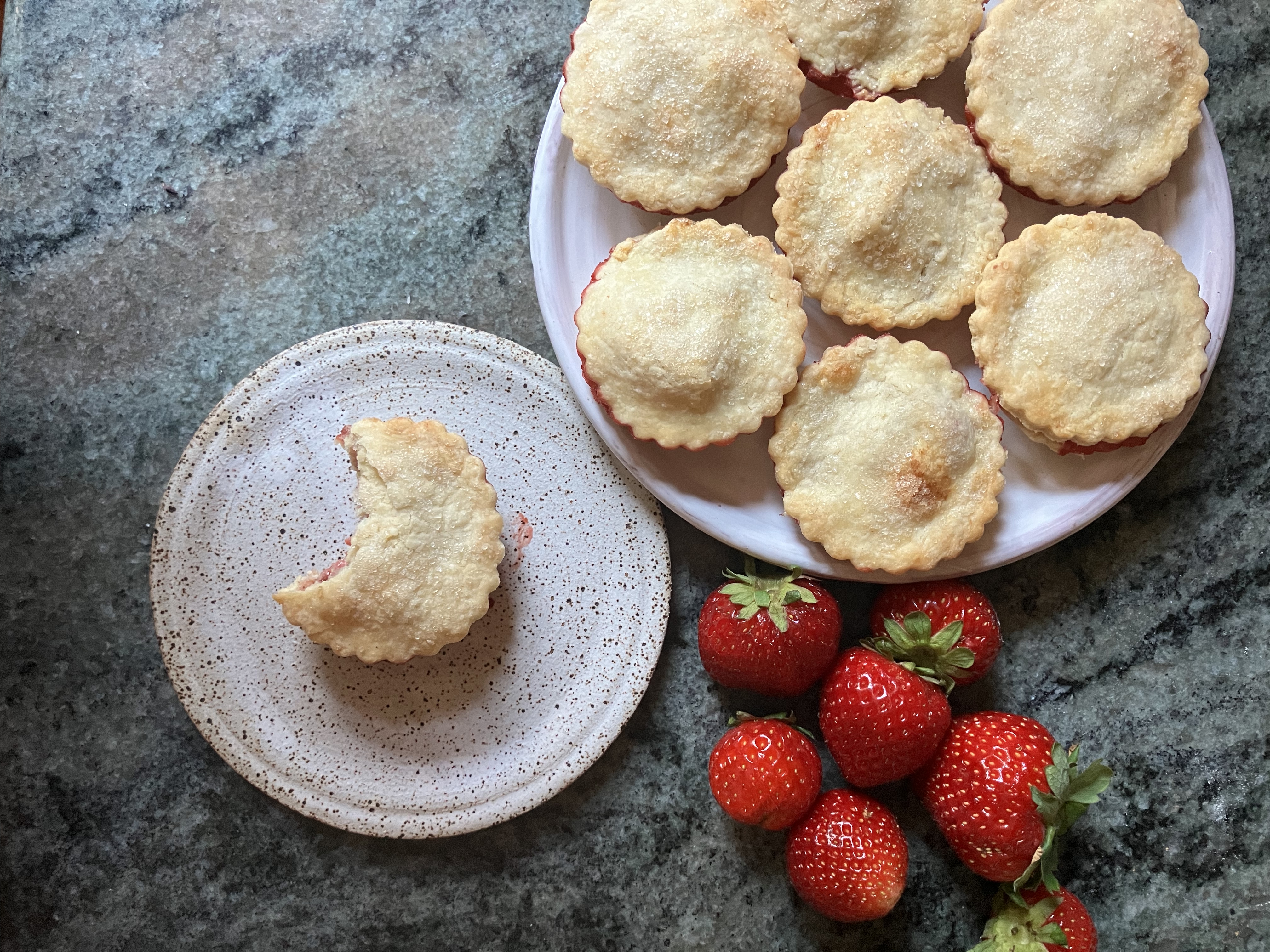
strawberry tart on plate with bite taken out, plate with tarts, strawberries on counter

**Extra Filling

I made one tart pan full of 12 tarts. By the time these came out of the oven, my kitchen was getting incredibly hot and I quickly shaped the remaining pastry into a (delicious) rustic galette filled with the remaining seasoned strawberries. I believe I had enough of everything to make about 8 more lidded tarts. If you only want to make a dozen tarts, I believe half the seasoned strawberry fulling will suffice, but you will need more than half the dough and the recipe above is not easy to divide as it contains a whole egg.
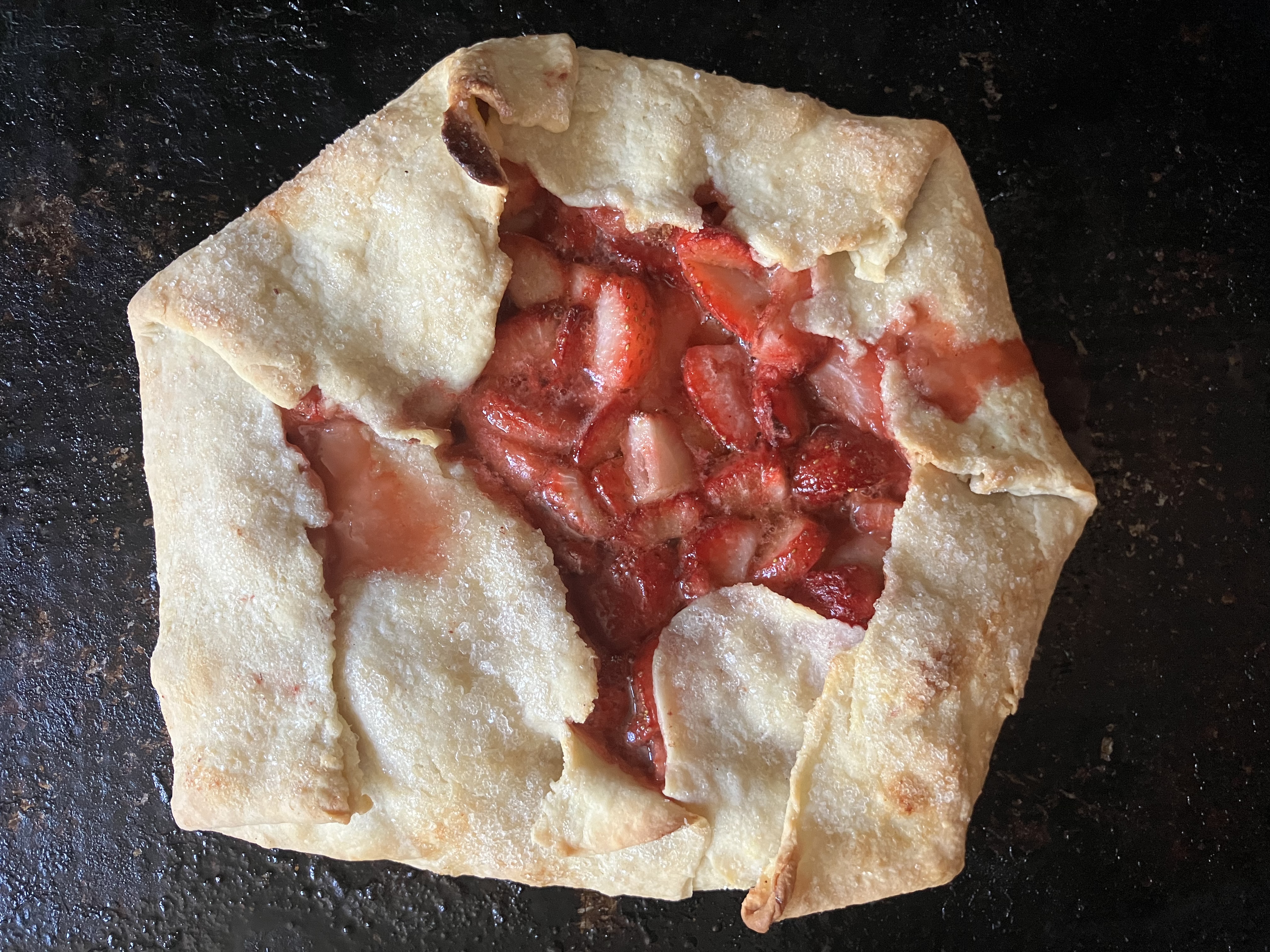
strawberry galette

*** Rosewater butter topping update
When Lisa Smith tried this recipe the week it was posted, she found that the rosewater overpowered the spices in the tarts. This was not my experience, but rosewater strength varies across brands so do keep this in mind as you prepare these tarts! Thanks again for baking and sharing your experience, Lisa!!
To preserve Strawberries

2020-05-30 05.34.30

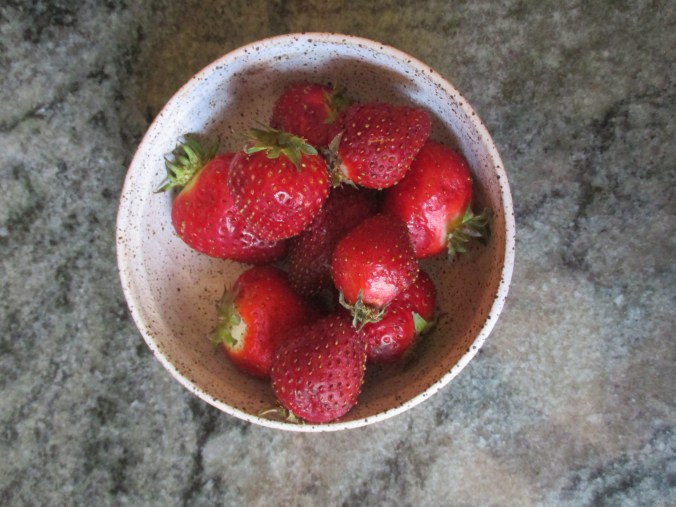
Description: Strawberries in a bowl.

There are more recipes for preserving fruit, vegetables, fish, and meat in early modern recipe books than there are for cakes. I often gravitate to the cakes – because I love cake – but if I ever cooked one of these recipe books cover-to-cover I would be up to my elbows in pickling brine and sugar.

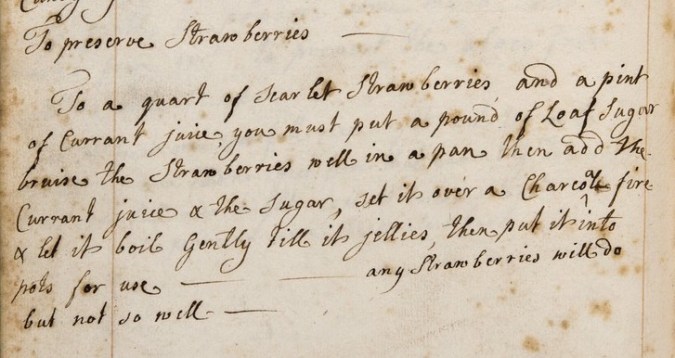
This delicious recipe for a strawberry and blackcurrant jam, “To preserve Strawberries” from the Clark Library MS.2012.011, capitalizes on sugar’s potent preserving power (just like this marmalade I posted last year). As sugar prices dropped over the course of the seventeenth century, sweet preservation recipes – rather than sour, vinegary ones –  became increasingly accessible to middle class families. The Hornyold family who began compiling and using this recipe book in the 1660s seem to fit this description. (I made Jasmine Butter from this same manuscript last summer.)

The declining price of sugar obscured what we would now think of as its true costs: Plantation slavery in the Caribbean and the Transatlantic slave trade. As Kim F. Hall’s ongoing work on sugar demonstrates, this prized ingredient in English kitchens both conveyed status to socially mobile families and embedded them in global systems of oppression. Distilling one of Hall’s recent lectures on the subject at the Race Before Race conference in January 2019, Ambereen Dadabhoy writes, “if we talk about women’s cooking cultures in the early modern period, we have to as Professor Kim F. Hall stated, call out the white women who participate in this culture and also uphold a racial regime of bondage and servitude in the plantation colonies and the metropole.” The Honryold household, like all households that consumed sugar in this era, benefited from and perpetuated systems of bondage. Slavery is an unavoidable part of the history of sweets in the seventeenth century.

Jam making was a seasonal, annual activity when fresh fruit was at its peak. This recipe specifically calls for “scarlet strawberries,” but notes that others “will do.” Here the manuscript may be referring to domesticated varieties of wild European strawberries or the recently arrived American wild strawberry fragaria virginiana. This American strawberry is one of the parents of modern commercial strawberry hybrids and it is sometimes called the “scarlet strawberry.” “Strawberries, Scarlet Strawberries,” was a cryer’s call in eighteenth-century London. Preserving fragile foods such as strawberries was crucial for survival during good times and bad times, years of abundance as well as plague. It’s strawberry season in Philadelphia and a wonderful time to make this recipe.

The Recipe

To Preserve Strawberries cropped

To preserve Strawberries –
To a quart of scarlet strawberries, and a pint
of currant juice, you must put a pound of Loaf sugar
bruise the Strawberries well in a pan then add the
Currant juice & the sugar, set it over a Charcoal fire
& let it boil Gently till it jellies, then put it into
pots for use —- any Strawberries will do
But not so well–

The first challenge of making this recipe was trying to find an unsweetened black currant juice without visiting lots of stores. I was able to order this juice made by R.W. Knudsen and have it delivered. Although the black currant juice adds something special here, you could omit it if you can’t find it and cook the jam for a shorter period. The second challenge was that I used a full pint of black currant juice the first time that I tested this recipe and ended up scorching the jam as I tried to reduce it adequately. When I made it again with a quarter cup of juice, the jam came together perfectly. I also consulted Marisa McClellan’s recipes for small batch strawberry vanilla jam and small batch strawberry balsamic jam.

Updated Recipe

Makes 3 cups of jam

1 quart strawberries (4 cups chopped)
455g sugar (scant 2 cups)
1/4 cup black currant juice

Prepare fruit

Cut strawberries into quarters.

Mix the strawberries with half of the sugar (1 cup) and let sit at room temperature for 2-3 hours.

Make jam

Put a small plate in your freezer.

Prepare your storage jar(s). If they’re not fresh from the dishwasher, rinse them with boiling water.

Put the macerated strawberries and sugar as well as the remaining sugar in a heavy saucepan with ample extra room. If you’re using a candy thermometer, affix it to the side of the pot.

Cook at a high heat and bring the strawberry mixture to the boil. Continue to cook and stir. Add the black currant juice after 15 minutes of cooking. Cook until the jam reaches 220°F and/or when you run a spoon along the bottom of the pan the jam does not immediately flood the space again. (My total cooking time was 25 minutes, but this will vary.)

As your jam nears temperature or the spoon parts it more effectively, put 1 teaspoon on the freezer plate and let sit for 30 seconds. If the jam holds its shape when you tilt the plate, it has set. If the jam is browning quickly or looks set before the temperature reaches 220°F, try the plate test earlier.

Store this small-batch preserve in the refrigerator and consume within two weeks. You can extend the life of your jam by properly canning it or by freezing it.

The Results

The first taste is sweet, then bright strawberry flavor, and finally the deep berry notes from the blackcurrant juice. I’ve been eating this delicious preserve on bread, toast, waffles, and biscuits. Even though I don’t have to wait almost another year to eat a strawberry, I know I’ll savor this peak summer flavor.

Further Reading

Dadabhoy, Ambereen. “After Race Before Race” January 19, 2019. https://ambereendadabhoy.com/2019/01/19/after-race-before-race/

Hall, Kim F. “Culinary Spaces, Colonial Spaces: The Gendering of Sugar in the Seventeenth Century,” in Feminist Readings of Early Modern Culture: Emerging Subjects, eds. Valerie Traub, Lindsay Kaplan, and Dympna Callaghan (Cambridge University Press, 1996), 168-90.

Hall, Kim F. “History, Pleasure, Identification: The Case for Early Modern Food Studies.” Race Before Race Conference. Arizona State University, Tempe. 19 Jan 2019. Lecture

Hall, Kim F.“Sugar and Status in Shakespeare” Shakespeare Jahrbuch145 (2009): 49-61.

MintzSidney W. Sweetness and Power: The Place of Sugar in Modern History. New York: Penguin, 1986.

Strawberr Water.

All of the references to strawberries in Samuel Pepy’s diary appear in June. In 1663, he attended a lovely dinner in Bethnal Green and remarked on the strawberries in his host’s garden: “A noble dinner, and a fine merry walk with the ladies alone after dinner in the garden, which is very pleasant; the greatest quantity of strawberrys I ever saw, and good, and a collation of great mirth.” In 1664, he records “very merry we were with our pasty, very well baked; and a good dish of roasted chickens; pease, lobsters, strawberries.” In 1668, he tipped a boy who showed him around various Oxford colleges in strawberries (costing 1s. 6.d). A few days later, he ate more strawberries in Bristol. A seasonal treat, Pepys noted seeing strawberries growing and eating them in the city and the country alike.

Last weekend, I bought my first local strawberries of the season and devoured them. This recipe for “Strawberr Water” wasn’t on my long list of things to cook, but it beckoned to me from across the page when I consulted a lemonade recipe in Judith Bedingfield’s recipe book, now UPenn Ms. Codex 631. Strawberries are in season where I live and I’m planning to eat as many as possible. Don’t worry: I’ll be making that lemonade sometime soon, too.

The Recipe

resolver-7

Strawberr Water

To a Quart of Water you must have a Pound of Strawberries, Which squeeze in the
same Water; then put in four or five ounces of sugar, & some Lemon Juice; if the
Lemons are large & juicy, one Lemon is enough to two Quarts of Water: all being well
mixed, put it through a straining Bag, then put it in a cool Place, & give it to drink

An early modern agua fresca, strawberry water is refreshing and delicious. The lemon cuts through the sugar and enhances the fresh strawberry flavor.

Updated Recipe

I decided to follow the original recipe’s instruction to strain the strawberries and remove their pulp. The strawberry water stayed nicely blended while I was preparing, sipping, and cleaning up. You might experiment with blending everything in a blender for a pulpier, quicker version of the recipe. However, the pulp might not stay suspended in the water and might gather at the bottom of your pitcher/container. (If you try it this way, please let me know in the comments!)

1 quart water
1 lb strawberries
4 oz sugar (1/2 cup)
juice of half a lemon (or more to taste)

Wash the strawberries, remove their stems, and chop them. Smash the strawberries with a potato masher, heavy spoon, or other promising kitchen tool. Transfer to a wire-mesh strainer and leave to drain. By mashing the strawberries into the strainer with a flat wooden spoon, I produced about 1 cup of strawberry juice.

Stir the sugar and lemon juice into the water until the sugar dissolves in a jug or other large container. Add the strawberry juice.

Serve chilled or over ice. Garnish with mint or lemon.

2019-05-10 16.11.31

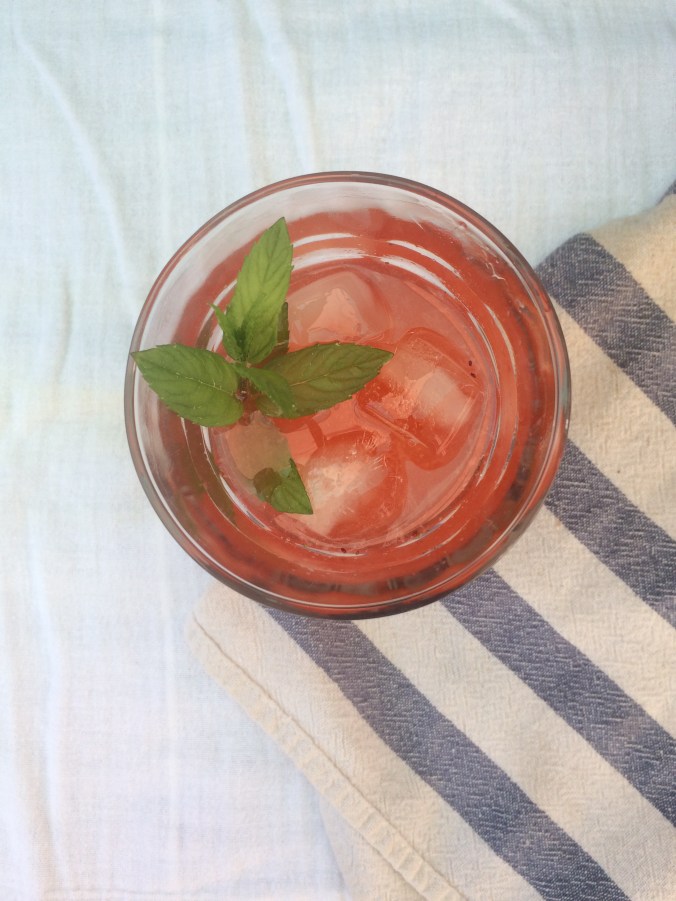
strawberr water

The Results

Shockingly pink and delightfully refreshing, this strawberry water would be a big hit for any brunch, picnic, or party. I could see increasing the lemon juice for added sharpness or spiking it with vodka for extra, boozy festivity.

Snow cream

It’s hot. The city of Philadelphia declared an excessive heat warning. Despite my undying love of summer, I’m thinking about snow.

2016-07-07 15.22.22

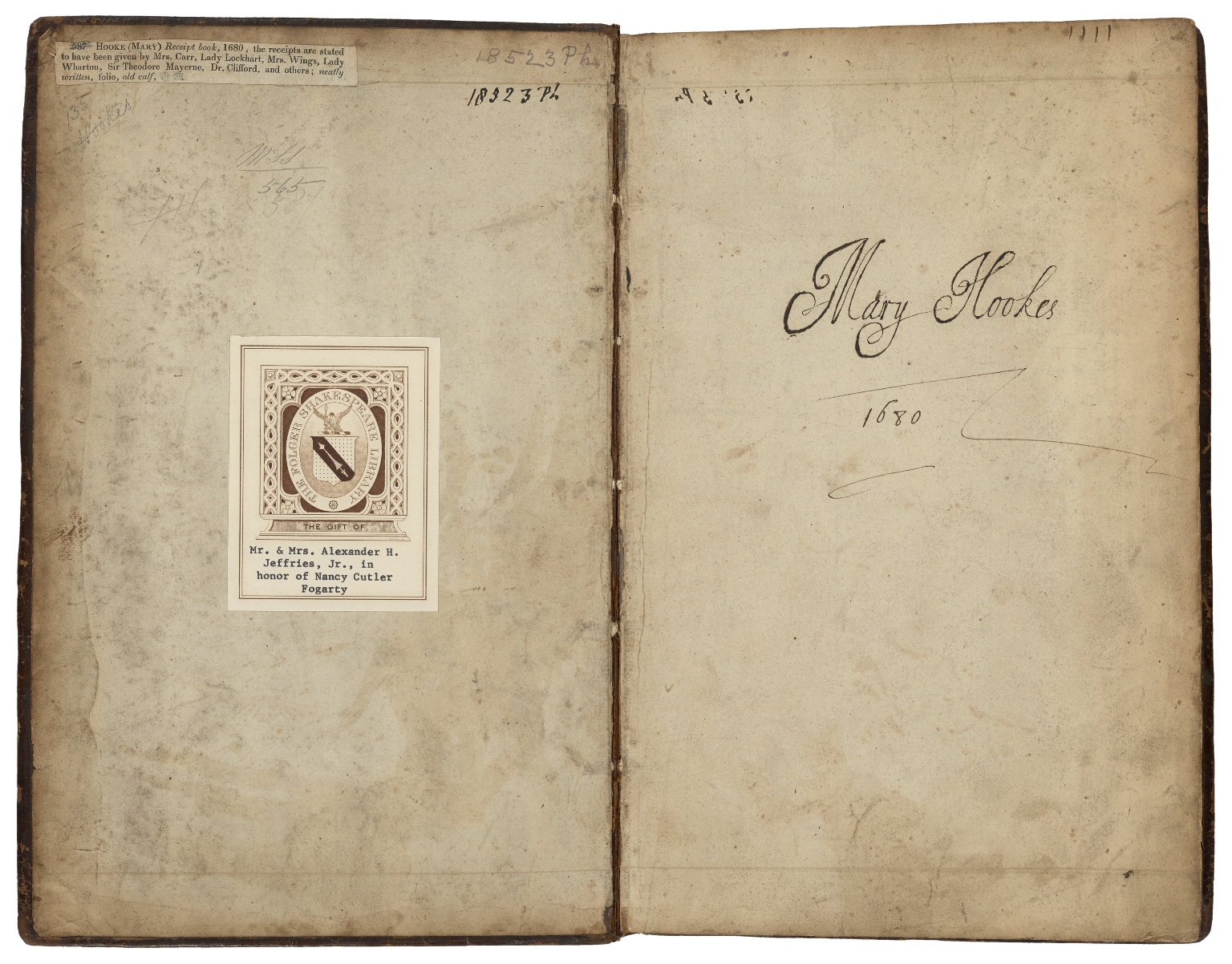
When Heather Wolfe, Sarah Powell, and I were selecting a recipe to cook with the paleography class at the Folger Shakespeare Library last month, Sarah added this recipe for “Snow cream” from Mary Hookes’s manuscript recipe book V.b.342 to our list. (Check out the Almond Jumballs we made here.) In my heat frenzy yesterday afternoon, I went digging through my email to track down the citation. The manuscript includes entries from circa 1675-1725 and was signed by Mary Hookes in 1680. It begins with an alphabetical index and contains a range of household recipes including perfumes, preserves, and cakes. I have much more work do to on this manuscript, but yesterday I had snow on the brain and decided to give this recipe a try. Rosewater flavored whipped cream? Almonds and strawberries? How could this be anything but delicious?

130843

The Recipe

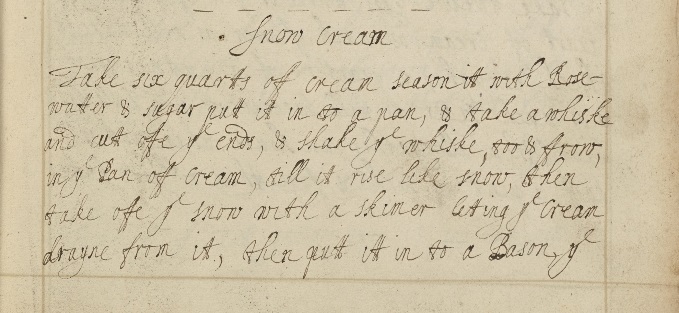
snow cream

snow cropped, page 2
Snow cream
Take six quarts of cream season itt with Rose-
watter & sugar putt itt in to a pan, & take a whiske
and cutt offe the ends, & shake the whiske, too & ffrow,
in the Pan off cream, till itt rise like snow, then
take offe the snow with a skimer letting the cream
drayne from itt, then putt itt in to a Bason, the

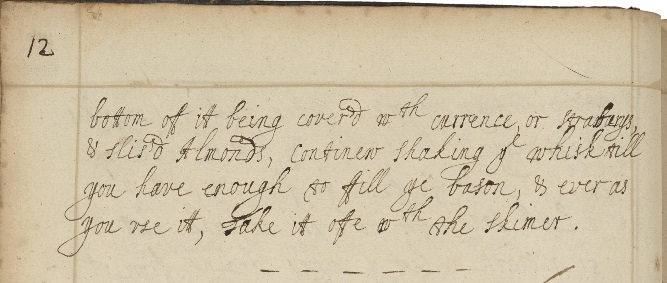
bottom off itt being cover’d with currence, or strabarys,
& slis’d Almonds, continew shaking the whisk till
you have enough to ffill the bason, & ever as
you use itt, Take itt offe with the skimer.

Whipped cream makes snowy drift on a base of nuts and summer fruits, such as currants and strawberries. The name “snow” makes this relative of fool, berries and cream, and even strawberry shortcake seem unfamiliar. Recipes for snow are common in seventeenth-century recipe books and usually include both cream and eggs. The Oxford English Dictionary defines snow, as a cookery term, as A dish or confection resembling snow in appearance, esp. one made by whipping the white of eggs to a creamy consistency.” Ken Albala’s The Banquet includes examples of “snow” stiffened with rice flour, seasoned with rosewater, and served alongside other sweet and savory dishes. (He also gestures to the role of dairy dishes like snow in the development of ice cream recipes. We promise that when we find an ice cream recipe we’ll make one for you.)

IMG_5016

Our Recipe

I used a hand mixer to whip my cream. This tool, as well as modern dairy processing methods, decreased the need for skimming mentioned in the original recipe. I started with one cup of cream instead of six quarts. The recipe below serves three-four people, six quarts of whipped cream would feed a crowd.

1 cup cream
2T sugar
1/2t rosewater
1 cup strawberries, hulled and chopped
1/4 cup almonds, slivered or roughly chopped

Line a serving dish with the strawberries and almonds.

Put the cream and sugar in a sturdy bowl. Using a hand-held mixer or a large whisk, whip the cream until it holds stiff peaks. Stir in the rosewater.

Add the whipped cream to the serving dish in large dollops.

Serve immediately.

The Results

Cool, sweet, and fresh, snow cream was exactly what I wanted to eat. Tufts of cream drenched the berry and nut base. The crunch of the almonds, the floral note from the rosewater, and the tang of the strawberries make for a chilly summer dessert. I could close my eyes and imagine snow.

I’d love to try this with black or red currants (and if you do I hope you will let us know). Feel free to substitute in any fresh berry or sliced fruit. Try a different nut or a mix of seeds. Swap out rosewater for orange blossom water or vanilla. This simple, refreshing dessert is highly adaptable in the modern kitchen.

Stay cool, dear readers, and let us know how  you fix your “Snow cream” this summer.