hou to bake Quinoces

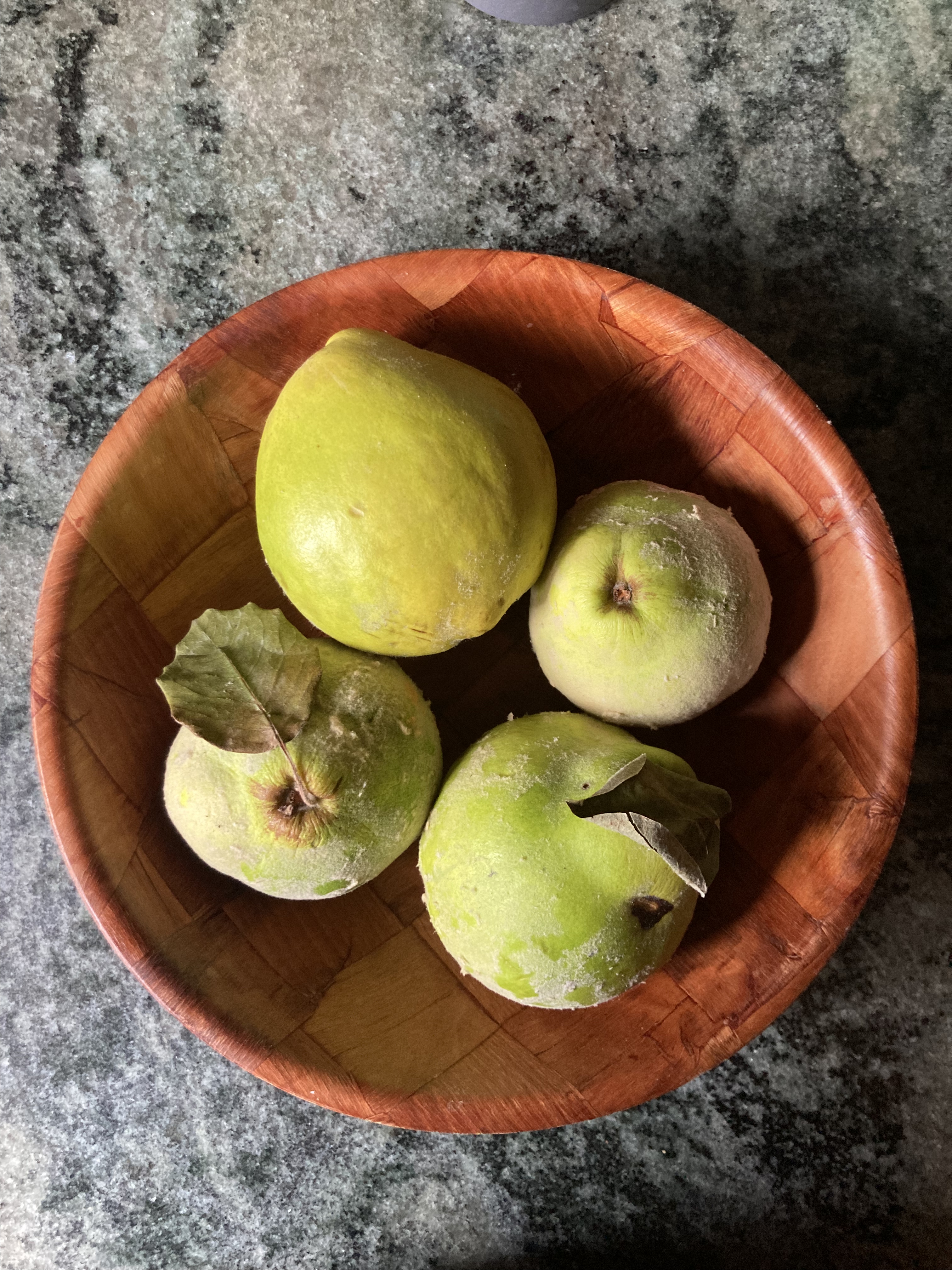
quinces in bowl and on cloth on table

I always buy too many quinces. I am so excited when I first encounter them at the market in the autumn. I fill my bag. (I’ve written about my love of quinces here before.)

So it was a good thing that I had already transcribed these two recipes for baked quinces from an early seventeenth-century manuscript cookbook now held at the British Library — Add MS 28319.

The Recipe(s)
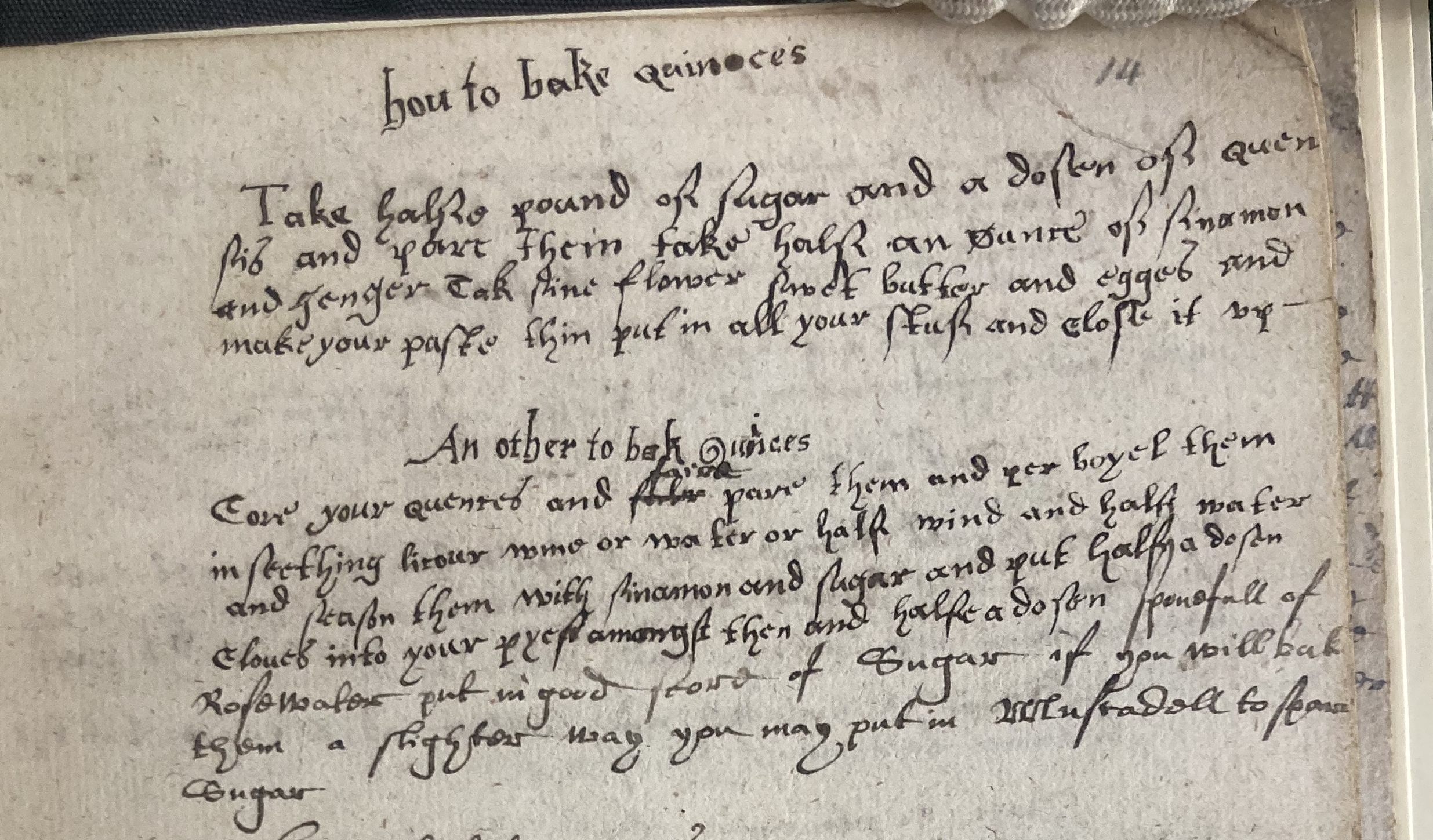
original recipe in culinary manuscript

hou to bake Quinoces
Take halfe pound of sugar and a dosen of quen
sis and pare them take half an ounce of sinamon
and genger Tak fine flower swet butter and egges and
make your paste thin put in all your stuf and close it vp

An other to bak Quinces
Core your quences and falx faire pare them and perboyel them
in seething licour wine or water or half wind and half water
and season them with sinamon and sugar and put half a dosen
Cloues into your pye amongst then and halfe a dosen sponefull of
Rosewater put in good store of Sugar if you will bak
them a slighter way you may put in Muscadell to spare
Sugar

Both recipes can be used to bake large volumes of quinces into delicious, sweet pies flavored with aromatic spices. The second recipe attends to the distinct toughness of the quince by first boiling the quince in water, wine, or a mixture of water and wine before baking in a lidded pie. There are other recipes later in the manuscript for open-topped tarts full of seasoned pureed quince.

My recreation below takes the method of parboiling in water and wine from the second recipe and combines the flavorings from both. I used sugar, cinnamon, ginger, cloves, and rosewater.

(Curiously, this is the only place in the manuscript where the recipe titles mimic printed lettering, instead of traditional cursive forms. Perhaps they were copied from a printed source into the manuscript.)

Updated Recipe

I tested these tarts with this pastry recipe and I have copied it into the instructions below. Feel free to use an historical or modern pastry recipe of your choice.

Parboiled Quinces
2 quinces
1.5 cups red wine
2 cups water

Pastry
1 3/4  cup flour (210 grams, 1/2 lb)
1 Tablespoon sugar
3/4 teaspoon salt
1 stick butter (113 grams, 8 Tablespoons, 1/4 lb)
1 egg
4 Tablespoons water (1/4 cup, added a spoonful at a time)

Filling
Parboiled quinces (above)
1/4 cup sugar
1/4 teaspoon cinnamon
1/4 teaspoon ground ginger
1/8 teaspoon ground cloves
1T Rosewater

Optional: milk or egg wash for the pastry

Peel and core the quinces. Cut them into ¼ inch slices.

Put the quinces, wine, and water into a medium sized saucepan. Bring to a boil. Reduce to a simmer and cook for approximately 20 minutes. The quinces should be tender when poked with a fork. Pour off the cooking liquid and let the quince cool. (This step can be completed in advance.)

When you are ready to assemble the pie, make the pastry. Put the flour, sugar, and salt in a large bowl. Stir to combine. Chop the butter into small pieces. Work the butter into the flour mix until a fine meal forms. Add the egg. Add the water one tablespoon at a time. Using your hands and/or a spoon, work the mix until it holds its shape as a ball. It will still feel dry to the touch.

If you are going to bake the pie immediately, put the pastry in the refrigerator to chill and preheat the oven to 450F. Grease a 9-inch pie dish with butter or baking spray. (Either the prepared pastry or the assembled pie can rest in the refrigerator before baking if needed.)

Put the cooked quinces into a large bowl. Add the sugar, cinnamon, ginger, cloves, and rosewater. Toss gently to combine without breaking up the pieces too much.

Assemble the pie by first dividing the pie crust into two balls. Roll out the first ball into a large, even circle on a floured surface. Line the 9-inch pie dish with pastry.

Arrange the seasoned quinces in an even layer inside the crust.

Roll out the second crust and place it on top of the pie. Cut off any excess pastry. Use a fork or your fingers to seal the edges. Cut vent holes or slits into the top crust. (At this stage you can add a milk or an egg wash for an especially golden crust.)

Put the pie on a baking sheet and put it in the oven. Bake at 450F for 10 minutes. Then reduce the temperature to 350F and bake for about 35 minutes until the pie is golden brown. Cool on a rack before serving.

The Results

A delicious fragrant pie. The flavors of wine, spice, and floral quince and rosewater pair beautifully with the rich pastry. I shared slices with friends and family who loved the flavors and found the dish both agreeably similar to an apple pie and delightfully unique.

I also had the pleasure of sharing the draft recipe with participants in a history skills workshop organized by the Historical Society of Michigan. We discussed how different the seasoning of the pie might be depending on when and how one used the cloves — what if I had added whole cloves to the red wine poaching liquid? what if I had used whole cloves in the pie, instead of ground cloves? Mulling this over, I also wonder how the fruit would taste if I had added whole cloves and cinnamon sticks to the wine during parboiling. If any of you try to spice your quinces or make your a bit differently, please let me know in the comments.

To Make Quince Cream

Since I love cooking with quinces at this time of year, I was eager to prepare this recipe “To Make Quince Cream” as part of my ongoing exploration of Christian Barclay‘s recipe book. In this post about a recipe to preserve quinces that I tried a few years ago, I wax poetic about the floral, fragrant quince as well as early modern and contemporary preserving practices. Instead of focusing on the fruit here, I’m going to consider the “cream.”

Quinces in a bowl

This recipe instructs a cook to stir cooled, cinnamon-infused cream into cooked, mashed, and sweetened quinces. It clearly explains the cooking method, but the recipe is short on measurements. A cook could add as much or as little cream as they preferred depending on their taste and the number of quinces that they were working with. They could also use this recipe to make a cream flavored with pears or wardens (a pear cultivar). In any case, sixteenth-, seventeenth-, and eighteenth-century English and Scottish cooks would have had access to an ample supply of dairy products to prepare creams.

Stephen Schmidt argues that creams specifically united rural and elite celebratory traditions in his post “What, Exactly, Was the Tudor and Stuart Banquet?” He writes that “Fresh fruits, cream, and local iterations of butter-rich cakes were typical treats of outdoor country festivals like May Day, which Robert Herrick frames as an idyll of ‘Cakes and Creame’ in his famed poem ‘Corinna’s Gone a Maying.’ The elite, meanwhile,  enjoyed sophisticated dishes called creams in the lighter, sweeter, generally more delicate second course of dinner, which intermixed savory morsels like roasted songbirds, sauced lobster meat, and prime seasonal vegetables with creams and other sweets like gelatin jellies and fruit tarts.” Due to widespread dairy production, creams might accompany humble or decadent celebrations – with or without spices, fruit, or accompanying cakes. As Ken Albala writes, in The Banquet, “by the mid sixteenth century, cheese and dairy products had become a major item on banquet menus” and English cookbooks regularly included recipes for “dairy-based desserts” such as “trifles, fools, creams, and flummeries” (49). Creams fit into the Concordia discors of the banqueting table by offering a soft, rich, cooling (and, in this case, fruity) contrast to an array of spiced, sweetened, and savory dishes laid out at the same time. (I explore this concept further in my post on “Portugal Eggs.”) There are a number of recipes for “creams” that I’ve tested for this site that encapsulate this trend. Quince cream is a fitting recipe for a celebratory seasonal gathering in late autumn or early winter when the fruit is at its best.

Original Recipe 

Barclay, 155 Quince Cream

To Make Quince Cream
Take & boyll them in fair water
but first let the water boyll, then
[p]ut them in, & being tender boylled
[t]ake them up & peele them, strain
[t]hem & mingle it with fine sugar
[t]hen take some very good & sweet
[c]ream mix all together & make it
of a fit thicknes, or boyll the cream
with a stick of Cinamon, & Let it
stand till it be cold before you put
[i]t to the quince, thus you do wardens
[o]r pears

Updated Recipe

2 small quinces (390g, 13.8oz)
1/4 cup sugar
1/2 cup cream
1 cinnamon stick

Put the whole quinces in a pot. Cover with water. Bring to a boil, then simmer for about 30 minutes or until the quinces are tender when poked with a fork.

While the quinces are cooking, put the cream and cinnamon stick in a pot. Bring to a simmer and then set aside and let cool.

Peel and core the cooked quinces. Mash them in a bowl. Stir in the sugar. Then stir in the cooled, cinnamon-infused cream.

The Results

The quince cream was sweet and floral with a hint of cinnamon. I found it quite rich, but pleasantly flavored. Although I ate it on its own, if I made it again I would serve it with a crunchy “cake” or cookie. My recipes for knotts, jumballs, or little cakes immediately come to mind. Let me know if you try this quince cream with an accompaniment or as part of a banqueting spread. (Let me know if you try it with pears (or wardens) instead of quinces, too!)

I would like to thank Clara Drummond, Heather Froehlich, Christina Riehman-Murphy, and my PSU Abington students for conversations about this manuscript that, in part, lead to me preparing this recipe.

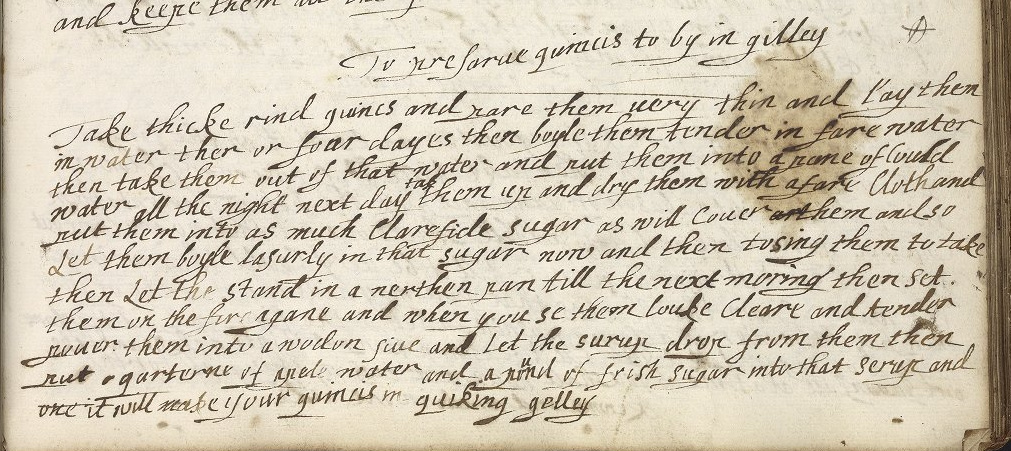
To presarue quincis to by in gilley

These preserved quinces, like the preserved apples and apricots, will be a delightful accompaniment to the pancake recipes we posted last week.

When I was in kindergarten, our class held an alphabet feast. Each of us was assigned a letter of the alphabet and tasked with providing a food whose name began with that letter. The “A” student could bring apples, the “P” student could bring pie, as the “Q” student I faced a great challenge. But, as always, my brilliant and resourceful mother had an idea: Quince Jam. I’m not sure I had ever tasted quinces before that day when we finally found a jar of imported Quince Jam after visiting what seemed like every specialty store in the western towns of Essex County, NJ. The “Q” student in the the other class may have had an easier time making quiche than hunting for quinces, but I think that my mom and I came out on top. My classmates and I ate quince jam on saltines sitting cross-legged on the classroom floor, or at least that’s how I remember it. I don’t think I tasted quince again until the man who is now my husband poached them in wine for dessert one cold winter evening in London.

Recalcitrant and inedible in their raw state, quinces have long inspired fear and love among cooks. Amanda E. Herbert shows how a gifts of “Marmalade of Quinces,” or other sugared fruits, circulated in a female social network in her book Female Alliances: Gender, Identity, and Friendship in Early Modern England. Local, hearty English quinces were softened and tempered with boiling and the extravagant use of imported sugar. Preserved quinces shared between women demonstrated generous consumption of expensive sweeteners and inborn feminine skills at taming the unruly quince. Molly Wizenberg’s recent post on Orangette reflects a twenty-first-century view of this very same issue and offers a great, simple recipe for taming and tenderizing this “esoteric fruit.” Since that early encounter and more recent reintroduction, I’m hooked on quinces. I’ve been making Hugh Fearnley-Whittingstall’s Sticky Quince and Ginger Cake for years now, Nigella Lawson’s Quince Meat is my household’s standard mince pie filling (or at least it was before  these came along), and I’ve long admired quince-whisperer Nigel Slater’s recipes.

This recipe from UPenn MS Codex 252 instructs cooks in a complex method for preserving quinces in a gelatinous liquid thickened with sugar and pectin from apples and the quinces themselves. Our recipe, below, is a bit simpler.

The Recipe

preserved quinces

To presarue quincis to by in gilley    X

Take thicke rind quincs and pare them uery thin and lay them
in water ther or four dayes then boyle them tender in fare water
then take them out of that water and put them into a pane of could
water all the night next day tak them up and dry them with a fare cloth and
put them into as much clarefide sugar as will couer or them and so
Let them boyle lasurly in that sugar now and then tosng them to take
then Let the stand in a nerthen pan till the next moring then set
them on the fire agane and when you se them louke cleare and tender
pouer them into a woden sive and let the surup drop from them then
put a quarterne of apele water and a pound of frish sugar into that serup and
one it will make your quincis in quiking gelley

Despite the lengthy description of cooking methods in this recipe, it is easy to streamline and requires very few ingredients. A quick search on Early English Books Online reveals many uses of “apple water,” or water in which apples have been boiled, in culinary and medicinal recipes. For this recipe, it seems to add pectin to the preserving liquid.

Our Recipe

1 quince
1 apple
3/4 c sugar (to use in 1/4 c and 1/2 c quantities)
6 c water (to use in 2 c quantities)

1 jar (if you plan to can these or prefer to store them in a jar)

*These proportions yield 1 ball jar of stewed quinces in sweet liquid. This can easily be doubled or tripled to preserve more fruit.*

Peel and core a quince. Slice it thin.  Soak in two cups of cold water overnight (or for a few hours depending on what suits your schedule).

Drain the quince from the soaking water and put in a pot with 1/4 c sugar and 2 c water. Bring to a boil and then turn it down to a simmer to cook the quince “leisurely” until soft. (I let my quince simmer for about two hours while I was doing other things.) Using a colander, strain out the quinces and discard the cooking liquid. Set quinces aside.

Either during the last half hour of cooking the quinces, or after, prepare a jar and make the apple water/preserving liquid.

Fill your jar with boiling water and then discard. Put the quinces in the jar.

Roughly chop an apple, skin core and all. Put the apple in 2 c water in a pot. Bring to a boil and then simmer for a half hour.  Remove the apples and add 1/2 c sugar to the cooking liquid. Boil until the sugar dissolves. Pour this liquid into the jar with the quinces. Let cool before covering.

The Results

Now, these preserved quinces did not  last long in my kitchen. (I eating them with pancake, ice cream, yogurt, cake, etc.) I cleaned my jar with boiling water, but I did not properly can these. If you want to can a batch of these, Marisa McClellan has great advice over here on Food and Jars and in her cookbooks.

Unfortunately, the syrup did not become jelly. I think this is partly because the original recipe instructs cooks to discard the pectin rich quince cooking water. On the other hand, perhaps my apple water could have been prepared more effectively. Luckily, the non-jellied liquid made an awesome syrup for the pancakes. Let us know if your quinces jelly!