Potingall/Portugal Cakes

This recipe has also been featured in the Washington Post, in Sarah Kaplan’s wonderful article on our project.

Check it out here.

Like the fantastic Desart Cakes, these Potingall Cakes caught my eye because of their intriguing name and relatively simple ingredient list. Unlike the Desart Cakes, which are what we would call cookies, these are little cakes. And pretty tasty ones at that.

This recipe comes from the first volume of UPenn Ms. Codex 631, dated 1730. (This two-volume collection has become one of our favorites.) “Potingall” is probably a stand-in for “Portugal,” since the recipe closely resembles the fairly common recipe for “Portugal cakes” found in many seventeenth- through nineteenth-century cookbooks. Getting “Potingall” from “Portugal” doesn’t seem unreasonable: the two words are visually similar, and the writer copying the recipe into Ms. Codex 631 could have been working from another recipe that was difficult to read or itself mistaken. (Like an eighteenth-century game of telephone!) “Portugal” named a type of orange in the period and might refer to the recipe’s use of orange flower water. However, Portugal cakes’ name more probably relates to one of their ingredients: sack, a sweet, fortified white wine originally produced in Portugal.

The Recipe
potingall cakes

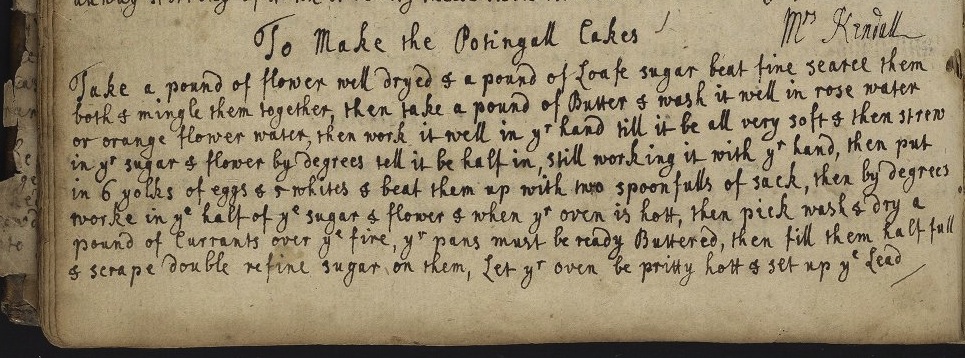
To Make the Potingall Cakes

Take a pound of flower well dryed & a pound of Loafe sugar beat fine searce them
both & mingle them together, then take a pound of Butter & wash it well in rose water
or orange flower water, then work it well in your hand till it be all very soft & then strew
in your sugar & flower by degrees tell (i.e. till) it be half in, still working it with your hand, then put
in 6 yolks of eggs & 5 whites & beat them up with two spoonfulls of sack, then by degrees
worke in the half of the sugar & flower & when your oven is hott, then pick wash & dry a
pound of Currants over the fire, your pans must be ready Buttered, then fill them half full
& scrape double refine sugar on them, Let your oven be pritty hot & set up the Lead

Our Recipe

[Note: I halved the recipe because these cakes taste best within one to two days.]

1/2 lb. all-purpose flour

1/2 lb. granulated sugar

pinch of salt

1/2 lb. [2 sticks] unsalted butter

1 tsp. rosewater or orange flower water*

2 whole eggs + 1 egg yolk

1 tbsp. sherry**

scant 1/2 lb. currants

optional: sugar for sprinkling on top

Preheat oven to 350F. Butter, coat with cooking spray, or line your pans.***

Mix together flour, sugar, and salt; set aside.

In a stand mixer or with a hand mixer****, cream the butter and flower water until light and fluffy.

With the mixer running at low speed, blend half of the flour mixture into the butter mixture; scrape down the bowl. Add the eggs and sherry, then mix at low-medium speed until combined; scrape down the bowl again. With the mixer at low speed, add the rest of the flour mixture; mix until the batter looks uniform. Add the currants and mix at low speed until they are distributed evenly.

Spoon batter into your pans (a cookie scoop works nicely here) and even out slightly with a buttered spatula. The cakes won’t rise much during baking but bake best as smaller cakes, so fill madeleine pans to the top, mini-cupcake pans nearly full, and cupcake pans 1/2 to 3/4 full. Optional: lightly sprinkle granulated sugar on top. (This adds a slight sparkle to the cupcakes but isn’t essential to their taste.)

Bake until cakes are firm to the touch at the center and golden brown around the edges. (A toothpick inserted into a cake should come out clean.) This will take around 12-14 mins. for mini-cupcakes, 14-16 mins. for madeleines, and 18 mins. for cupcakes. Let cool in pans for 3-5 mins., then remove onto cooling racks.

NOTES:

*Note on flower water: I tried these with both rosewater and orange flower water; I preferred the rosewater version because the flavor was subtler, but both flavorings played nicely with the currants.

**Note on sherry: I replaced sack (a sweet, fortified white wine) with the similar and more readily-available sherry. If you prefer a non-alcoholic cake, orange juice or white grape juice (or water) would most likely be a fine substitute. Raisins could also substitute for currants in a pinch.

***Note on pans: This recipe works best as small cakes: cupcakes, mini-cupcakes, or madeleines, for example. Use whatever combination of pans you’d like. The recipe yields approx. 18-32 cakes: 12 large madeleines (filled with 3 tbsp. batter each) + 6 cupcakes / 12 small madeleines (filled with 2 tbsp. batter each) + 10 cupcakes / 24 mini-cupcakes + 8 cupcakes.

****Note on mixing: In the spirit of updating this recipe to modern kitchens, I used a stand mixer rather than blending the dough by hand. However, the original method would also work – and be satisfyingly messy.

The Results

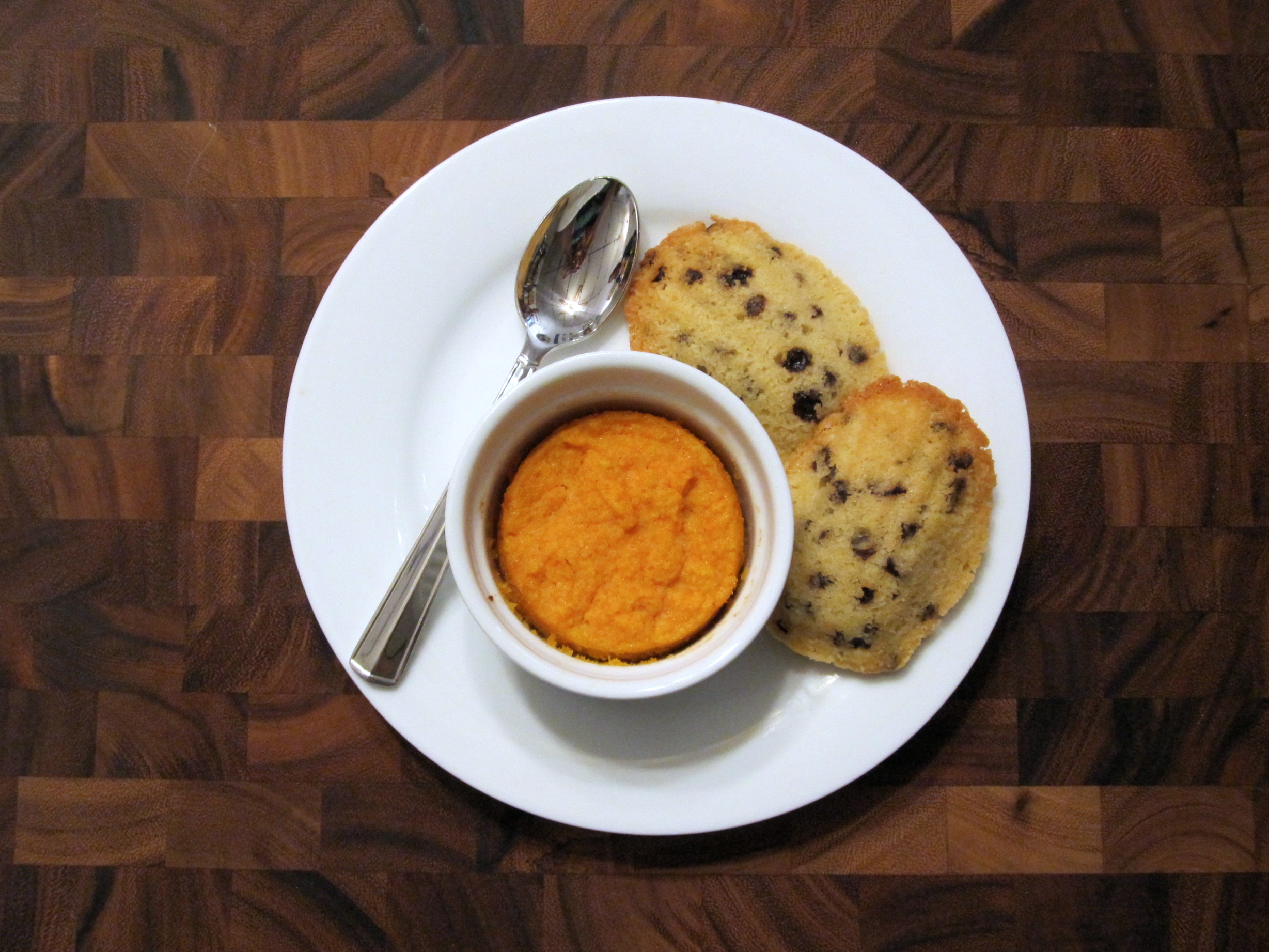
These are not light and fluffy cakes. They’re moist and dense, like a weightier muffin, with a rich flavor from the flower water, sherry, and currants. I liked them best as madeleines because that shape provides the highest edge-per-bite ratio – the crisply browned edges are particularly tasty. They also made an excellent snack alongside our old favorite, carrot pudding.
IMG_4455

To make maccarons of valentia Almonds

Today’s Cooking in the Archives post is also published on ABO-Public: An Interactive Forum for Women in the Arts, 1640-1840. Check out a slightly longer version of this post here.

What do ladies bake? Ladies bake macaroons, tasty almond macaroons.

This recipe “To make maccarons of valentia Almonds” is from MS Codex 627 The delights for ladys: to adorne there persons beautyes stillyris banquits perfumes & wators. MS Codex 627 is designed to look like a printed book and includes a title page with the date 1655, a full table of contents, and a running header “The delights” on the verso and “for ladies” on the recto of on each opening. We’ve only worked with one other manuscript with these features in this project to date: MS Codex 625 where we found “Shrewsbury Cakes.”

Another important feature of this manuscript is obscured, rather than revealed, by our digital images: its size. It’s very small! It fits in the palm of your hand. It could be easily carried in a pocket. As such, it may have also been somewhat difficult to use in the kitchen. Many of the other manuscripts we’ve surveyed have been substantially larger and would be easier to prop open on a table for kitchen use.

Although this manuscript is specifically designed as a book for women, it was likely written by a man. After all, the volume is modeled on Hugh Plat’s Delightes for Ladies (1602) which you can read about in more detail here. The introductory letter, partially missing from the manuscript, is signed by a Jose: Lovett and the hand is consistent throughout. This led the Penn cataloger to suggest that this may be Lovett’s book and written in his hand. However, the back of this book contains a reverse recipe book in a few hands signed “Mabella Powell Her Booke.”

Regardless of who wrote the bulk of this book, Mabella Powell was an owner, composer, and reader of its recipes.

The Recipe

To make maccarons
of valentia Almonds

Take one pound of blanched al-
monds and beat them in a marble
mortor with a woden pestill and in
beating of them now and then
about 12 times drop into them
a sponfull of red Rose water and
and when thay are small beaten
put into them one li [pound] of fine suger
well beaten & searsed then take
one grane of muske and a little
amber greece or siuet and dissolue
it in a little Red rose water
and mingled well a mongst it
then take up your past into a faire
Silu[er] or pewter dish and spread
it with a spoone all ouer the
dish and set it in an ouen

when your bread is new drawne &
when it dryes and begines to looke
white upon the topp then stirr it
& spread it againe and soe use it halfe
a dozen times and within one halfe
quarter of an howre it will bee drye
enough then take the whits of halfe
a dozen new layd eggs and straine
them through a fine Cloth and beat
them alittle and then mingle them
with the almonds & suger & soe
with a little slice lay them upon
a sheete of pure whit papor & set
them in the ouen, the ouen being
then in the sme temper it was in
when bread was newly drawne out
of it, and lay under them for feare
of borning some plate or some such
thing and soe bake them and keepe
them for your use in some cobbord
or some box not farr from the
fire.

This is a fairly simple recipe and the method for cooking it is explained in great detail.  It’s rare to see such specific instructions for the oven heat or cookie storage. Beyond halving the quantity I made very few changes.

 Our Recipe

1 1/3 C ground almonds (1/2 lb)
rosewater (1-2 T total)
2 T butter
1/2 C sugar
3 egg whites, lightly beaten
Preheat oven to 350 F.

Mix ground almonds with 6 drops rosewater stirring the mix after each drop (approximately 1T total.) Melt butter with a drop of rosewater. Stir aromatic butter into the ground almonds mix. Stir in sugar.

Spread the mixture on a baking sheet and bake for 10 minutes. Check at 5 minutes and stir to ensure the edges do not burn.

Return the fragrant, toasted almond mix to a mixing bowl. Stir in 3 lightly beaten egg whites. A sticky dough should form. Line a baking sheet with parchment paper. Use a 1 tsp spoon to scoop this sticky mix onto your baking sheet.

Bake for 15-20 minutes or until the bottom of a macaroon is brown and the top is beginning to brown slightly. Allow to cool for 5-10 minutes before eating. Although they will smell incredibly tempting.

Ladies (and gentlemen) these macaroons are delicious. They are fragrant and nutty. When I served them at a holiday party, my guests simply devoured them. But they are just as nice to eat in a more solitary manner with a nice cup of tea.

Since I used store-bought ground almonds, I imagine my mix was much less oily than it would be if ground from fresh almonds. I added 2T of butter to restore that oil and compensate for not using greasy ambergris, suet, or musk as suggested. The recipe talks about slicing, but there was no way I could slice my sticky cookie mix.

While I think that toasting the almond mix deepened the flavor, I think you could skip that step if you were in a hurry or concerned about burning the mix. However, I think either baking parchment or very well-greased pan is essential to getting these cookies onto a plate in one piece.

Try them with whole almonds or ground, with orange blossom water or other spices.

Shrewsbury Cakes

{Today’s post is also published on Unique at Penn, a blog maintained by Penn libraries to highlight their collections. Since we’ve been exploring the library’s manuscript recipe books, we’re thrilled to share one of our finished recipe with Unique at Penn’s readers.}

One of the things we’ve been struck by along the way in this stroll through the culinary archives has been the similarity of certain recipes to many we follow today.  This holds true particularly for baked goods. (Except the notorious fish custard.) We weren’t quite sure what to expect from these “Shrewsbury cakes” – small cakes? Pancakes? Drop cookies? It turns out that Shrewsbury cakes are basically early modern snickerdoodles.

This recipe comes from MS Codex 625, a manuscript recipe book that belonged to a student in a London cooking school in the early eighteenth century. The pastry school was owned by Edward Kidder, who taught at a few locations in London between around 1720 and 1734. Blank books with printed title pages seem to have been used by students to write down recipes they learned. Kidder also published his recipes in the printed volume, Receipts for Pastry and Cookery, in 1720.

The Recipe

shrewsbury cakes

Shrewsbury Cakes.

Take a pound of fresh butter a pound of double
refind sugar sifted fine a little beaten
mace & 4 eggs beat them all together with.
your hands till tis very leight & looks
curdling you put thereto a pound & 1/2 of
flower roul them out into little cakes

Our recipe (halved from the original)

1/2 lb. (2 sticks) butter, softened
1/2 lb. sugar
1/4 tsp. mace
1/2 tsp. cinnamon
2 eggs
3/4 lb. flour

Using an electric mixer, cream together the butter and sugar. Then add the eggs and mix at medium speed until the mixture looks curdled. Sift together dry ingredients and add at low speed until just combined. Scoop and roll the dough by hand into 1-tbsp. balls, then pat flat. [You could also refrigerate the dough until it’s firm enough to roll out on a flat surface and cut out into rounds.]

Bake  at 350F for 15-18 minutes (ours were about 1/3″ thick, so you could roll them thinner and have a slightly shorter cooking time) They’re done once they turn the slightest bit brown around the edges. This halved recipe yielded about two dozen cookies.

The Results

If you like snickerdoodles (and who doesn’t?), you’d like these. We added the cinnamon because we like it and couldn’t resist, and we thought it rounded out the mace nicely. These are mild, fairly soft cookies that are great with tea. We rolled and patted the dough into individual cookies because it was too soft and stick to roll out, but a little bit more flour and a stint in the fridge might make the dough easier to work with a rolling pin.