to make a Brown Frickasey

As the end of November approaches each year, I get increasingly excited about two things: Thanksgiving turkey and the annual re-run of the “Poultry Slam” episode of This American Life. Like it or not, November and December are the very height of poultry season. Unsurprisingly, there are lots of recipes for cooking poultry in Penn manuscripts from making chicken pot pie and fried chicken (two ways) to numerous instructions for roasting.

When I cooked this recipe last Tuesday it was raining in southern California. It was a major news event out here. It was also one of the first dark, chilly, and damp days I’ve seen in ages. I decided to try a recipe “to make a Brown Frickasey” from MS Codex 252 and it was a perfect dish to warm the house and the belly.
The Recipe

frickasy

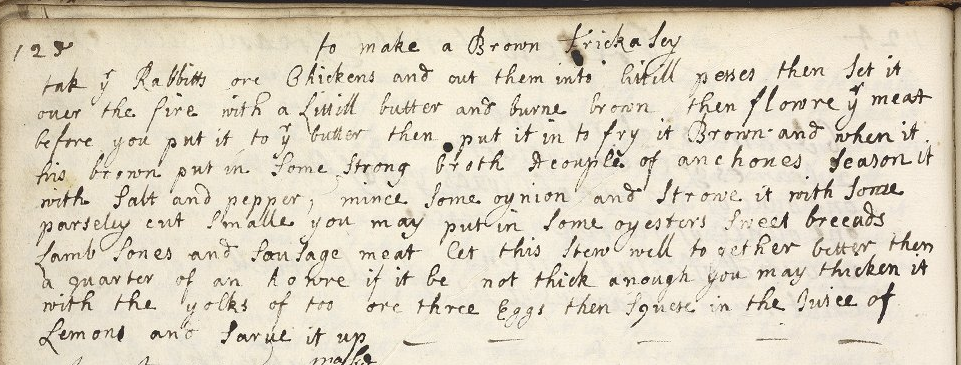
to make a Brown Frickasey

tak the Rabbits ore Chickens and cut them into littill pesses then set it
ouer the fire with a Littill butter and burne brown then flowre the meat
before you put it to the butter then put it in to fry it Brown and when it
tis brown put in some strong broth A couple of anchoves season it
with salt and pepper, mince some oynion and strowe it with some
parseley cut smalle you may put in some oyesters sweet breeads
Lamb sones and sausage meat let this stew well together better then
a quarter of an howre if it be not thick enough you may thicken it
with the yolks of too ore three Eggs then squese in the Juice of
Lemon and sarue it up

This is a simple and delicious recipe with lots of room for variation: Brown a delicious mix of meats in butter then add more meat, stock, and flavors. Ken Albala’s Cooking in Early Modern Europe, 1250-1650 describes a fricassee as a method for frying meat and adding a flavorful sauce. As this recipe demonstrates, it is a very flexible method that works well with poultry and other meats. I decided to use chicken breasts, pork sausage, and chicken stock, but I also could have faithfully followed this recipe using rabbit, oysters, sweet breads, or other offal.
Our Recipe

3-4 T butter
2 chicken breasts, sliced into 2-inch strips
4 T flour (for coating chicken)
1/2 lb. pork sausage meat (either sausage removed from its casing or sausage meat sold uncased)
1  onion, medium sized, chopped
4 anchovies, chopped
1 1/2 -2 c chicken broth
salt and pepper (to taste)
the juice of half a lemon
2 T chopped parsley

Lightly flour the chicken strips by rolling them in a plate or bowl of flour. Finish chopping the onion and anchovies and readying the sausage meat . Make sure your stock is also ready to go if you’re defrosting it or using a concentrated boullion preparation.

In a dutch oven or large pot, heat the butter until it melts, smells nutty, and starts to darken in color. Add the strips of floured chicken slowly. Don’t worry if all the chicken doesn’t fit at the beginning because the strips will shrink as they cook. Turn the meat over so that it cooks on both sides. When the outside of the chicken starts to brown, add the sausage meat and cook for 1 minute. Add the chopped onion and anchovies and cook for 1 minute more.

Add the broth and simmer uncovered for 15-20 minutes. When the gravy is thick and everything is well cooked, squeeze the juice of half a lemon into the stew. Sprinkle parsley on top. Serve hot.

Results

My spouse and I devoured this delicious stew with some roast butternut squash, kale salad, and a bottle of fine, west-coast IPA. It was warming and satisfying meal. We both picked additional mouthfuls of sausage-y chicken out of the pot after we’d cleaned our plates.

I started by browning 2 T butter and added about 2 more as the chicken cooked. The sauce thickened into beautiful gravy on its own. I used homemade chicken stock that I (try to) always keep in my freezer. Homemade stock from pork bones would also be a delicious addition. Store-bought or concentrated stocks will work well here, too. But be sure to taste the mix before adding additional salt.

I can see how this method of preparation would work well for a variety of poultry and other meat. The strips of chicken stayed tender and flavorful, but this would be great with dark meat chicken. I used peppery pork breakfast sausage meat from a local farm. I think a pork and sage or even a pork and apple sausage would work well here. Finally, the anchovies added an unexpected note that was more umami than fishy. I suggest that you give them a try if you’re an anchovy skeptic, but not if you absolutely despise these small, flavorful fish. The lemon adds an essential bright note that complements the fat and savory flavors of the dish.


Notes towards roasting a lobster

To take a break from roast poultry, I wrote about a recipe for roast lobster from MS LJS 165 for The Appendix Blog. You can click here to read the full post.

Since I haven’t yet tried the recipe and roasted a lobster in my own kitchen, this post does not follow our normal format. But I didn’t want you, dear reader, to miss out on a potentially delicious archival preparation for this mighty crustacean.  I’ve copied  my transcription of the recipe and a few notes below in case any of you are brave enough to give it a try. Let us know how it goes!

We’re working on some tasty holiday recipes to share with this season. Until then, consider roasting a lobster. Or give this brilliant Financial Times article about cooking traditional Christmas dishes with food historian Ivan Day a read.

roast lobster

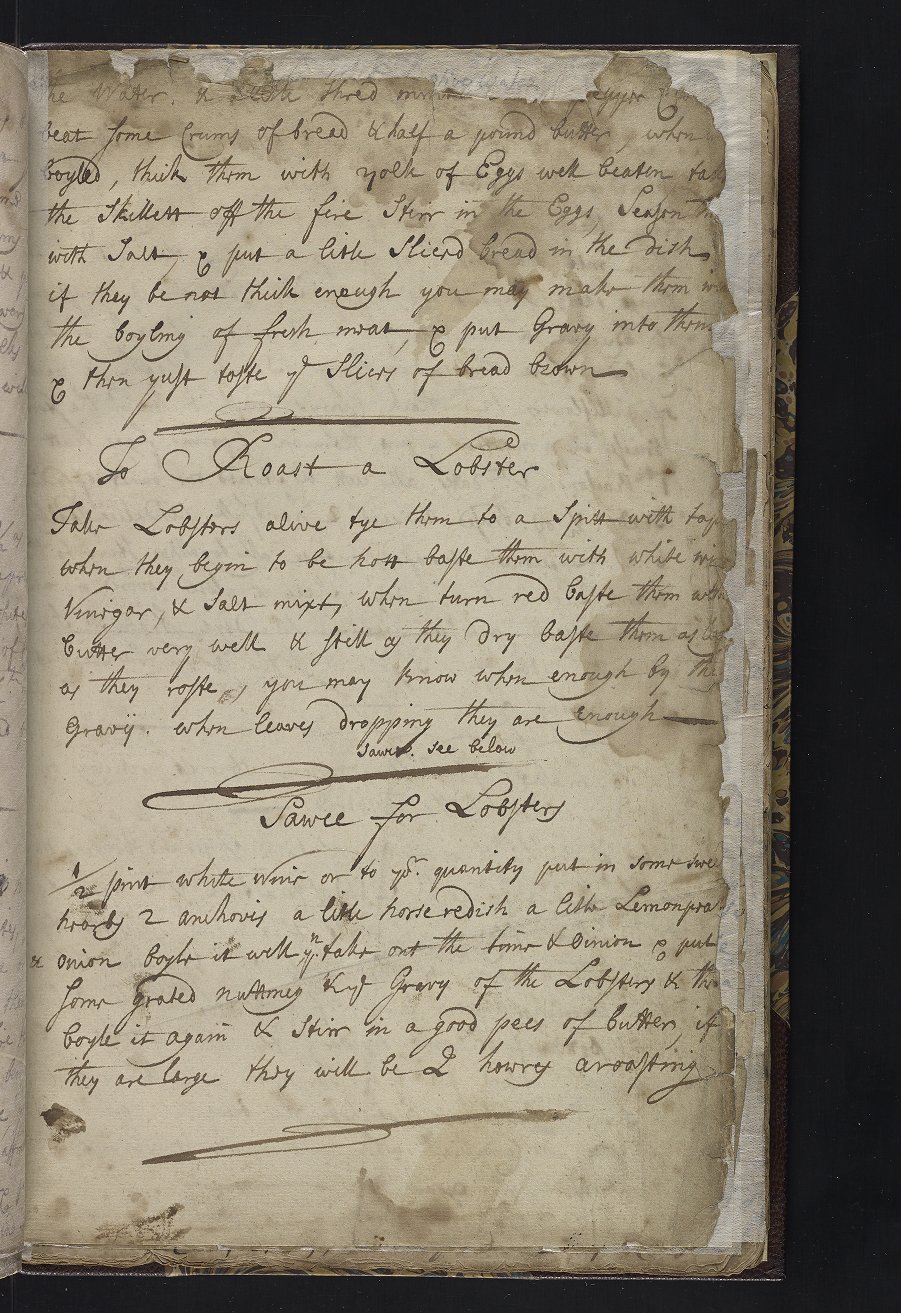
To Roast a Lobster
Take Lobsters alive tye them to a spitt with tap[e]
when they begin to be hott baste them with white wine
Vinegar, & salt mixt, when turn red baste them with
butter very well & still as they dry baste them as l[on]g
as they roste, you may know when enough by the
gravy. when leaves dropping they are enough –

sawce see below

Sawce for Lobsters
1/2 pint white wine or to your quantity put in some swe[et]
hearbes 2 anchovis a litle horseredish a litle lemonpeal
& onion boyle it well then take out the time & oinion & put
some grated nuttmeg the gravy of the Lobsters and then
boyle it again & stirr in a good pees of butter, if
they are large they will be 2 howres aroasting

Tied to a stake, the lobsters are roasted over a fire and basted with butter for approximately two hours. An accompanying white wine and butter sauce, seasoned with anchovies, horseradish, lemon, onion, and nutmeg, complements the rich flavor of the lobster itself.

Desart Cakes

King Arthur Flour’s Magazine Sift featured a version of our recipe here.

I’m a baker. I enjoy cooking – even more so now that we’re back in soup season – but to me there’s something special about the precise measurements that produce a perfect chocolate cake, the fiddly steps of making italian meringue frosting, the flexibility of quick bread recipes, the scooping and rolling of cookies. So I’m especially interested in the many recipes for baked goods scattered throughout the archive of recipe books we’ve been exploring. These “Desart Cakes” caught my eye – what characterizes a dessert cake? Is it not a cake but, like the snickerdoodle-esque Shrewsbury cakes, what we think of as a cookie? Could they even make the cut for my holiday cookie gift bags?

The recipe comes from UPenn Ms. Codex 1038, a fairly general compilation of recipes put together through the late eighteenth and early nineteenth centuries. This particular recipe was probably written down before 1793. Marissa also whipped up and enjoyed a batch of lemonade from the same volume here. (In fact, these recipes occupy facing pages. Lemonade and cookies, anyone?)

The Recipe

desart cakes

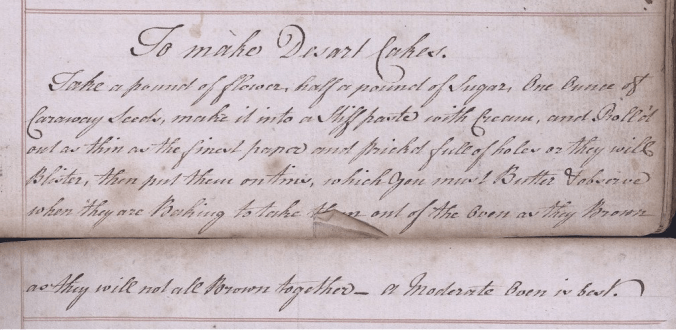
To make Desart Cakes.

Take a pound of flower, half a pound of Sugar, One Ounce of

Caraway Seeds, make it into a Stiff paste with Cream, and Roll’d

out as thin as the finest paper and pricked full of holes or they will

Blister, then put them on tins, which you must Butter & observe

when they are Baking to take them out of the Oven as they Brown //

as they will not all Brown together — a Moderate Oven is best.

Our Recipe

[If I’m not sure how a recipe is going to turn out, I like to avoid making an enormous quantity of it. Cookies make that easy: here, I halved the recipe. which yielded 44 2″ cookies. Plenty!]

1/2 lb. flour

1/4 lb. sugar

1/2 oz. caraway seeds (about 3 tsp.)

1 1/4 c. heavy cream*

optional: 1/2 tsp. vanilla**

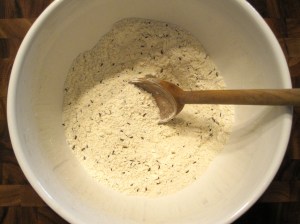
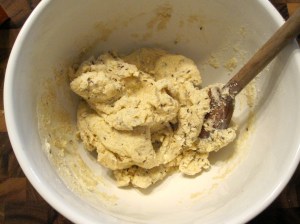
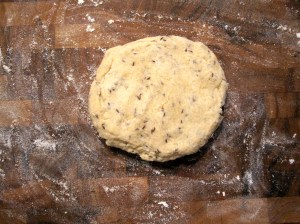
In a mixing bowl, stir together the dry ingredients. Stir in the vanilla and the cream about 1/2 c. at a time, incorporating it thoroughly before adding the next pour. (A wooden spoon works nicely here.) The dough should start to hold together in a shaggy mass damp enough to be squeezed gently into an elastic, cohesive ball. (It shouldn’t be so damp that it sticks to your fingers at all – this isn’t a particularly messy dough. If this does happen, just add a touch more flour.) ]

Preheat oven to 350F.***

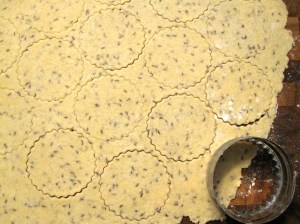
Divide the dough into halves or thirds for rolling out easily. Lightly flour your surface and rolling pin; you won’t need too much flour, but repeat the step often to avoid sticking. Roll to about 1/8″ thickness – thinner if you can since the dough shrinks back slightly once on the cookie sheets. Cut out dough with any cookie cutter**** and place on a baking sheet. (I lined mine with parchment paper.) Bake for 10-12 minutes, removing cookies as they brown around the edges. Cool on a rack – and try not to eat one as soon as it’s semi-cool!

NOTES:

*How much cream to add: I added 1/2 c. to start with and then more in 1/4-c. increments until the dough held together and felt slightly elastic when squeezed in a handful. My dough was wetter than biscuit dough or pie crust, for example. It should be wet enough to hold together easily without bits crumbling off but not so sticky that it adheres to your hands.

**Adding vanilla: I thought vanilla might add some nice depth of flavor with the caraway seeds, and I think I was right. In fact, next time I might add the full teaspoon. You could also try almond extract, orange extract, or skip the extract altogether. Or even switch out the caraway seeds for poppy seeds and toss in some lemon zest. It’s a flexible recipe.

***Baking temperature: I baked one sheet at 325F for 14-16 minutes and another at 350F for 10-12 minutes. I didn’t notice any difference in browning or in crispness produced by the different temperatures, so less time at 350F should be fine. You’ll start to smell the cookies when they’re nearly done; I removed them from the oven when golden-brown on the bottom and slightly browned around the edges. I also forgot to prick holes in the first tray (oops). I did add them to the second but didn’t note any difference (or “blistering”); feel free to stab them a few times with a fork if yours seem to be puffing up.

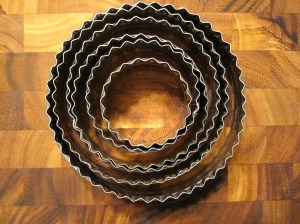
****Cookie cutter: I chose and liked a 2.5″ biscuit cutter with fluted edge, but most shapes would work, as would the top of a drinking glass. As mentioned, the dough does shrink a bit on the cookie sheet and then in the oven – none of my circles baked up to be perfectly even, and the caraway seeds make for somewhat ragged edges, so avoid any intricate shapes.

The Results

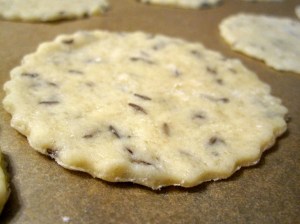
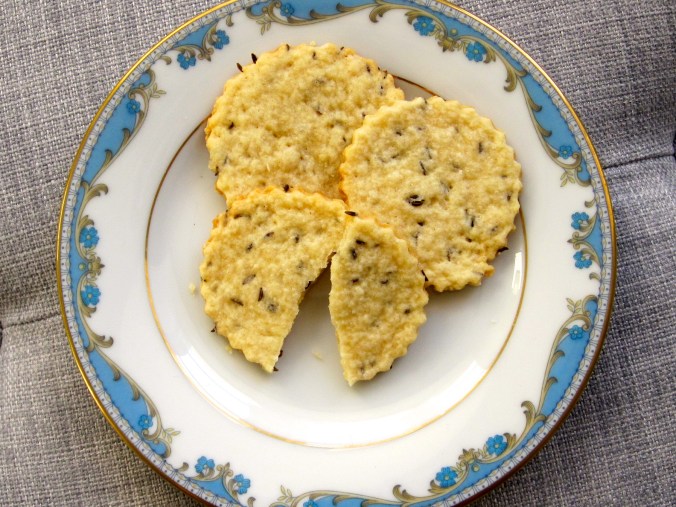
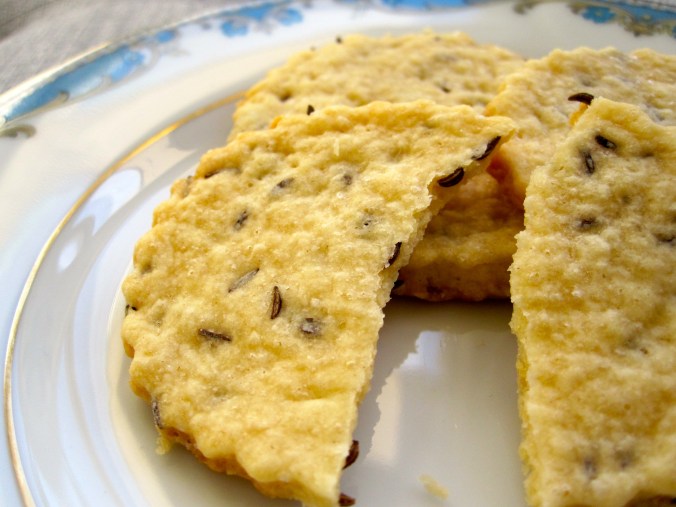
I thought these might be bland – inoffensive, sure, but not particularly tasty – and so was pleasantly surprised at how much I enjoyed them. They’re nicely crisp (rolling them “as thin as the finest paper” really does produce the best result), sweet without being cloying, and flavorful from the caraway seeds. Plus, they smell incredible while baking! I ate the first few with a cup of tea … and then a few more later on with a glass of wine … and then a few more for breakfast the next morning in a pinch. If you like caraway seeds, you’ll like these. And if you don’t like caraway seeds, you can still like these cookies by swapping them out for poppy seeds or another variation. I might experiment with adding in some ground almonds or pistachios. (If you do some experimenting, please report back!) And indeed, some of these might even make their way into my holiday cookie rotation.

A tarte of green pease

This is the recipe book that started it all: At a meeting of the Penn Paleography Group almost five years ago we transcribed a few recipes from MS Codex 1601. In the process of deciphering the handwriting of this recipe, and others from the volume, I became very curious about what on Earth “a tarte of green pease” would taste like. While peas, especially fresh spring peas, have a delightful sweetness, I was intrigued by the mix of sweet and savory ingredients in this tart.

The Recipe

green pease

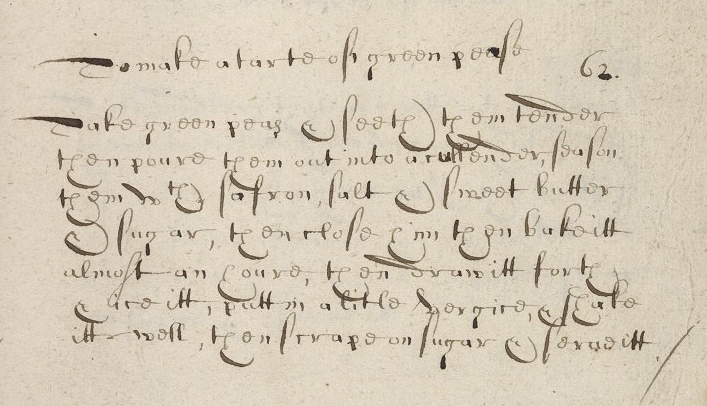
To make a tarte of green pease

Take green peas & seeth them tender
then poure them out into a cullender, season
them with safron, salt & sweet butter
& sugar, then close him then bake itt
almost an houre, then draw itt forth
& ice itt, putt in a litle wergice; & shake
itt well, then scrape on sugar & serve itt.

This recipe is made from fairly common ingredients, but it includes no measurements. We approximated all our ingredients to make one small tart. The most surprising ingredient in the list is “wergice,” which we think is an alternative spelling for “verjuice,” a bitter liquid made from young grapes that was also called for in our Could Possett recipe. Like before, we used lemon juice instead to add an acidic sourness to the recipe.

Our Recipe

2 c. peas
1 sheet puff pastry (homemade or store-bought and defrosted)
juice of 1/2 a lemon
2 T unsalted butter, cut into small pieces
2 t sugar, plus some to sprinkle on the top
1/4 t salt
pinch saffron

Cook the peas. If you’re using fresh peas, remove them from their pods, blanch them in boiling water for about a minute, and refresh under cold water immediately. If you’re using frozen peas, cook them according to the instructions on the package. We used frozen peas and they worked well.

Season the peas with the lemon juice, butter, sugar, salt, and saffron. Taste and adjust seasoning as needed.

Roll out the puff pastry. We folded the pastry into a rustic galette. You can also line a tart pan and reserve strips or a second sheet to cover the peas.

Add the pea filling to the puff pastry and fold or cover. Sprinkle sugar on top of your tarte. (An egg or milk wash on the top would be a nice touch as well.)

Bake at 350 F for 30 min or until the pastry is golden brown. Slice and serve.

Results

Perhaps not surprisingly, the “tarte of green pease” was somewhere between a dessert and a main course. The peas were both sweet and vegetal, the seasonings bright and savory. While I confess that it was not my favorite dish we’ve prepared over the course of this project, the taste was certainly unique. The starchiness of the peas made me feel like the dish was lacking an essential element and I wanted  to include other ingredients in the pie itself or on the side.

Since there are no measurements in the original recipe, we think this is a great opportunity for experimentation. With a few alterations, we think this recipe could be transformed in either a sweet or savory direction. To make it into a true dessert we would add more sugar and serve this tart with a side of vanilla ice cream. To turn it into a savory side-dish we would cut out the sugar altogether and instead add caramelized onions or shallots to the mix. The savory version might accompany roast squash, spicy baked tofu, or a roast chicken.


Lemonade

In August I moved to southern California from Philadelphia. Yes, dear readers, while Alyssa and I are still posting recipes we cooked together this summer, still scouring the manuscript archives at Penn in person and through digital surrogates, still scheming up delightful things to cook and share, we’re no longer working side-by-side in the kitchen. To cope with this change and steel myself for an October heatwave in the triple digits, I decided to start my weekend by making lemonade from a recipe in MS Codex 1038.

The Recipe

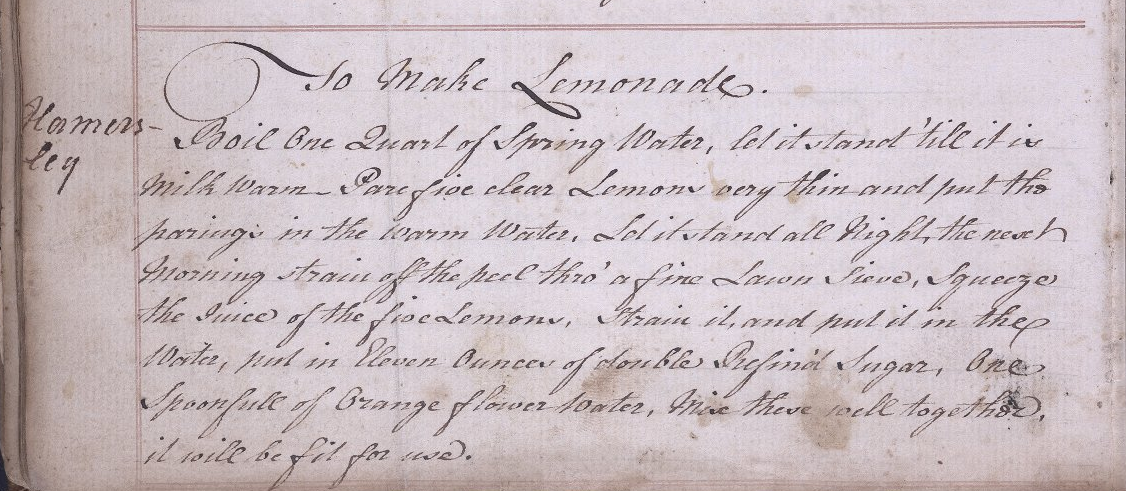
lemonade

To Make Lemonade.
Hamers-
ley

Boil One Quart of Spring Water, let it stand ’till it is
Milk Warm. Pare five clear Lemons very thin and put the
parings in the warm water. Let it stand all Night, the next
Morning strain off the peel thro’ a fine Lawn Sieve, Squeeze
the Juice of the five Lemons. Strain it and put it in the
Water, put in Eleven Ounces of double Refin’d Sugar, One
Spoonfull of Orange flower water. Mix these well together,
it will be fit for use.

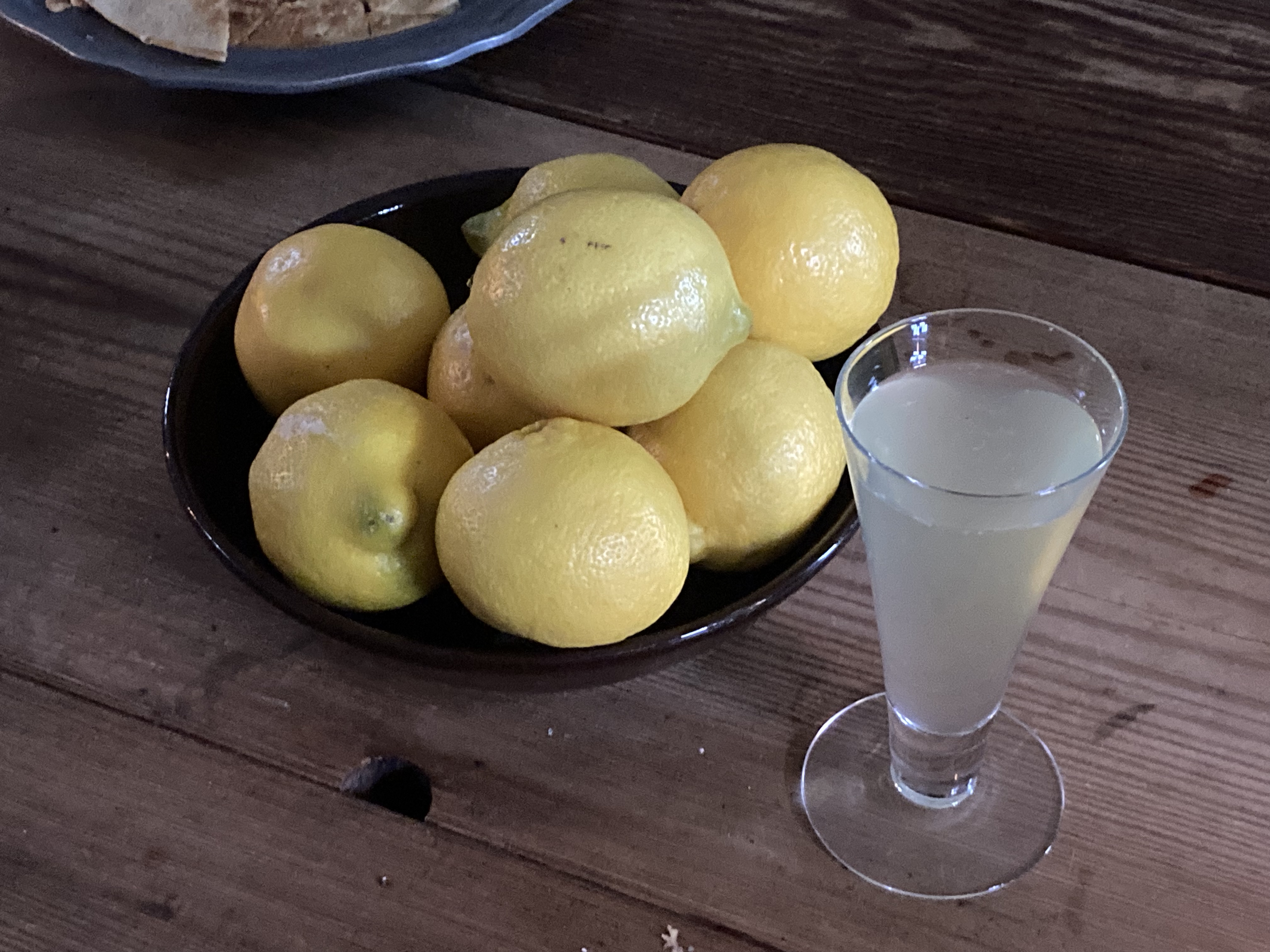
This recipe is wonderfully lazy: Infuse the water with lemons overnight, sweeten and season it in the morning. Sip lemonade all day. Repeat.

I think that there are two valid ways to interpret this recipe’s instructions for preparing the lemons. Both interpretations depend on how one defines the verb “pare.” This recipe is from the eighteenth or early nineteenth century and according to The Oxford English Dictionary “pare” was used around this time to describe both slicing and peeling fruit. Here are two approximate paraphrases of the text above:

1) Slice five lemons very thinly and add the slices to the warm water. Strain mix in the morning. Squeeze any remaining juice from the lemon slices into the mix.

2) Peel five lemons and add the peel to the warm water. Set five peeled lemons aside. Strain mix in the morning. Squeeze the juice from five peeled lemons into the mix.

I decided to proceed with the first interpretation, but I’d be curious to hear from any readers who try the other method of preparation.

I was also curious about the recipe’s specification for “clear lemons.” Other historical recipes like the ones on this blog also require clear lemons. I turned to the Oxford English Dictionary again and found that “clear” was increasingly becoming a synonym for “unbruised” or “unblemished” around the time this recipe book was compiled. Following suit, I selected the best lemons I had on hand for this recipe.

In the past I’ve purchased useful and cheap ($2) orange blossom water from various Indian grocery stores to use in baking and cocktails. My choice to fix this recipe this weekend was partly inspired by finding a bottle of it in my local cheese shop. The Nielsen-Massey Orange Blossom Water is a bit stronger than other floral waters I’ve used in the past and it hold up to the acidity of the lemons in this recipe.

Our Recipe

5 lemons, sliced

1 quart water

11 ounces sugar (1 1/2 c) – or to taste

1 T orange blossom water

ice and/or sparkling water to serve

Day 1:

Boil a quart of water and set aside to cool. Slice five lemons as thin as possible. Let the water cool until it is warm to the touch, but no longer scalding. Add lemons, cover, and let sit overnight.

Day 2:

Strain the lemon mix and squeeze remaining juice from the lemons. Reserve a few slices to garnish your lemonade. Stir in the sugar. Add the orange blossom water.

When I first tasted the unsweetened, electric yellow lemon infusion it was delightfully tart. Normally I don’t like my drinks *too* sweet and I often adjust the amount of sugar in recipes accordingly, but the mixture was so strong I decided to use the full amount this time. The finished lemonade was syrupy and very, very sweet. To my taste, the citrus and floral notes were a bit overwhelmed by the sweetness. With a few ice cubes and a lemon garnish it was much more refreshing. After sipping half my glass, I added a generous pour of sparkling water and found my perfect version of this lemonade. In the future, I might halve the sugar instead.

Still, this lemonade greatly improved my steamy Saturday. If the heat wave holds on for much longer, I might try it again with variations adding like thyme, sage, rosemary, mint, or lemon balm from my garden to the initial infusion, or even swapping out the orange blossom water for rose water.

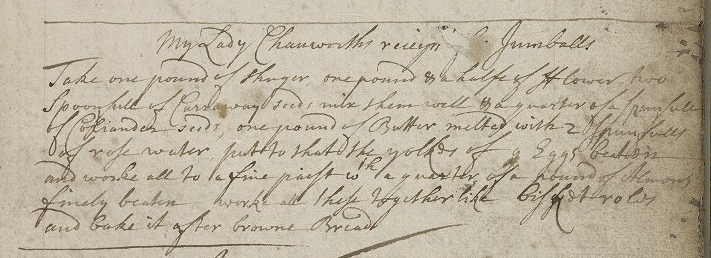
My Lady Chanworths receipt for Jumballs


CookingArchives-4184

Photo by Carley Storm Photography http://www.carleystormphotography.com

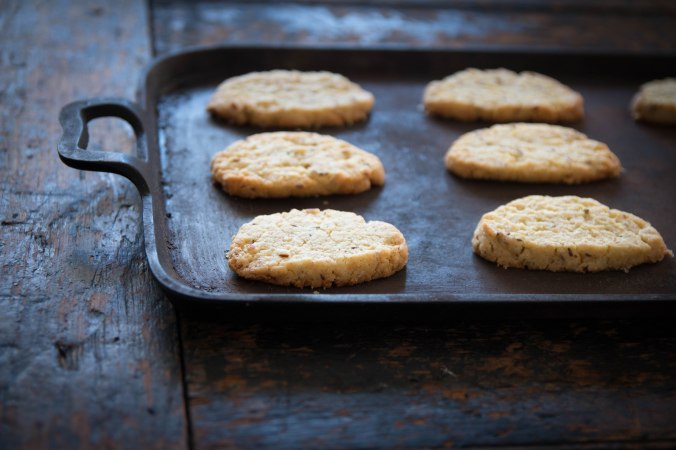
It’s high time that we talk about jumballs. We were initially mystified by the moniker, but jumballs are a classic early modern treat: A rich, satisfying, highly-spiced, shortbread cookie. They are the single most delicious thing we’ve cooked from the archives to date.

Even a quick search to define the term revealed the jumball’s long-term popularity, from Gervase Markam’s classic English Housewife (1649) to the iconic Mrs Beeton’s Book of Household Management (1888), with examples on many other historical cookery sites like this one. The Oxford English Dictionary generalizes among the range of different spices and methods in these various recipes to define early modern jumballs as a “kind of fine sweet cake or biscuit, formerly often made up in the form of rings or rolls.”

In LJS 165 there are two recipes for jumballs back to back: “To Make Jumballs / My Mother Anges receipt” and “My Lady Chanworths receipt for Jumballs.” We thought that the first recipe’s mention of the compiler’s mother (or another source’s mother) was a poignant look into the perennial practice of handing down knowledge from mother to child, most likely mother to daughter. But the final instruction in that first recipe — soaking the baked jumballs in vinegar overnight — was not especially appealing, although it is very likely an excellent method for preserving the biscuits.  Besides, who among us can take delicious cookies out of the oven and not eat them immediately? We decided to prepare the second recipe instead: “My Lady Chanworths receipt for Jumballs.” (If any readers try the alternate recipe, we’d love to hear how it turns out.)

The Recipe

jumballs

My Lady Chanworths receip[t  for] Jumballs

Take one pound of shuger, one pound & a halfe of fflower, two
spoonfull of Carraway seeds, mix them well & a quarter of a sponfull
of Coriander seeds one pound of Butter melted with 2 spunfulls
of rose water, put to that the yolkes of 4 Eggs beaten
and worke all to a fine paist with a quarter of a pound of Almons
finely beaten worke all these together like bisket roles
and bake it after browne Bread

Like other sweet and savory recipes from the period, this recipe uses fragrant whole caraway and coriander seeds enlivened by aromatic rose water, the richness of egg yolks and butter, and the deep nuttiness of ground almonds. Other than halving the quantities in the recipe (which still made a lot of cookies) we’ve made no changes to the dough mix and simply reformatted the instructions into a modern style below.

Now, there are a wide variety of ways to shape jumball dough before baking. Recipes call for twisting, rolling, slicing, and folding. Given the texture of the jumball dough in a very hot kitchen (summer in Philadelphia) we decided to follow a classic shortbread method and to roll our dough into a long log, slice cookies 1/4 inch thick, and bake them. (If you try this recipe and shape them differently, send us a photo!)

Our Recipe

*Halved from the original. We also used a baking scale for this one, but we’ve included approximate volume measurements.

1/2 lb sugar (1c)
3/4 lb flour (2 3/4 c)
1 t caraway seeds
1/2 t coriander seeds
1/2 lb butter, melted (2 sticks or 16 T)
1 t rosewater
2 egg yolks, beaten
1/8 lb ground almonds (generous 1/2 c)

Preheat oven to 350F.

Mix flour, sugar, and spices in the bowl of a stand mixer (or a large bowl if mixing by hand). Add melted butter, rosewater, egg yolks, and ground almonds and mix until a uniform dough forms.

Place dough on a lightly floured surface and shape into cookies. We did this by rolling the dough into a log and slicing 1/4 inch cookies, but there are many other ways to shape this kind of dough.

Bake 20 minutes or until brown around the edges. Cool on a rack before devouring, if you have the willpower.

Results

They don’t look like much when you lift them onto the cooling rack (does shortbread ever look impressive?). But the aroma of spice and sweet gives it all away.

Jumballs are truly delicious. Their balance of nut and spice, fragrance and buttery texture is divine. They’d hold their own in a spread of cookies. We’ve since learned that they pair well with Italian Cheese, but we suspected from the beginning that they would complement vanilla ice cream, custard, fresh fruit, or a simple cup of tea.

When we shared these with unsuspecting friends they were bowled-over by the surprising and delightful presence of coriander. And their first guess was that we’d found the recipe on one of the latest trendy food blogs, not through this archival project. We’ll be making these again.


Italian Cheese

This “Italian cheese” has intrigued me for some time. It comes from UPenn MS Codex 876 (1780). Just under this one is a recipe for “Cow Head Cheese” – containing not just “two Cow Heads” but also “two Calves Feet” plus “two Calves or Sheepe tongues.” I wasn’t feeling daring enough for this one (and didn’t happen to have a few bovine appendages hanging around), but it certainly represents a nose-to-tail approach! Since I’d rather just carry home a pint of cream and a few lemons from the market, I decided that it was time for Italian Cheese. This recipe only requires three main ingredients: cream, lemons, and sugar, plus almonds and raisins (or whatever you’d like) for garnish.

The Recipe

italian cheese

Italian Cheese

Grate the rind of two Lemons,

into a Pint of good Cream, add to

it the Juice of one Lemon, &

a quarter of a pound fine Sugar,

Whip it up together, put it in

a small Sieve, & let it stand

all Night. When sent up, stick

it with blanch’d Almonds &

Raisins — it must not be over

whipp’d —

The Results

The easy availability of these ingredients and the straightforward instructions meant that I followed the instructions above fairly closely.  Since the recipe cautioned that “it must not be over whipp’d,” I whisked the cream, lemon, and sugar mixture lightly, by hand, for about 30 seconds. The mixture was thicker than unwhipped heavy cream but not yet thick or airy. I then poured it into my handy sieve … only to have most of it go straight through into the bowl below. Oops. I lined the sieve with two single sheets of cheesecloth and tried again, which worked perfectly. As instructed, I let it sit in the fridge overnight (plus the non-eighteenth-century addition of some plastic wrap on top) to drain and thicken. It had yielded about 2-3 tablespoons of liquid within a few hours; since that amount didn’t seem to increase much overnight, you could probably rush this recipe in 3+ hours if necessary.

I suspected that it might turn out something like our cream cheese, just sweeter and citrusy, perhaps closer in taste to mascarpone than to the tanginess of cream cheese. And this hunch was mostly correct: it’s thinner than cream cheese or mascarpone (think the consistency of a thin custard or non-Greek yogurt), with a rich, sweet creaminess. The lemon zest in addition to the juice adds a nice zip – since I like citrus, I might increase both the zest and the juice next time. It would be fun to try this with orange, with meyer lemons, or with a mix of lemon and orange. Many citrus possibilities!

Since this uses a pint of cream, and depending on how you’re serving it, it could probably yield at least six servings and up to ten. I spooned a few dollops into a bowl and sprinkled slivered almonds on top. I don’t particularly care for raisins but had some dried sour cherries at hand and used those instead – I really liked the lemon/cherry combination. Raisins could of course work, as would currants or even chopped dried apricots or figs. Basically, I think this recipe lends itself to many variations. I ate a few spoonfuls of the concoction on its own and then remembered some spiced jumball cookies (we’ll post the recipe soon) in my freezer. It turns out that jumballs make an excellent vehicle for Italian cheese! It would also work very well spooned over fresh fruit or in a trifle. Italian cheese: easy to make, easy to enjoy.

Shrewsbury Cakes

{Today’s post is also published on Unique at Penn, a blog maintained by Penn libraries to highlight their collections. Since we’ve been exploring the library’s manuscript recipe books, we’re thrilled to share one of our finished recipe with Unique at Penn’s readers.}

One of the things we’ve been struck by along the way in this stroll through the culinary archives has been the similarity of certain recipes to many we follow today.  This holds true particularly for baked goods. (Except the notorious fish custard.) We weren’t quite sure what to expect from these “Shrewsbury cakes” – small cakes? Pancakes? Drop cookies? It turns out that Shrewsbury cakes are basically early modern snickerdoodles.

This recipe comes from MS Codex 625, a manuscript recipe book that belonged to a student in a London cooking school in the early eighteenth century. The pastry school was owned by Edward Kidder, who taught at a few locations in London between around 1720 and 1734. Blank books with printed title pages seem to have been used by students to write down recipes they learned. Kidder also published his recipes in the printed volume, Receipts for Pastry and Cookery, in 1720.

The Recipe

shrewsbury cakes

Shrewsbury Cakes.

Take a pound of fresh butter a pound of double
refind sugar sifted fine a little beaten
mace & 4 eggs beat them all together with.
your hands till tis very leight & looks
curdling you put thereto a pound & 1/2 of
flower roul them out into little cakes

Our recipe (halved from the original)

1/2 lb. (2 sticks) butter, softened
1/2 lb. sugar
1/4 tsp. mace
1/2 tsp. cinnamon
2 eggs
3/4 lb. flour

Using an electric mixer, cream together the butter and sugar. Then add the eggs and mix at medium speed until the mixture looks curdled. Sift together dry ingredients and add at low speed until just combined. Scoop and roll the dough by hand into 1-tbsp. balls, then pat flat. [You could also refrigerate the dough until it’s firm enough to roll out on a flat surface and cut out into rounds.]

Bake  at 350F for 15-18 minutes (ours were about 1/3″ thick, so you could roll them thinner and have a slightly shorter cooking time) They’re done once they turn the slightest bit brown around the edges. This halved recipe yielded about two dozen cookies.

The Results

If you like snickerdoodles (and who doesn’t?), you’d like these. We added the cinnamon because we like it and couldn’t resist, and we thought it rounded out the mace nicely. These are mild, fairly soft cookies that are great with tea. We rolled and patted the dough into individual cookies because it was too soft and stick to roll out, but a little bit more flour and a stint in the fridge might make the dough easier to work with a rolling pin.


Chery brandy

There are many recipes for making alcohol in Penn’s manuscript recipe books. But most would require the average home cook to purchase complex equipment and invest quite a lot of time, energy (and, dare I say, courage?) in their execution. From recipes for “braggart liquor” (spiced beer), “sperit of rasberrys” (raspberry wine), and “Meade to make according to Queen Elizabeth receipt” (the “Queen’s” mead) in Penn’s manuscripts, to the infamous recipe for “cock ale” held in the Folger Shakespeare Library collections, working with spirits can challenge even the most adventurous cooks. (And we’re the cooks who made  fish custard!) There are some approachable beverage recipes in the archive. Our recipe for could possett was one, “Chery brandy” from Ms. Codex 1601 is another.

The Recipe

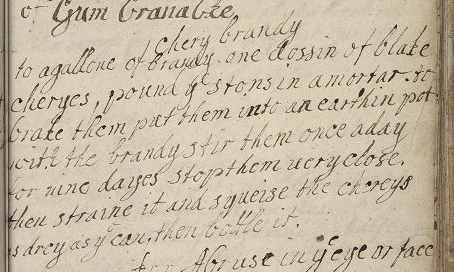
cherry brandy

Chery brandy

to a gallone of Brandy one dossin of blake
cheryes, pound the stons in a mortar to
brake them put them into an earthin pot
with the brandy stir them once a day
for nine dayes stop them uery close.
then straine it and squeise the chereys
[a]s drey as you can, then bottle it.

This is a very simple recipe. Cherries mingle with alcohol and magic happens. Other than reducing the volume a bit, we only made one major change: We didn’t break the cherry pits or add them to the liquor. Cherry pits carry low-levels of toxins, like cyanide. We may be fearless in the kitchen, but we see no need to experiment with known poisons, whatever flavor they may impart to a beverage.

Our Recipe

2 c brandy

6 cherries (washed, pits removed, and halved)

Put brandy and cherries in a well-sealed glass container. Place in a dark, cool area and stir daily for nine days.

The results

Over the nine days the cherries infused the brandy, the color of the concoction slowly, incrementally deepened to a rich red. Chery brandy is beautiful to look at in the bottle and in the glass.

Straight up, chery brandy is a bracing beverage. Like any brandy, it is a warming drink with strong flavors. The cherries added a pleasing, rich sweetness. After the initial sipping, we added an ice cube, bitters, and lemon peel to create a mellower drink, a sort of “chery brandy old fashioned.” We think this would be a great way to savor a hint of summer cherry deliciousness on a cold winter night. But it’s high summer, so we took it one step further and added some ginger ale to the mix. This final result created a lovely refreshing cocktail.

To make a “Chery brandy old fashioned”

2 oz cherry brandy
ice (one giant cube or 2 small cubes)
slice of lemon peel
dash bitters

Put ice in a rocks glass. Add brandy. Season with bitters. Garnish with lemon peel.

To make a “Chery brandy fizz”

2 oz cherry brandy
6 oz ginger ale (preferably high-quality, sweetened with cane sugar)
Lemon slice
ice

Fill a tall glass with ice. Add brandy and ginger ale. Garnish with lemon.

With late-summer stone fruits flooding the farmer’s markets, we’re curious to see how this recipe would work with apricots, plums, and peaches. Other base alcohols could add unique flavors to the mix (plum vodka? peach rum?). Melissa Clark proposed a related method for preserving summer fruits in alcohol in the New York Times  a few years ago. But, as you now know, mixing fruit and alcohol is a very old idea.


Fish Custard

Update: Since we posted this recipe, we’ve learned that our fish custard might have been tastier had we prepared it using different methods and ingredients. Please see the comments for a variety of helpful suggestions. And if you successfully recreate this dish, please let us know!

Some recipes should stay in the archives.

We’ve had surprising success so far with these early modern recipes. All have been edible, most have been pretty tasty, and a few – like the inaugural mac and cheese and some spiced “jumball” cookies we’ll tell you about soon – have been downright great. So, we thought, let’s branch out and have a more daring culinary adventure. When Marissa found this recipe for “fish custard” (that’s right, Marissa, I’m blaming you), we thought immediately of Doctor Who’s infamous snack:

doctor-who-fish-custard_1653637_GIFSoup.com (1)

The Doctor makes fish fingers and custard look pretty tasty. And while we suspected that fish custard might not prove our favorite recipe from this project, how bad could it really be?

Bad. So. Very. Bad.

This fish custard comes from UPenn Manuscript LJS 165, a collection of  recipes in multiple hands, written and gathered together sometime between 1690 and 1802. Readers could consult the collection to find other culinary recipes but also to find out about various household remedies, like how to cure colic (presumably, by not making someone eat this dish) or to kill moths (probably by setting out a bowl of fish custard, thereby driving all living things out of the vicinity).

Please don’t try this at home. No, really. Please don’t.


The Recipe

fish custard

ffish Custard

One pound of Almons beat them small, in the beating

put in the Row of a Pike 4 dates cut and the yolkes of

4 Eggs temper it with cold water Straine it through a

Strainer & make a quart of it Season it with Suger Rosewater

Salt pxxxxe beaten Mace When it is Baked scrape suger on

Our version:

1 c. ground almonds

1 to 1 1/2 tbsp. fish roe (ours was salmon)

3 dates, seeded and roughly chopped

2 eggs + 1 egg yolk

1/4 c. whole milk

1/4 c. sugar

1 tsp. rosewater

1/8 tsp. ground mace

a few pinches of salt

Preheat the oven to 350F. Butter a small casserole dish. Stir together all ingredients, then spread evenly in casserole dish. Bake for 15-20 minutes. Remove from oven and cool for at least 10 minutes before serving.

We quickly realized that this wasn’t going to be a traditional custard – the ratio of almonds to dairy is much too high to produce anything like a creamy texture. (The original recipe did include straining, but that would have removed all of the almonds and dates, which seemed counterproductive.) To make the mixture stir-able, we added a few spoonfuls of milk. We were unsure how vigorously to beat in the fish roe: should the eggs be broken down and, liquified, dispersed evenly throughout the custard? Or should they maintain their shape? We erred on the side of folding them in gently. It’s possible that we should have put the whole mixture in the food processor; this might have improved the final texture somewhat, though it’s unlikely to have helped the taste.

This recipe raised some interesting questions for us about interpreting early modern culinary instructions: with other recipes, we’ve had some idea of how they would turn out, especially when we started cooking and realized that they resembled some modern-day counterpart. This similarity provided some guidance; even when the original recipe’s instructions weren’t quite clear to us, we could extrapolate from other knowledge and proceed with some degree of confidence. The addition of the fish roe, in fact, threw us off less than the realization that this “custard” would not resemble anything we would call by that name. We were apprehensive – which seems a valid reaction to a fishy dessert – but also curious. What would the texture be like? Would the fish roe somehow pair beautifully with the almonds and dates in a salty-earthy-sweet combination?


The Results

Big surprise: dates, almonds, and fish roe don’t play well together. And the rosewater just made things worse. The “custard” resembled a bar cookie: very firm and sliceable into squares. In fact, it was quite dry, to the point that even if it had tasted good (ha!), eating more than a few bites wouldn’t have been very appealing. Another texture issue: baked fish roe either explodes warmly when chewed or takes on an off-putting rubberiness. We took tiny servings and managed a spoonful. (I think the fact that we did so speaks highly to our research initiative.)

So, was this failure our fault? The fault of the recipe? Should we write off early modern palates as utterly mystifying? Was the mere existence of this recipe a joke from the time-traveling Doctor? We’re willing to believe that the original execution of this recipe was probably more appealing than our effort, though we doubt that this would ever have tasted good.

Readers, we did this for you. You’re welcome. Now, please excuse me while I go brush my teeth again.