Bake this recipe between September 30 – October 8 to participate in the fourth annual Great Rare Books Bakeoff! (More information at the end of the post.)
Many thanks to my Barclay Project collaborators, (especially Jonah Carver and Christina Riehman-Murphy), Eberly Family Special Collections (especially Clara Drummond), and The Center for Virtual/Material Studies (especially Sarah Rich).


I first saw Christian Barclay Jaffary’s 1697 recipe book in February 2020 when librarians brought materials from Penn State Libraries’ Eberly Family Special Collections to the Abington College campus for a series of special classes. I was immediately intrigued to learn more about this small manuscript brimming with recipes written in a beautiful hand. I was especially curious because the manuscript was held in family papers and because the Barclay family were prominent Scottish Quakers with close ties to William Penn.
Since that day, Christian’s recipe book has received quite a lot of attention. First, the library’s conservation and digitization teams collaborated to safely create images and make the manuscript available online in 2021 so that more students and scholars could access Christian’s recipes for medicines, cookery, and fabric dying. Over the past two years, I have worked with students and collaborators who have transcribed the manuscript in its entirety — using the digital images and original manuscript . (We will be publishing that transcription very soon and are excited to share it with you!)
Of course, I’ve also been cooking from this manuscript over the past few years. I always learn something when I take historical recipes into my rowhome kitchen — something about flavor, heat, texture, ingredients, method. Preparing “Sugar Bisket” revealed an interesting set of textures between the whipped eggs and sugar that form the base of the batter and the sugar crystals that coat the top after it has been smoothed — by a feather in the original or a spatula in my kitchen. (My quills are in my office on campus.)
This past summer I also had the pleasure of testing wool-dying recipes from this manuscript at a lively workshop with an eclectic and brilliant group of colleagues in preparation for Sad Purple and Mauve: A History of Dye-Making, a new exhibition that has just opened in Special Collections. Since I normally lead most recipe recreation workshops that I attend, it was a nice change to step back and learn from other experts, to see what experience and know-how they supplied to make Christian’s dyes come to life in the dye-pot. I was also pleased to share my first batch of recreated Sugar Bisket with the group. The verdict? Delicious.
Original Recipe
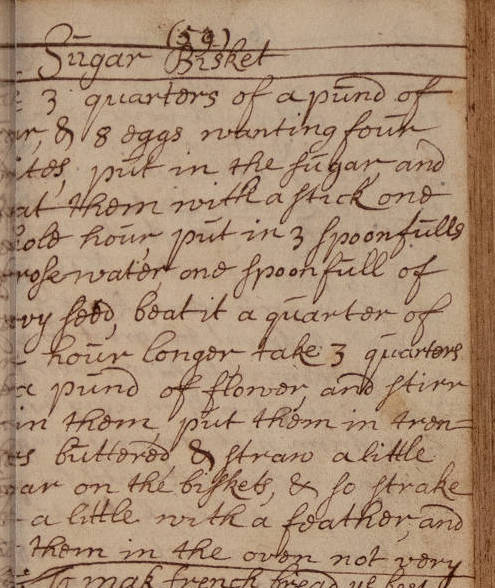
Sugar Bisket
Take 3 quarters of a pund of
sugar, & 8 eggs wanting four
whites, put in the sugar and
Beat them with a stick one
whole hour, put in 3 spoonfulls
rosewater, one spoonfull of
Carvy seed, beat it a quarter of
ane hour longer, take 3 quarters
of a pund of flower, and stirr
it in them, put them in tren
chers buttered & straw a little
suggar on the biskets, & so strake
them a little with a feather, and
them in the oven not very hot:


Updated Recipe
Makes approximately 20 cookies
¾ cup (150g) sugar, plus 1 teaspoon sugar to sprinkle on top
4 eggs, 2 whole eggs and 2 egg yolks
4 teaspoons rosewater
1 ½ teaspoons caraway seeds
1 1/3 cups (167g) flour
Butter to grease the baking sheets
Preheat your oven to 325F (162C). Butter two baking sheets.
Put the sugar, two whole eggs, and two egg yolks in a large bowl (or the bowl of a standing mixer). Using a hand mixer (or the whisk on a standing mixer), mix on a high speed for about 10 minutes. Use a spatula to ensure that the sugar is fully integrated. The mixture will turn glossy and slightly bubbly.
Add the rosewater and caraway seeds and mix for 1 minute to integrate both completely.
Gently stir in the flour with a spatula or a large spoon.
Dollop batter onto the baking sheet using a Tablespoon as a guide. Leave room between the cookies as they will spread. Smooth the tops with a spatula. Sprinkle 1 teaspoon of sugar over all the cookies.
Bake for approximately 20 minutes. The bottoms and the edges of the cookies will be lightly browned and the tops will be fully set and crispy with sugar.
Remove the cookies from the baking sheets and let cool.
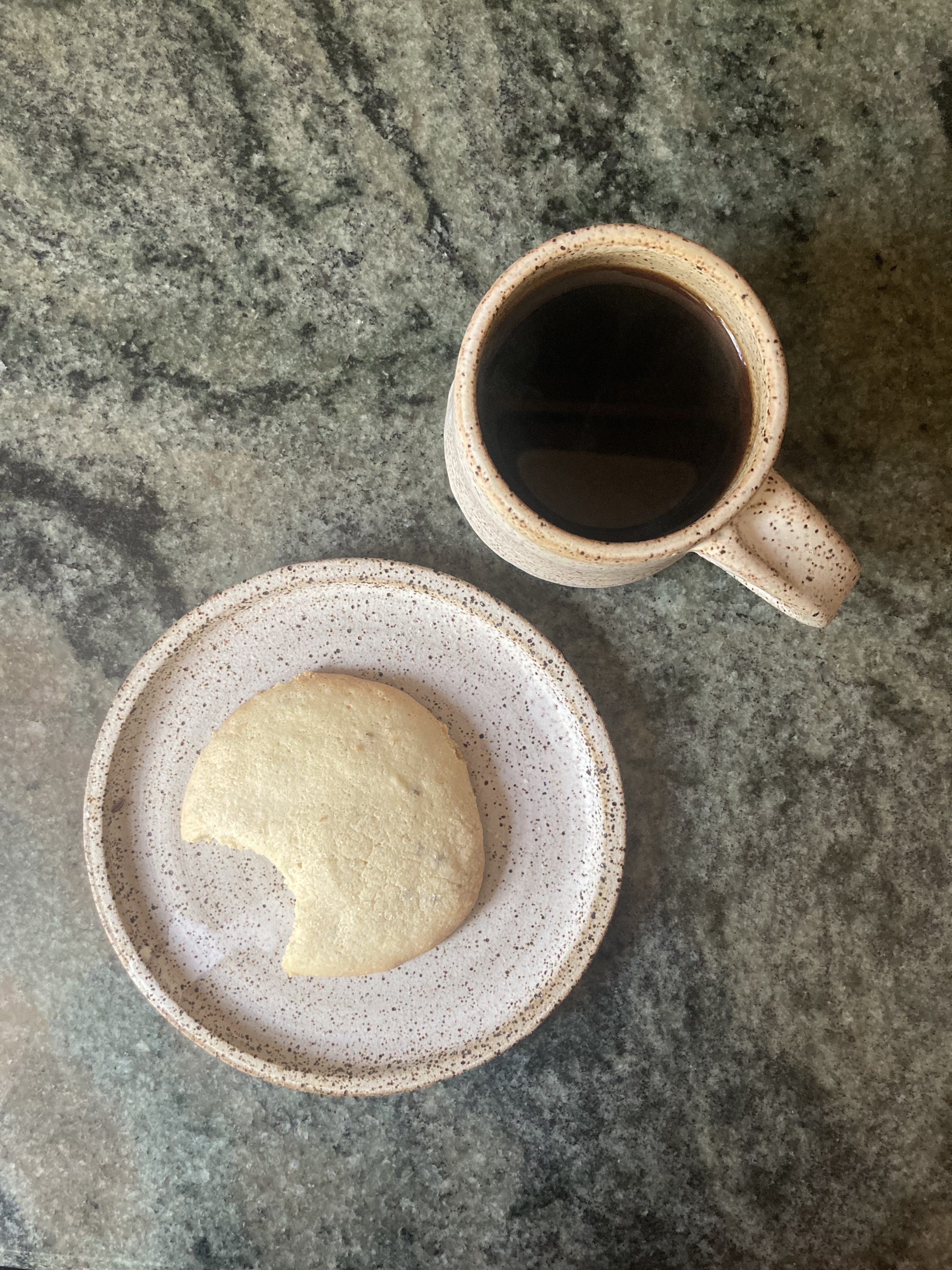
These sugar biskets have a meringue-like texture and the caraway seeds and sugar topping give them a satisfying crunch. Stored in a container, they traveled well and remained fresh and delectable for days. Enjoy with a cup of tea or coffee.
Today I’m also inviting you to get into your kitchen, bake Sugar Bisket, and participate in a virtual baking competition: the fourth annual The Great Rare Books Bake Off, a friendly contest between the sister libraries of Penn State University and Monash University. There are so many intriguing recipes to try from our library collections and you can learn so much by baking a recipe instead of just reading it! An engraved pie pan trophy will be awarded to the library that receives the most social media posts featuring photos of your baked goods tagged with its hashtag: #BakePennState or #BakeMonash. The competition runs September 30 – October 8, 2023 so you have lots of time to read the recipes, shop for ingredients, and get baking. All the details are on the site linked above.
If these sugar bisket are not inspiring you to participate, there are a lot of other recipes to choose from. In past years I’ve also updated recipes for doughnuts and almond jumballs from Christian Barclay’s manuscript. Finally, I’ve also contributed an early eighteenth-century chocolate cream recipe, a desert that can be prepared on the stovetop, to this year’s recipe line-up. Stay tuned for a chocolate cream recipe coming to the site next week!
 Cooking in the Archives
These look mouth-watering. I look forward to making some and helping to return the pie tin to Penn State!
Wonderful!
The thought of beating them by hand for an hour makes me want to have a quiet lie down!
I agree!